Day 68 of 120 · Week 10
Eyes, month three
Last reviewed · 3 min read · 12 sources · Plain-text version
By 3 months, babies focus on faces and close objects and follow a moving one; colors come by 4 months. A mirror on the floor, and why your own vision changes are still urgent.
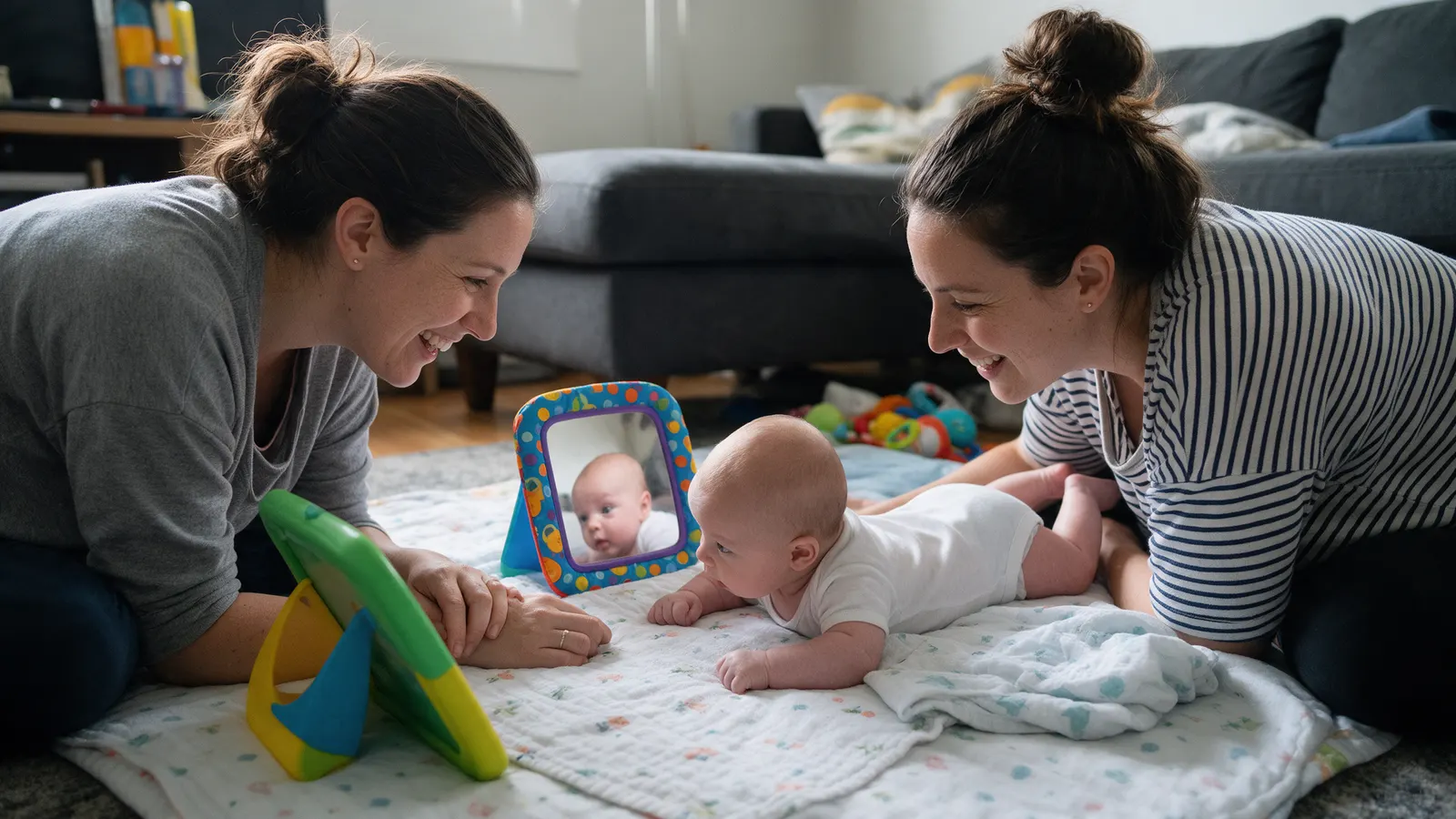
Week 10 begins with the eyes: steadier now, and starting to go where your baby wants.
Heart
By 3 months, babies should be able to focus on faces and close objects and follow a moving object with their eyes. Occasional wandering or crossing should be going away by 2 to 3 months. By 4 months, babies see colors and shades better and often love circular patterns, one reason faces are so appealing (AAP).
Head
Eyes and hands are joining up: hands and eyes start working together around 2 months (AAP), and by about 8 weeks babies focus more easily on nearby faces (AOA). Color comes early: lab studies show 2-month-olds can already tell some colors apart (Teller, 1998). The AAP lists an unbreakable mirror among good toys around 4 months (AAP), and liking to look in a mirror is a 6-month milestone (CDC), so today is an introduction, not a test.
Body
Following with the eyes pulls the neck along. Watching you as you move is on the 2-month list (CDC), and holding the head steady when held is a 4-month milestone (CDC). On the tummy, something to look at is the reason to lift the head: set your face or toys in a circle around your baby to reach toward (AAP).
Try today
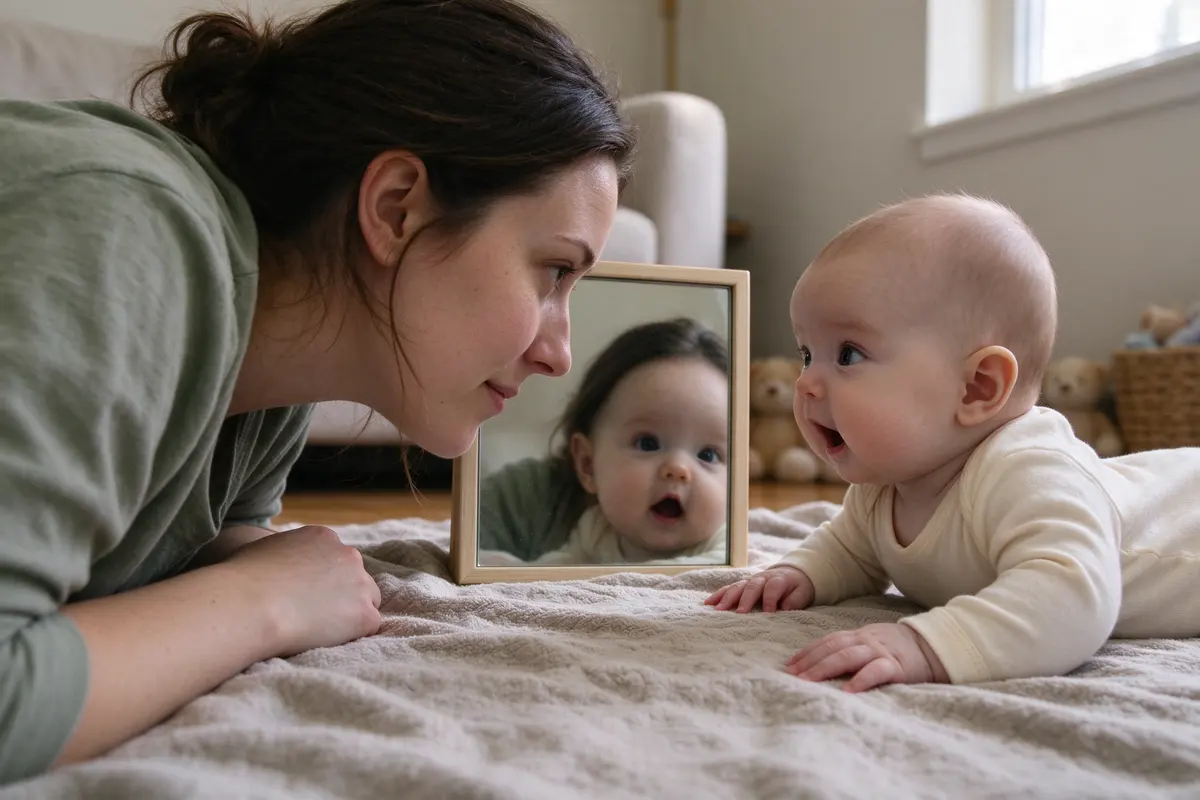
Mirror chats
Time: 2 to 3 minutes, during tummy time or on your lap · Mirror chats in the guide
Prop an unbreakable baby mirror in front of your baby during tummy time.
Put your face next to theirs in the mirror and talk about what you see.
Tilt the mirror slowly to one side and back, and watch whether their eyes follow.
Make it work:Mirror play hasn't been studied; the point is a face to look at. Stop when your baby looks away or fusses, and if they get sleepy, lay them on their back in their own sleep space (Moon, AAP).
Watch for
Normal
an eye that drifts now and then, going away by 2 to 3 months (AAP).
Bring it up with your pediatrician
if your baby's eyes still often cross or wander after 3 months (AAP).
Normal
a long stare past you at the window.
Bring it up with your pediatrician
if your baby doesn't look at your face, and ask about developmental screening (CDC).
Normal
breathing that speeds up with excitement and settles.
Go to the ER now
for any trouble breathing, including ribs pulling in with each breath or wheezing (AAP).
For you
Your own vision changes are still urgent, ten weeks on. Changes in vision are on the CDC's list of urgent maternal warning signs, with a headache that won't go away or gets worse, and extreme swelling of your hands or face; seek care immediately, and tell the provider you were pregnant within the last year (CDC). The discharge instructions agree: swelling, a headache that won't go away, or vision changes can mean postpartum preeclampsia (MedlinePlus). Blurry patches, flashing lights, spots: not something to mention next week.
Tired eyes are different; if reading is harder than it was, say so at your postpartum visit.
If you're the partner: look at her eyes once today, and ask about the headache she hasn't mentioned.
Sources
- American Academy of Pediatrics. "Infant Vision Development: What Can Babies See?" HealthyChildren.org, 2024. https://www.healthychildren.org/English/ages-stages/baby/Pages/Babys-Vision-Development.aspx
- American Academy of Pediatrics. "Developmental Milestones: 1-4 Months Old." HealthyChildren.org, 2026. https://www.healthychildren.org/English/ages-stages/baby/Pages/Developmental-Milestones-3-Months.aspx
- American Optometric Association. "Infant Vision: Birth to 24 Months of Age." 2026. https://www.aoa.org/healthy-eyes/eye-health-for-life/infant-vision
- Teller DY. "Spatial and temporal aspects of infant color vision." Vision Research, 1998. https://pubmed.ncbi.nlm.nih.gov/9893838/
- Centers for Disease Control and Prevention. "Milestones by 6 Months." Learn the Signs. Act Early., 2026. https://www.cdc.gov/act-early/milestones/6-months.html
- Centers for Disease Control and Prevention. "Milestones by 2 Months." Learn the Signs. Act Early., 2026. https://www.cdc.gov/act-early/milestones/2-months.html
- Centers for Disease Control and Prevention. "Milestones by 4 Months." Learn the Signs. Act Early., 2026. https://www.cdc.gov/act-early/milestones/4-months.html
- American Academy of Pediatrics. "Back to Sleep, Tummy to Play: Give Your Baby a Safe, Strong Start." HealthyChildren.org, 2026. https://www.healthychildren.org/English/ages-stages/baby/sleep/Pages/back-to-sleep-tummy-to-play.aspx
- Moon RY. "How to Keep Your Sleeping Baby Safe: AAP Policy Explained." HealthyChildren.org, 2026. https://www.healthychildren.org/English/ages-stages/baby/sleep/Pages/a-parents-guide-to-safe-sleep.aspx
- American Academy of Pediatrics. "Breathing Trouble" (symptom checker). HealthyChildren.org, 2026. https://www.healthychildren.org/English/tips-tools/symptom-checker/Pages/symptomviewer.aspx?symptom=Breathing+Trouble
- Centers for Disease Control and Prevention. "Urgent Maternal Warning Signs and Symptoms." HEAR HER. https://www.cdc.gov/hearher/maternal-warning-signs/index.html
- MedlinePlus. "Vaginal delivery - discharge." National Library of Medicine. https://medlineplus.gov/ency/patientinstructions/000628.htm
This guide is general education that summarizes published research and guidance from groups like the American Academy of Pediatrics, the CDC, and the WHO. It isn’t medical advice, and every child develops on their own timeline. Your pediatrician knows your child; if something feels wrong, call them. In an emergency, call 911.
Get each day’s note the morning it applies
Add your baby to a free Chorevia household with their date of birth, and every morning for 120 days the day’s note arrives in the app and by email: what’s developing, one thing to try, what to watch for, and a word for you.
Create your household