Day 77 of 120 · Week 11
Eleven weeks
Last reviewed · 3 min read · 12 sources · Plain-text version
Eleven weeks old: why the AAP says to read from birth, what a big replication found about the baby voice, and five minutes of rhymes on your lap that count as all of it.
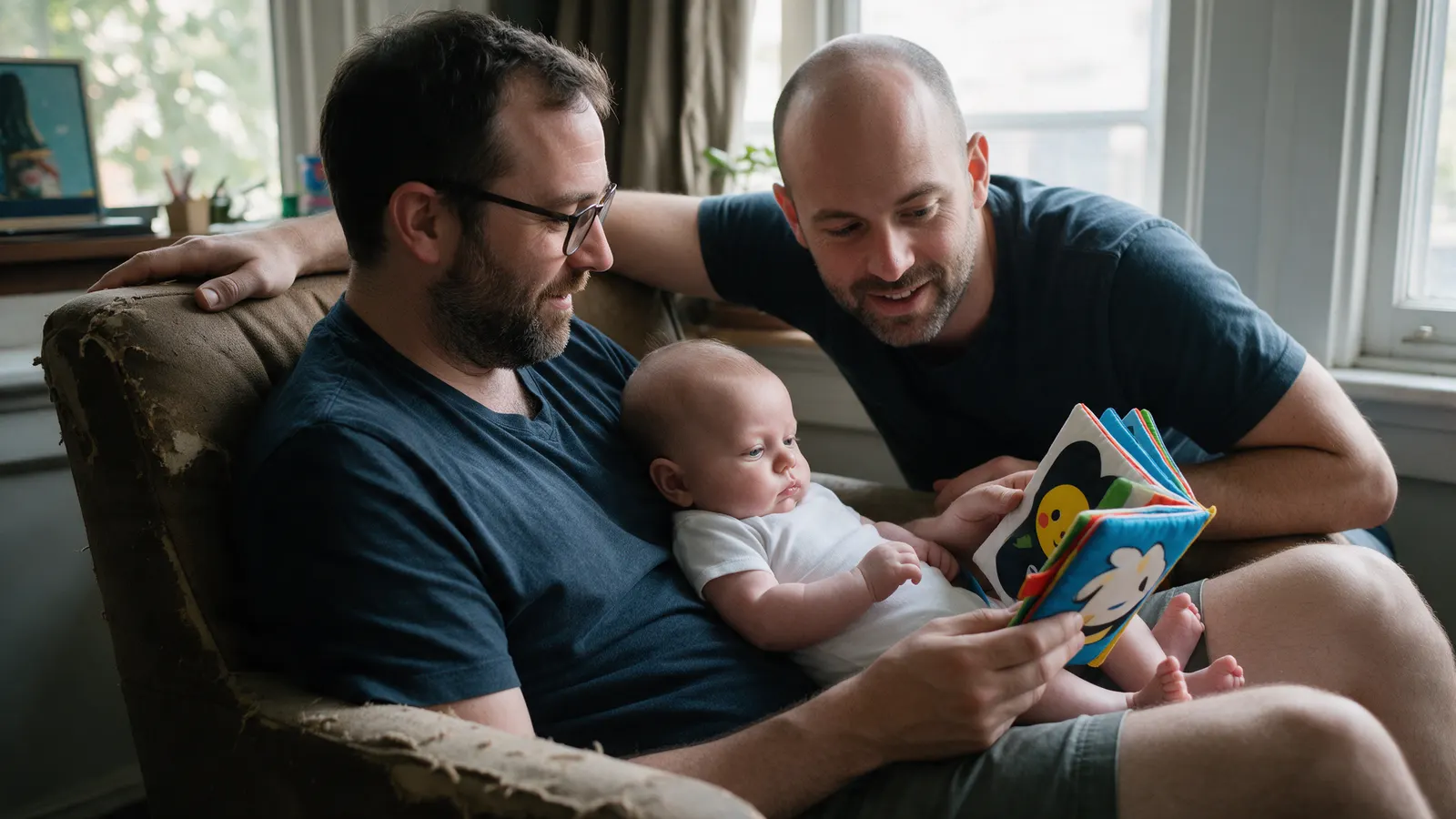
Eleven weeks. Your baby has been listening to you since before birth; this week, the plan is to read to them on purpose, and to stop apologizing for the voice you do it in.
Heart
Talk, read, and sing to your baby every day (CDC). The AAP recommends shared reading starting at birth, based on research linking it to stronger relationships and early language (Klass et al., 2024); it's never too early (AAP). The book is a prop for the real thing, which is your face, your voice, and a pause long enough for a coo.
Head
About that voice. Parentese, the higher-pitched, slower, more melodic way adults talk to babies (Ferjan Ramírez et al., 2020), was tested in 67 labs across North America, Europe, Australia, and Asia: babies prefer it to adult-style speech, though the effect was about half the size earlier studies suggested, and stronger in older babies and when the speech matched their own language (ManyBabies Consortium, 2020). So the sing-song you fall into with a rhyme is the right register. And don't count words: a meta-analysis of 19 studies found a difference in speech directed to children across families, but none when all speech was counted (Dailey & Bergelson, 2022). Talk with your baby, not just near them.
Body
Reading is a hands game now too. Hands and eyes start working together around 2 months (AAP), and looking at their hands with interest is a 4-month milestone (CDC), so expect a swipe at the page and a corner in the mouth. A cloth or board book is fine to mouth; nothing sharp, hot, or small enough to choke on (CDC).
Try today

Lap reading with rhymes
Time: 5 minutes, once or twice a day · Lap reading with rhymes in the guide
Hold your baby on your lap with a board or cloth book with bold, bright pictures.
Read in a sing-song voice; rhymes and repetition are great.
Point to pictures, name them, and pause for coos.
Stop when they look away for good; that's the end of the page, not a review of your reading.
Make it work:Any book counts; it's the time together that matters (AAP). No book in reach? A rhyme you know by heart is a book.
Watch for
Normal
looking away mid-page; it gives your baby some control and keeps them from getting overwhelmed (AAP).
Bring it up with your pediatrician, don't wait,
if your baby doesn't react to loud sounds or make sounds other than crying (CDC).
Normal
eyes that occasionally wander or cross; that should be going away by 2 to 3 months (AAP).
Bring it up
if the eyes still often cross or wander after 3 months (AAP).
Normal
a damp book corner; drooling ramps up at 2 to 3 months (Shu, AAP).
Call your pediatrician
if heavy drooling comes with fever, trouble swallowing, or illness (Shu, AAP).
For you

The library again, or the rhymes you know by heart. The library is free, warm, and has a changing table; a carrier walk there is a daylight outing with a purpose, and the AAP's reading advice is as much about the relationship as the language (Klass et al., 2024). If leaving the house is too much today, the rhymes your own parent said to you count the same. You'll find you still know them.
One line from the CDC's list, because tired parents skip it: overwhelming tiredness is an urgent maternal warning sign, not a personality trait; if it's that bad, seek care (CDC).
If you're the partner: the bedtime book is yours from tonight. Same book, same voice, every night, so it becomes the sound of you.
Sources
- Centers for Disease Control and Prevention. "Milestones by 2 Months." Learn the Signs. Act Early., updated 2026. https://www.cdc.gov/act-early/milestones/2-months.html
- Klass P, Miller-Fitzwater A, High PC; AAP Council on Early Childhood. "Literacy Promotion: An Essential Component of Primary Care Pediatric Practice: Policy Statement." Pediatrics, 2024. https://pubmed.ncbi.nlm.nih.gov/39342414/
- American Academy of Pediatrics. "Checkup Checklist: 4 Months Old." HealthyChildren.org, updated 2023. https://www.healthychildren.org/English/ages-stages/Your-Childs-Checkups/Pages/Your-Checkup-Checklist-4-Months-Old.aspx
- Ferjan Ramírez N, Lytle SR, Kuhl PK. "Parent coaching increases conversational turns and advances infant language development." PNAS, 2020. https://pubmed.ncbi.nlm.nih.gov/32015127/
- ManyBabies Consortium. "Quantifying Sources of Variability in Infancy Research Using the Infant-Directed-Speech Preference." Advances in Methods and Practices in Psychological Science, 2020. https://doi.org/10.1177/2515245919900809
- Dailey S, Bergelson E. "Language input to infants of different socioeconomic statuses: A quantitative meta-analysis." Developmental Science, 2022. https://pubmed.ncbi.nlm.nih.gov/34806256/
- American Academy of Pediatrics. "Developmental Milestones: 1-4 Months Old." HealthyChildren.org, updated 2026. https://www.healthychildren.org/English/ages-stages/baby/Pages/Developmental-Milestones-3-Months.aspx
- Centers for Disease Control and Prevention. "Milestones by 4 Months." Learn the Signs. Act Early., updated 2026. https://www.cdc.gov/act-early/milestones/4-months.html
- American Academy of Pediatrics. "Emotional & Social Development: Birth Through 3 Months." HealthyChildren.org, updated 2026. https://www.healthychildren.org/English/ages-stages/baby/Pages/Emotional-and-Social-Development-Birth-to-3-Months.aspx
- American Academy of Pediatrics. "Infant Vision Development: What Can Babies See?" HealthyChildren.org, updated 2024. https://www.healthychildren.org/English/ages-stages/baby/Pages/Babys-Vision-Development.aspx
- Shu J. "Drooling Baby? Here's Why Spit Happens." HealthyChildren.org, updated 2026. https://www.healthychildren.org/English/ages-stages/baby/teething-tooth-care/Pages/Drooling-and-Your-Baby.aspx
- Centers for Disease Control and Prevention. "Urgent Maternal Warning Signs and Symptoms." HEAR HER. https://www.cdc.gov/hearher/maternal-warning-signs/index.html
This guide is general education that summarizes published research and guidance from groups like the American Academy of Pediatrics, the CDC, and the WHO. It isn’t medical advice, and every child develops on their own timeline. Your pediatrician knows your child; if something feels wrong, call them. In an emergency, call 911.
Get each day’s note the morning it applies
Add your baby to a free Chorevia household with their date of birth, and every morning for 120 days the day’s note arrives in the app and by email: what’s developing, one thing to try, what to watch for, and a word for you.
Create your household