Day 70 of 120 · Week 10
Reaching
Last reviewed · 3 min read · 15 sources · Plain-text version
Swipes at things just out of reach are the start of reaching. What two small studies found about practice, the circle of toys, and why the floor beats the seat.
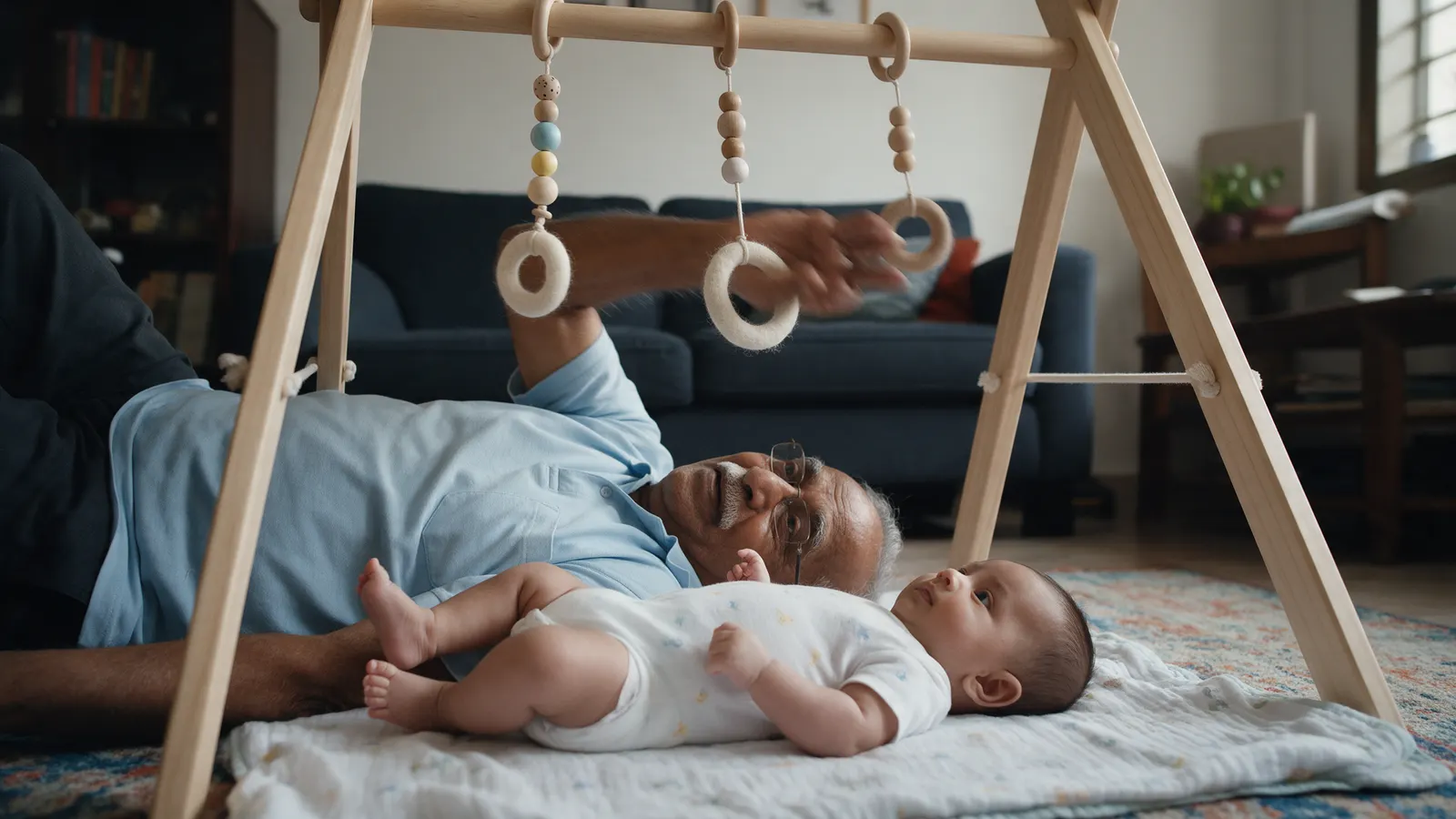
An arm that waves at a toy and misses is the beginning of reaching. The miss is worth watching.
Heart
Head
Babies who got 2 weeks of daily, parent-guided play with Velcro "sticky mittens" that let them pick up toys advanced in reaching; babies who only watched their parents handle the toys didn't (Libertus & Needham, 2010). In a follow-up with 24 not-yet-reaching babies just under 3 months old, plain mittens worked at least as well: after 16 days, only the plain-mitten group made significantly more toy contacts than 13 untrained babies (Williams et al., 2015). The takeaway is cheap: repeated chances to reach for real toys, which is also the AAP's tummy-time tip: your face or toys in a circle around your baby to reach toward (AAP).
Body
WHO advises interactive floor play several times a day and not keeping babies strapped in a stroller, seat, or carrier for more than 1 hour at a time (WHO). The AAP advises against leaving babies in bouncer seats, where they get less chance to practice using their muscles (AAP). A bouncer, when used, goes on the floor only, never on a counter, table, bed, or sofa, straps buckled (CPSC).
Try today
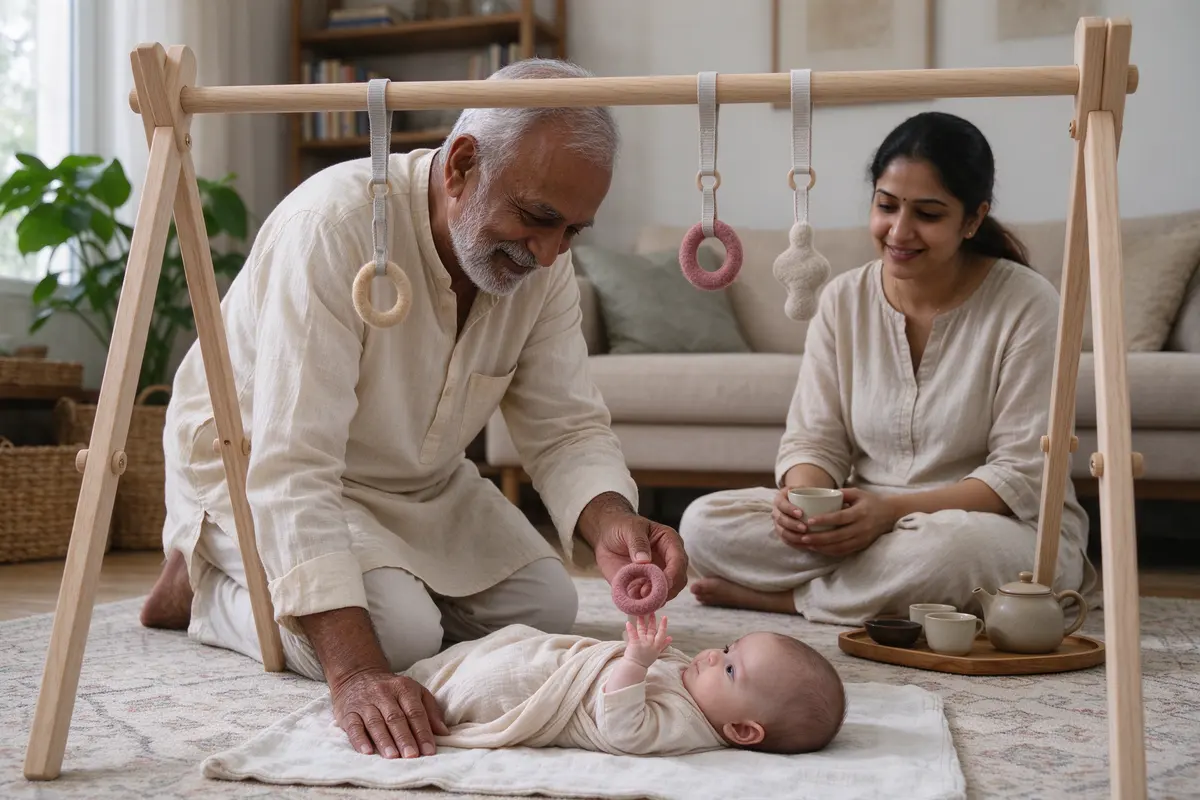
Swat-the-toy
Time: 5 minutes, once or twice a day · Swat-the-toy in the guide
Lay your baby on their back under a play gym, or hold a soft toy above their chest, within arm's reach.
Gently touch the toy to their hand so they notice it.
Cheer when they bat it, then let them try again.
Switch sides so both arms get practice.
Make it work:Hanging toys are for awake play with you there; nothing hangs over or sits in the crib for sleep (Moon, AAP).
Watch for
- Normal: swipes that miss, or none yet; swinging at toys is a 4-month milestone (CDC). Don't wait if you're concerned: your state's early intervention program gives a free evaluation without a referral (CDC).
- Normal: a toy that lands on the face and a startled cry. Call 911 for bluish lips or face, or struggling for each breath (AAP).
- Normal: a nap that starts in the bouncer; move your baby to their back on a firm, flat surface (Moon, AAP). Call your pediatrician right away if your baby cries when touched or moved, or has a bulging soft spot (AAP).
- Trust your instincts. If your baby just doesn't seem right to you, call (Lurie Children's).
For you

The floor is yours too. Lying next to the baby on the play mat counts as being there, and as rest. After a C-section, most regular activities come back in 4 to 8 weeks (MedlinePlus), so at ten weeks getting down and up should be allowed. If it still hurts, or the incision is still tender, that goes on the list for your postpartum visit, due no later than 12 weeks after birth (ACOG, 2018).
Severe swelling, redness, or pain in a leg is on the CDC's urgent list (CDC); sore from the floor is different.
If you're the partner: get down there. Your face in the circle is a toy too.
Sources
- Wusthoff CJ. "Movement Milestones: Birth to 3 Months." HealthyChildren.org, 2020. https://www.healthychildren.org/English/ages-stages/baby/Pages/Movement-Birth-to-Three-Months.aspx
- Centers for Disease Control and Prevention. "Milestones by 4 Months." Learn the Signs. Act Early., 2026. https://www.cdc.gov/act-early/milestones/4-months.html
- Libertus K, Needham A. "Teach to reach: the effects of active vs. passive reaching experiences on action and perception." Vision Research, 2010. https://pubmed.ncbi.nlm.nih.gov/20828580/
- Williams JL, Corbetta D, Guan Y. "Learning to reach with 'sticky' or 'non-sticky' mittens: a tale of developmental trajectories." Infant Behavior and Development, 2015. https://pubmed.ncbi.nlm.nih.gov/25636028/
- American Academy of Pediatrics. "Back to Sleep, Tummy to Play: Give Your Baby a Safe, Strong Start." HealthyChildren.org, 2026. https://www.healthychildren.org/English/ages-stages/baby/sleep/Pages/back-to-sleep-tummy-to-play.aspx
- World Health Organization. "To grow up healthy, children need to sit less and play more." 2019. https://www.who.int/news/item/24-04-2019-to-grow-up-healthy-children-need-to-sit-less-and-play-more
- US Consumer Product Safety Commission. "New Federal Standard to Improve Safety of Infant Bouncer Seats Takes Effect." 2018. https://www.cpsc.gov/Newsroom/News-Releases/2018/New-Federal-Standard-to-Improve-Safety-of-Infant-Bouncer-Seats-Takes-Effect
- Moon RY. "How to Keep Your Sleeping Baby Safe: AAP Policy Explained." HealthyChildren.org, 2026. https://www.healthychildren.org/English/ages-stages/baby/sleep/Pages/a-parents-guide-to-safe-sleep.aspx
- Centers for Disease Control and Prevention. "Concerned About Your Child's Development?" 2026. https://www.cdc.gov/act-early/families/concerned.html
- American Academy of Pediatrics. "Breathing Trouble" (symptom checker). HealthyChildren.org, 2026. https://www.healthychildren.org/English/tips-tools/symptom-checker/Pages/symptomviewer.aspx?symptom=Breathing+Trouble
- American Academy of Pediatrics. "Crying Baby - Before 3 Months Old" (symptom checker). HealthyChildren.org, 2026. https://www.healthychildren.org/English/tips-tools/symptom-checker/Pages/symptomviewer.aspx?symptom=Crying+Baby+-+Before+3+Months+Old
- Latimer T. "When to Call the Pediatrician for Your Newborn." Lurie Children's Hospital of Chicago, 2022. https://www.luriechildrens.org/en/blog/when-to-call-the-pediatrician-for-your-newborn/
- MedlinePlus. "Going home after a C-section." National Library of Medicine. https://medlineplus.gov/ency/patientinstructions/000624.htm
- American College of Obstetricians and Gynecologists. "ACOG Committee Opinion No. 736: Optimizing Postpartum Care." Obstetrics & Gynecology, 2018. https://pubmed.ncbi.nlm.nih.gov/29683911/
- Centers for Disease Control and Prevention. "Urgent Maternal Warning Signs and Symptoms." HEAR HER. https://www.cdc.gov/hearher/maternal-warning-signs/index.html
This guide is general education that summarizes published research and guidance from groups like the American Academy of Pediatrics, the CDC, and the WHO. It isn’t medical advice, and every child develops on their own timeline. Your pediatrician knows your child; if something feels wrong, call them. In an emergency, call 911.
Get each day’s note the morning it applies
Add your baby to a free Chorevia household with their date of birth, and every morning for 120 days the day’s note arrives in the app and by email: what’s developing, one thing to try, what to watch for, and a word for you.
Create your household