Day 65 of 120 · Week 9
Hands find each other
Last reviewed · 3 min read · 10 sources · Plain-text version
Fists relax, hands open and shut and meet in the middle, and hands and eyes start working together. Why the drool isn't teeth, and a clapping game for changing time.

Sometime soon, two fists meet in the middle and your baby notices. Hands are this month's first toy.
Heart
Those hands are becoming an object of fascination, and "these are my hands" is a real lesson: looking at their hands with interest and bringing them to the mouth are both 4-month milestones (CDC). In month two, hands caught your baby's attention and, after many tries, reached the mouth, where sucking can become a way to self-soothe (AAP). That's your baby's first tool for calming down.
Head
Hands and eyes start working together around 2 months (AAP). By month three, fists relax, and many babies open and shut their hands, swipe at objects just out of reach, and may hold and shake a toy (AAP). The palm grasp reflex is still there underneath, fading at 5 to 6 months (AAP), a clamp on your finger is reflex; a hand that opens to be looked at is the new thing.
Body
Expect drool, not teeth. Salivary glands "kick into high gear" at around 2 to 3 months, before babies can swallow all that spit (Shu, AAP). First teeth usually come in between 6 and 10 months (AAP). Use a soft bib while your baby is awake and take it off for sleep (Shu, AAP). Now that hands reach the mouth, so does anything in reach: keep small, sharp, or hot things away (CDC).
Try today

Hands-together games
Time: 1 to 2 minutes, during changes or cuddles · Hands-together games in the guide
Gently bring your baby's hands together over their chest.
Clap them softly to a short rhyme, like "Pat-a-cake."
Let go and see if your baby brings their hands together or to their mouth.
Make it work:These games haven't been studied; the reason to play is that hands and eyes are starting to work together (AAP).
Watch for
Normal
fists still closed part of the day; the palm grasp lasts until 5 to 6 months (AAP).
Call your pediatrician
if your baby uses only one hand or one side of the body (AAP).
Normal
a wet chin and a damp shirt by lunchtime.
Call your pediatrician
if heavy drooling comes with fever, trouble swallowing, or illness (Shu, AAP).
Normal
hands in the mouth between feeds; it can also be hunger, so check the timing of the last feed (Jain & Bunik, AAP).
Call your pediatrician right away
if your baby drinks very little or nothing for more than 8 hours (AAP).
For you
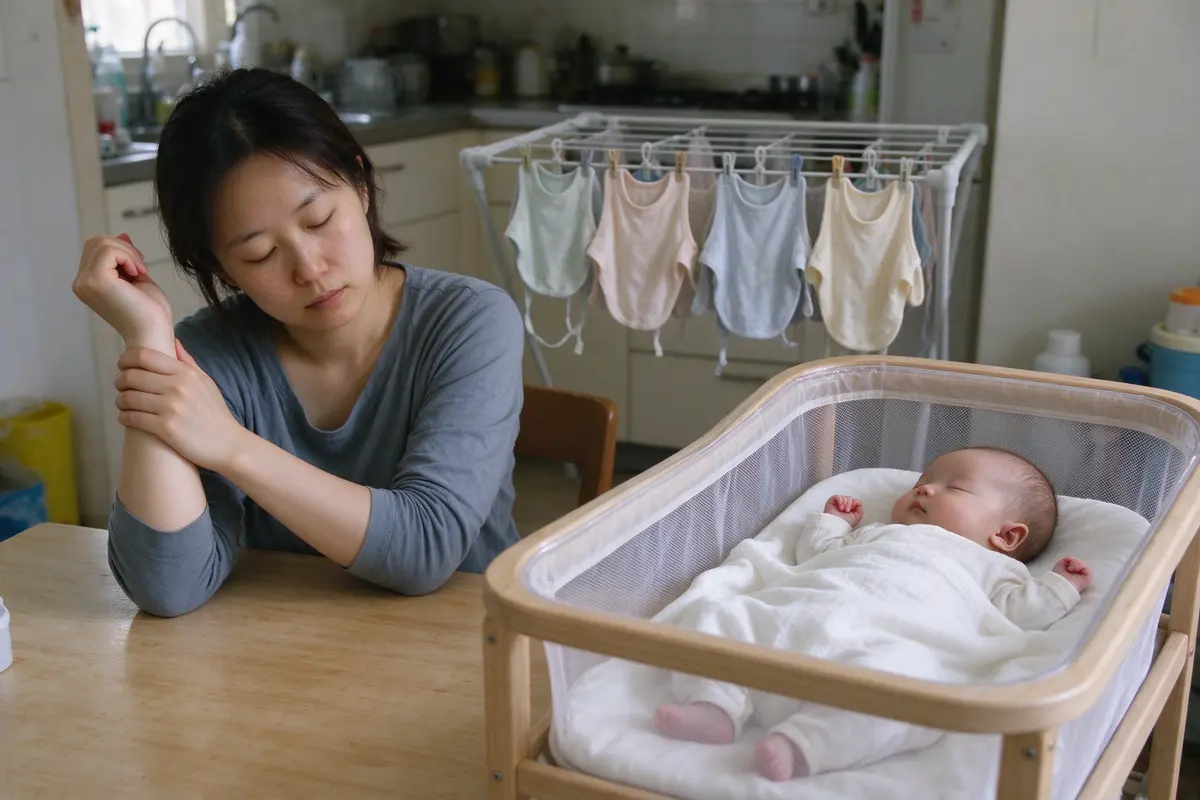
Bibs and your own hands. The bib comes off before every sleep (Shu, AAP); buy more than you think you need.
Your hands have done nine weeks of lifting, latching, and cradling. After a C-section, most regular activities come back in 4 to 8 weeks (MedlinePlus), so the lifting limit has usually passed, but your wrists may not have noticed. Switch sides, rest the hand that aches, and pillow the arm that holds the baby. Pain or numbness that keeps on belongs on the list for your postpartum visit, which ACOG says should happen no later than 12 weeks after birth (ACOG, 2018).
If you're the partner: the car seat is still yours to carry. So are the bibs.
Sources
- Centers for Disease Control and Prevention. "Milestones by 4 Months." Learn the Signs. Act Early., 2026. https://www.cdc.gov/act-early/milestones/4-months.html
- Wusthoff CJ. "Movement Milestones: Birth to 3 Months." HealthyChildren.org, 2020. https://www.healthychildren.org/English/ages-stages/baby/Pages/Movement-Birth-to-Three-Months.aspx
- American Academy of Pediatrics. "Developmental Milestones: 1-4 Months Old." HealthyChildren.org, 2026. https://www.healthychildren.org/English/ages-stages/baby/Pages/Developmental-Milestones-3-Months.aspx
- American Academy of Pediatrics. "Newborn Reflexes." HealthyChildren.org, 2022. https://www.healthychildren.org/English/ages-stages/baby/Pages/newborn-reflexes.aspx
- Shu J. "Drooling Baby? Here's Why Spit Happens." HealthyChildren.org, 2026. https://www.healthychildren.org/English/ages-stages/baby/teething-tooth-care/Pages/Drooling-and-Your-Baby.aspx
- American Academy of Pediatrics. "Teething Pain Relief: How to Soothe Your Baby's Discomfort." HealthyChildren.org, 2025. https://www.healthychildren.org/English/ages-stages/baby/teething-tooth-care/Pages/Teething-Pain.aspx
- Jain S, Bunik M. "How Often and How Much Should Your Baby Eat?" HealthyChildren.org, 2024. https://www.healthychildren.org/English/ages-stages/baby/feeding-nutrition/Pages/How-Often-and-How-Much-Should-Your-Baby-Eat.aspx
- American Academy of Pediatrics. "Crying Baby - Before 3 Months Old" (symptom checker). HealthyChildren.org, 2026. https://www.healthychildren.org/English/tips-tools/symptom-checker/Pages/symptomviewer.aspx?symptom=Crying+Baby+-+Before+3+Months+Old
- MedlinePlus. "Going home after a C-section." National Library of Medicine. https://medlineplus.gov/ency/patientinstructions/000624.htm
- American College of Obstetricians and Gynecologists. "ACOG Committee Opinion No. 736: Optimizing Postpartum Care." Obstetrics & Gynecology, 2018. https://pubmed.ncbi.nlm.nih.gov/29683911/
This guide is general education that summarizes published research and guidance from groups like the American Academy of Pediatrics, the CDC, and the WHO. It isn’t medical advice, and every child develops on their own timeline. Your pediatrician knows your child; if something feels wrong, call them. In an emergency, call 911.
Get each day’s note the morning it applies
Add your baby to a free Chorevia household with their date of birth, and every morning for 120 days the day’s note arrives in the app and by email: what’s developing, one thing to try, what to watch for, and a word for you.
Create your household