Day 72 of 120 · Week 10
Grasp
Last reviewed · 3 min read · 10 sources · Plain-text version
Fists are relaxing into hands that open, shut, and hold on. What grasping looks like this month, why the reflex and the real thing overlap, and a rattle to put in that palm.

Hands were the story last month. This month they start to do something: close on purpose, hang on for a second, and let go.
Heart
By month three, fists relax. Many babies open and shut their hands, swipe at objects just out of reach, and may hold and shake a toy (AAP). Holding a toy you put in their hand is a 4-month milestone (CDC), and that list describes skills at least 75% of babies show by that age (Zubler et al., 2022), so a grip that lasts two seconds today is right on course.
Head
Two kinds of grasp overlap right now. The palm grasp reflex, the one that closed around your finger on day one, doesn't fade until 5 to 6 months (AAP). The new thing is a hold your baby chooses, and what they learn from it is that their movement makes a sound: shake the hand, hear the rattle. In a classic experiment, 3-month-olds learned that kicking made a mobile move and remembered it for days (Rovee-Collier et al., 1980). Tell your pediatrician if a reflex seems different on one side, or if your baby moves one side of the body better than the other (AAP).
Body
The AAP lists sturdy rattles among good toys at this age (AAP). Whatever goes in the hand will go to the mouth, so pick one that's too big to choke on and won't break (AAP; CDC), and keep small, sharp, or hot things out of reach (CDC). Expect it to come back wet: salivary glands kick into high gear at around 2 to 3 months, before babies can swallow all that spit (Shu, AAP).
Try today
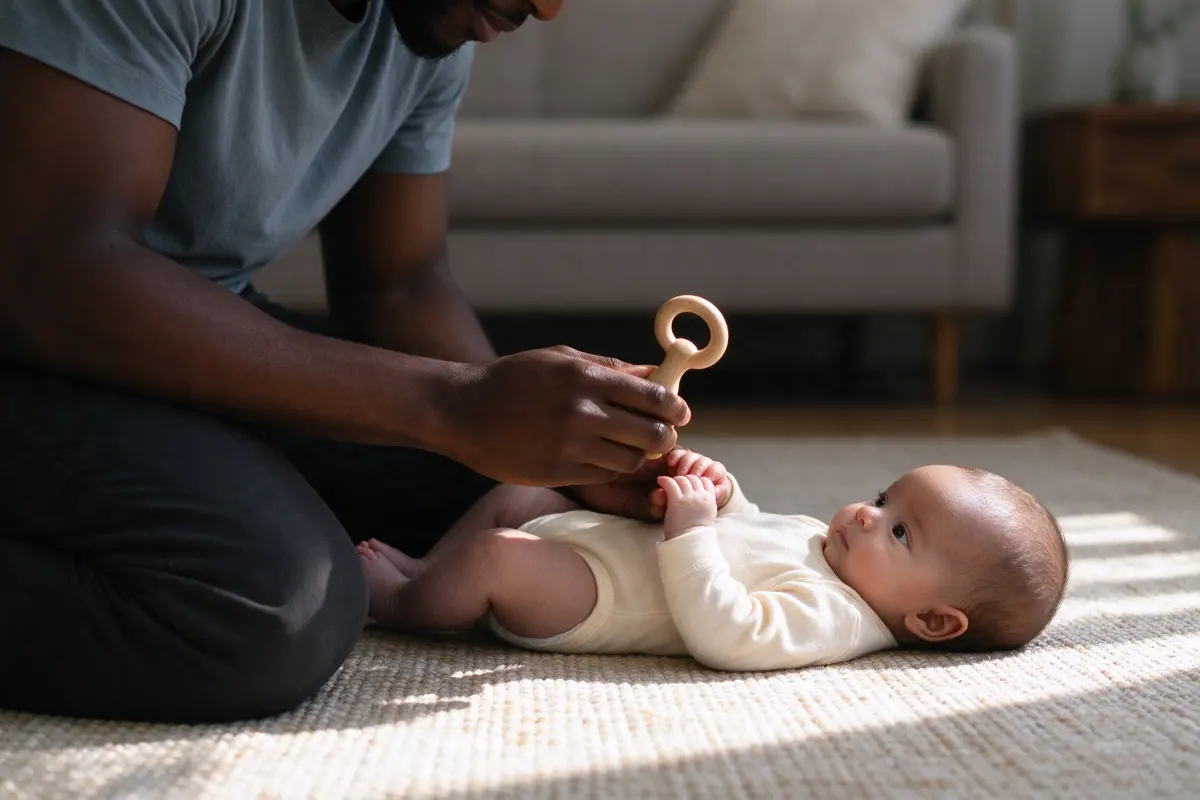
Rattle in the hand
Time: 1 to 3 minutes · Rattle in the hand in the guide
Place a light, sturdy rattle in your baby's palm.
Gently shake their hand so it makes a sound, and say what happened: "You shook it!"
Let them hold it, drop it, and try again.
Switch to the other hand, so both sides get a turn.
Watch for
Normal
a grip that lets go after a few seconds, or a hand that stays fisted part of the day.
Bring it up with your pediatrician
if your baby uses only one hand or one side of the body (AAP).
Normal
jerky arm movements as the swipes get aimed.
Call your pediatrician right away
if your baby seems especially floppy, or has shaking of the whole body (AAP).
Normal
a soaked bib and a wet rattle.
Call your pediatrician
if heavy drooling comes with fever, trouble swallowing, or illness (Shu, AAP).
For you
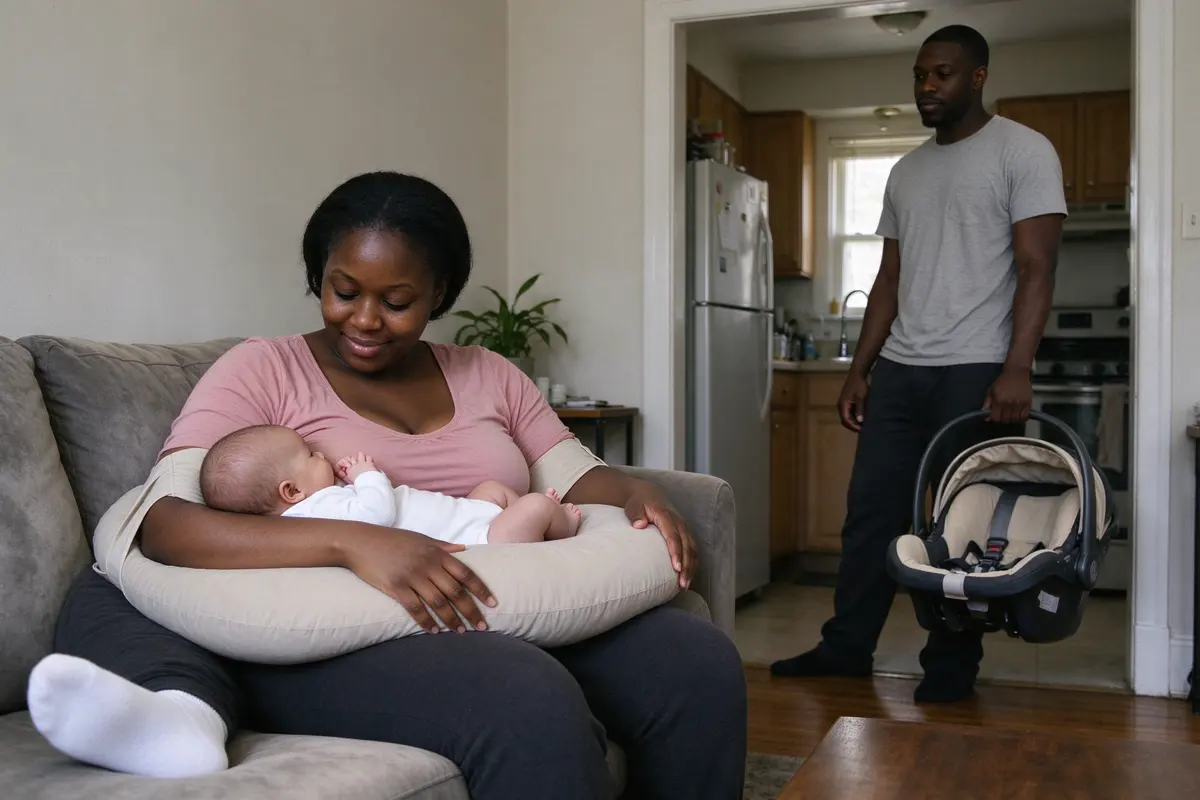
Your wrists, again. The baby is heavier than when you last checked how you hold them, and the one-handed head cradle costs more each week. For feeds, rest both forearms on a pillow so your wrists aren't carrying the weight, and switch sides and hands. Pain or numbness that keeps on goes on the list for your postpartum visit; recovery is on that visit's agenda by design (ACOG, 2018). Severe swelling, redness, or pain in one arm or leg is different: that's an urgent warning sign, so get care right away (CDC).
After a C-section, most regular activities come back in 4 to 8 weeks (MedlinePlus), so by now the limits have likely lifted. That doesn't mean you have to carry everything.
If you're the partner: the car seat is still yours. So is the stroller up the steps.
Sources
- Wusthoff CJ. "Movement Milestones: Birth to 3 Months." HealthyChildren.org, updated 2020. https://www.healthychildren.org/English/ages-stages/baby/Pages/Movement-Birth-to-Three-Months.aspx
- Centers for Disease Control and Prevention. "Milestones by 4 Months." Learn the Signs. Act Early., updated 2026. https://www.cdc.gov/act-early/milestones/4-months.html
- Zubler JM, Wiggins LD, Macias MM, et al. "Evidence-Informed Milestones for Developmental Surveillance Tools." Pediatrics, 2022. https://pubmed.ncbi.nlm.nih.gov/35132439/
- American Academy of Pediatrics. "Newborn Reflexes." HealthyChildren.org, updated 2022. https://www.healthychildren.org/English/ages-stages/baby/Pages/newborn-reflexes.aspx
- Rovee-Collier CK, Sullivan MW, Enright M, Lucas D, Fagen JW. "Reactivation of infant memory." Science, 1980. https://pubmed.ncbi.nlm.nih.gov/7375924/
- American Academy of Pediatrics. "Developmental Milestones: 1-4 Months Old." HealthyChildren.org, updated 2026. https://www.healthychildren.org/English/ages-stages/baby/Pages/Developmental-Milestones-3-Months.aspx
- Shu J. "Drooling Baby? Here's Why Spit Happens." HealthyChildren.org, updated 2026. https://www.healthychildren.org/English/ages-stages/baby/teething-tooth-care/Pages/Drooling-and-Your-Baby.aspx
- American College of Obstetricians and Gynecologists. "ACOG Committee Opinion No. 736: Optimizing Postpartum Care." Obstetrics & Gynecology, 2018. https://pubmed.ncbi.nlm.nih.gov/29683911/
- Centers for Disease Control and Prevention. "Urgent Maternal Warning Signs and Symptoms." HEAR HER. https://www.cdc.gov/hearher/maternal-warning-signs/index.html
- MedlinePlus. "Going home after a C-section." National Library of Medicine. https://medlineplus.gov/ency/patientinstructions/000624.htm
This guide is general education that summarizes published research and guidance from groups like the American Academy of Pediatrics, the CDC, and the WHO. It isn’t medical advice, and every child develops on their own timeline. Your pediatrician knows your child; if something feels wrong, call them. In an emergency, call 911.
Get each day’s note the morning it applies
Add your baby to a free Chorevia household with their date of birth, and every morning for 120 days the day’s note arrives in the app and by email: what’s developing, one thing to try, what to watch for, and a word for you.
Create your household