Day 82 of 120 · Week 12
Siblings
Last reviewed · 3 min read · 14 sources · Plain-text version
An older child and a baby on the same floor: the rules that make it safe, the supervised floor time the AAP suggests, and a big kid's first family job.

If there's a bigger kid in the house, they've waited two months for the baby to do something. Around now, the baby starts to.
Heart
Around 3 or 4 months, babies become fascinated by other children (AAP). The AAP suggests inviting older children to play with the baby, with clear rules such as never picking the baby up without permission (AAP). Having a young child play with the baby during tummy time, while an adult keeps watch, is one of the AAP's own tummy time ideas (AAP). Say the rules once, plainly, and repeat them without heat.
Head
A big kid's first family job can start here. Fetching a diaper, or singing to the baby, is real work with a real result (AAP), and it's different from being told to be gentle and quiet. Talking, reading, and singing to the baby every day is the CDC's advice to you (CDC); a sibling's off-key song counts.
Body
Two things come with a sibling. Their toys: now that hands reach the mouth, keep small, sharp, or hot things away (CDC), and the small pieces of an older child's set are the usual culprits. Their germs: babies under 6 months are too young for a flu shot, so the AAP recommends a yearly one for every eligible family member (AAP), and it recommends RSV immunization for all babies under 8 months born during or entering their first RSV season, unless they're protected by a vaccine their birthing parent got in pregnancy (AAP). A preschooler brings both home.
Try today
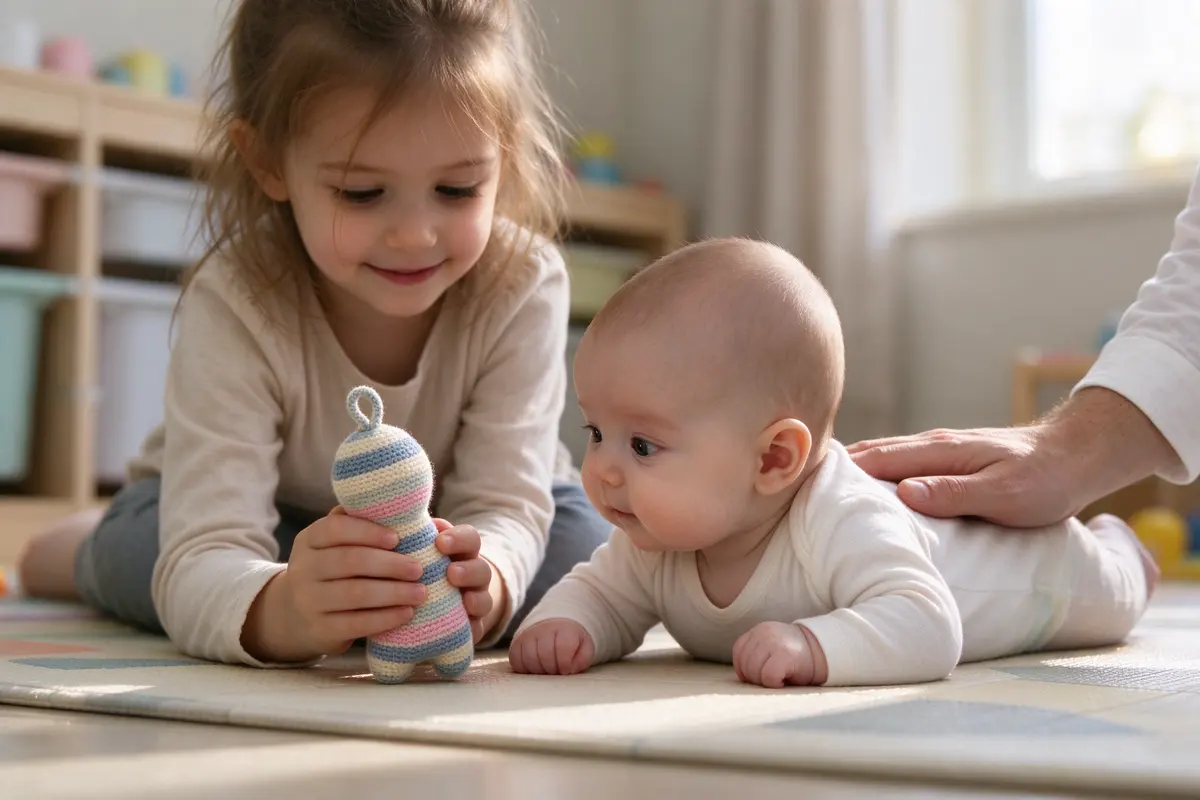
Sibling floor time
Time: 5 minutes, with an adult watching · Sibling floor time in the guide
Lay the baby tummy-down on a floor blanket, and invite the older child to lie down face to face.
Give the big kid a job: show a toy, sing a song, or make funny faces.
Stay right there with a hand near the baby; the rule is that an adult does the picking up (AAP).
Thank them for helping, and end while it's still fun, or sooner if the baby looks away or fusses.
Watch for
Normal
a startle when the big kid shrieks; the Moro reflex usually fades around 2 months, so it may already be rarer (AAP).
Tell your pediatrician
if a reflex seems different on one side, or your baby moves one side of the body better than the other (AAP).
Normal
a baby who looks away when a sibling gets too close; looking away gives them some control and keeps them from getting overwhelmed (AAP).
Call your pediatrician right away
if your baby cries nonstop for more than 2 hours and can't be consoled (AAP).
Normal
sneezes, which clear dust and fuzz from the nose and aren't an allergy (AAP).
Go to the ER now
for any trouble breathing, including ribs pulling in with each breath or wheezing (AAP).
Normal
a preschooler's cold passing through the house.
For you
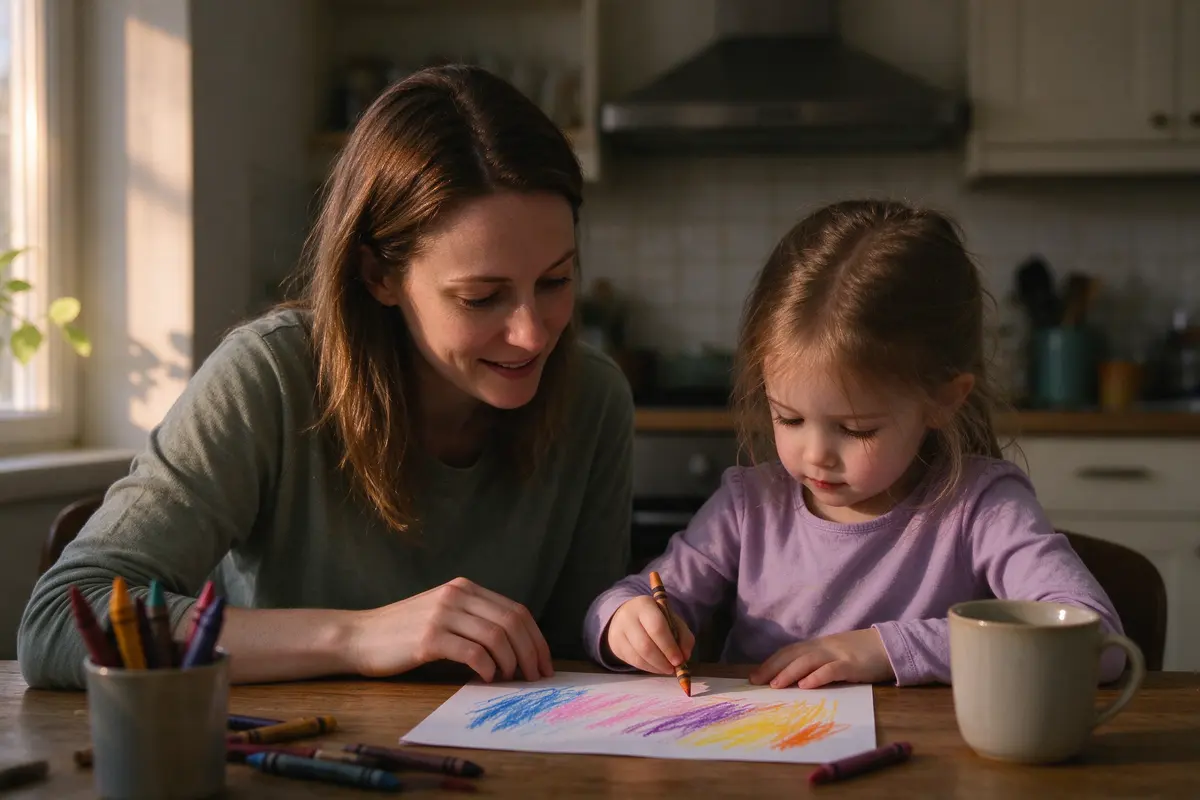
One-on-one minutes for the older child. Ten of them, on the floor or at the table, with the baby in another room if the other adult can take them. Pick what the big kid likes, not what's useful, and let them lead. The AAP urges pediatricians to support fathers' involvement (Yogman & Garfield, 2016); at home, that looks like one of you taking the baby so the other can take the big kid, and trading next time.
If you're the partner: the ten minutes are a swap, not a favor. Take the baby for a walk in the carrier, and she gets the older child. Tomorrow, the other way around.
Sources
- American Academy of Pediatrics. "Emotional & Social Development: Birth Through 3 Months." HealthyChildren.org, 2026. https://www.healthychildren.org/English/ages-stages/baby/Pages/Emotional-and-Social-Development-Birth-to-3-Months.aspx
- American Academy of Pediatrics. "Developmental Milestones: 1-4 Months Old." HealthyChildren.org, 2026. https://www.healthychildren.org/English/ages-stages/baby/Pages/Developmental-Milestones-3-Months.aspx
- American Academy of Pediatrics. "Back to Sleep, Tummy to Play: Give Your Baby a Safe, Strong Start." HealthyChildren.org, 2026. https://www.healthychildren.org/English/ages-stages/baby/sleep/Pages/back-to-sleep-tummy-to-play.aspx
- Centers for Disease Control and Prevention. "Milestones by 2 Months." Learn the Signs. Act Early., 2026. https://www.cdc.gov/act-early/milestones/2-months.html
- Centers for Disease Control and Prevention. "Milestones by 4 Months." Learn the Signs. Act Early., 2026. https://www.cdc.gov/act-early/milestones/4-months.html
- American Academy of Pediatrics. "Protecting Babies & Young Children From Flu: What Parents Need to Know." HealthyChildren.org, 2026. https://www.healthychildren.org/English/health-issues/conditions/flu/Pages/protecting-babies-and-young-children-from-flu-what-parents-should-know.aspx
- American Academy of Pediatrics. "AAP Releases RSV Immunization Recommendations for 2026-2027 Season." HealthyChildren.org, 2026. https://www.healthychildren.org/English/news/Pages/aap-updates-rsv-immunization-recommendations-for-2026-2027-season.aspx
- American Academy of Pediatrics. "Newborn Reflexes." HealthyChildren.org, 2022. https://www.healthychildren.org/English/ages-stages/baby/Pages/newborn-reflexes.aspx
- American Academy of Pediatrics. "Crying Baby - Before 3 Months Old" (symptom checker). HealthyChildren.org, 2026. https://www.healthychildren.org/English/tips-tools/symptom-checker/Pages/symptomviewer.aspx?symptom=Crying+Baby+-+Before+3+Months+Old
- American Academy of Pediatrics. "Newborn Reflexes and Behavior" (symptom checker). HealthyChildren.org, 2026. https://www.healthychildren.org/English/tips-tools/symptom-checker/Pages/symptomviewer.aspx?symptom=Newborn+Reflexes+and+Behavior
- American Academy of Pediatrics. "Breathing Trouble" (symptom checker). HealthyChildren.org, 2026. https://www.healthychildren.org/English/tips-tools/symptom-checker/Pages/symptomviewer.aspx?symptom=Breathing+Trouble
- American Academy of Pediatrics. "Immunization Reactions" (symptom checker). HealthyChildren.org, 2026. https://www.healthychildren.org/English/tips-tools/symptom-checker/Pages/symptomviewer.aspx?symptom=Immunization+Reactions
- American Academy of Pediatrics. "Fever and Your Baby." HealthyChildren.org, 2025. https://www.healthychildren.org/English/health-issues/conditions/fever/Pages/Fever-and-Your-Baby.aspx
- Yogman M, Garfield CF; AAP Committee on Psychosocial Aspects of Child and Family Health. "Fathers' Roles in the Care and Development of Their Children: The Role of Pediatricians." Pediatrics, 2016. https://pubmed.ncbi.nlm.nih.gov/27296867/
This guide is general education that summarizes published research and guidance from groups like the American Academy of Pediatrics, the CDC, and the WHO. It isn’t medical advice, and every child develops on their own timeline. Your pediatrician knows your child; if something feels wrong, call them. In an emergency, call 911.
Get each day’s note the morning it applies
Add your baby to a free Chorevia household with their date of birth, and every morning for 120 days the day’s note arrives in the app and by email: what’s developing, one thing to try, what to watch for, and a word for you.
Create your household