Day 81 of 120 · Week 11
Safe to mouth
Last reviewed · 3 min read · 12 sources · Plain-text version
Everything goes in the mouth now, and that's how babies learn. Which things are safe to mouth, which never are, and a basket of three to keep by the play mat.

Hands reach the mouth now, and whatever is in the hand goes along. Today is about making that safe, so you can let it happen.
Heart
By month three, fists relax, and many babies open and shut their hands and swipe at objects just out of reach. After many tries, hands reach the mouth, where sucking can become a way to self-soothe (AAP). The CDC's advice is to let them mouth safe things: nothing sharp, hot, or small enough to choke on (CDC). Mouthing isn't a habit to break. It's how a baby this age finds out what things are.
Head
Expect drool with it. Salivary glands "kick into high gear" at around 2 to 3 months, before babies can swallow all that spit (Shu, AAP). It isn't a sure sign of teeth: first teeth usually come in between 6 and 10 months, though some babies feel discomfort earlier (AAP). A soft bib while your baby is awake catches the worst of it; take it off for sleep (Shu, AAP).
Body
Now that hands reach the mouth, anything in reach can end up there. Keep small, sharp, or hot things away (CDC). Never tie a pacifier to the crib or around your baby's neck or hand (AAP). Skip amber or other teething necklaces and bracelets: the FDA warned against them in 2018 after reports of choking and a strangulation death, and the AAP doesn't recommend any jewelry for babies (AAP). A rattle for the hand should be too big to choke on and sturdy enough not to break (AAP; CDC).
Try today
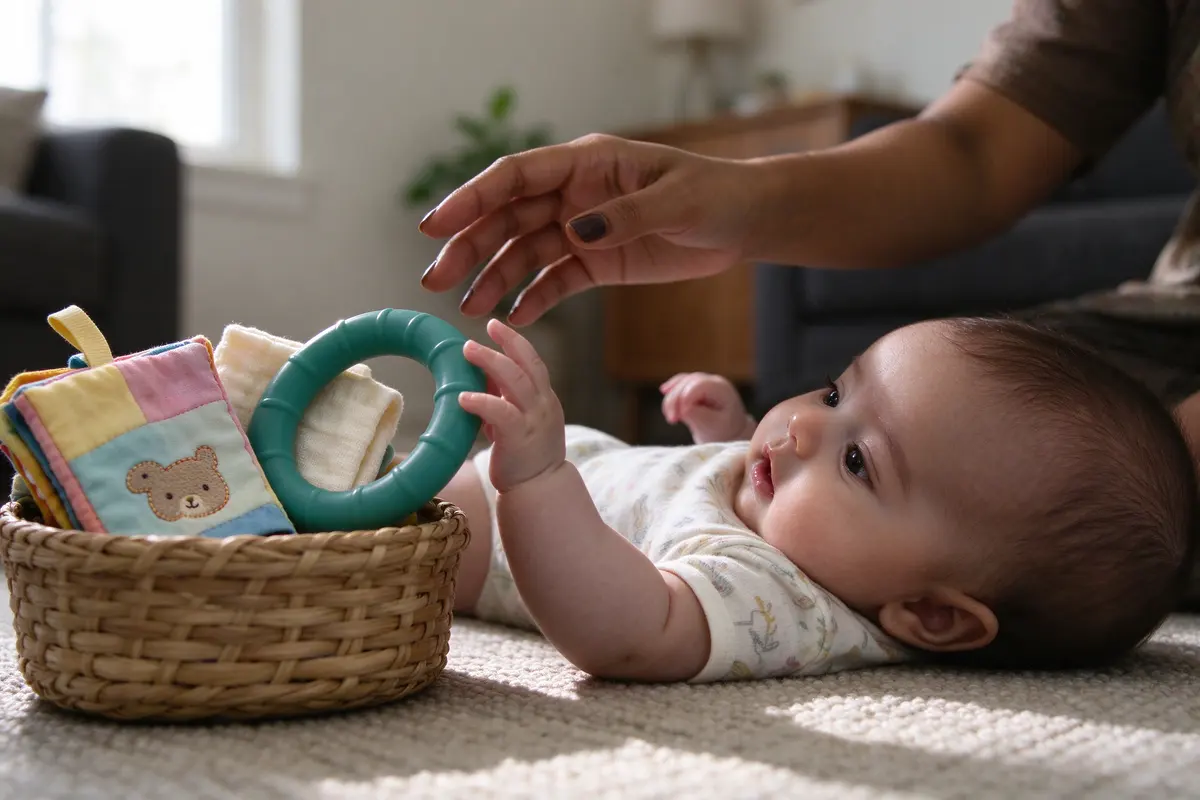
The mouthing basket
Time: 5 minutes to set up, then any floor play · Safety and when to call your pediatrician in the guide
Put them in a basket by the play mat, and offer one at a time during floor play, with you right there.
Swap in a clean one when it's soaked, and wash the lot when play is done.
Make it work:The basket is for awake play on the floor. Nothing from it goes in the crib, which stays a fitted sheet and nothing else (Moon, AAP).
Watch for
Normal
drool down the chin and a soaked bib by lunch (Shu, AAP).
Call your pediatrician
if heavy drooling comes with fever, trouble swallowing, or illness (Shu, AAP).
Normal
a washcloth or a ring in the mouth for minutes at a time, with you watching (CDC).
Call 911
if your baby is struggling for each breath, has stopped breathing, or has bluish lips or face (AAP).
Normal
hand sucking between feeds, which can be comfort rather than hunger (Jain & Bunik, AAP).
Call your pediatrician right away
for a new weak suck or poor feeding (Nationwide Children's).
Normal
a bib on while awake.
For you
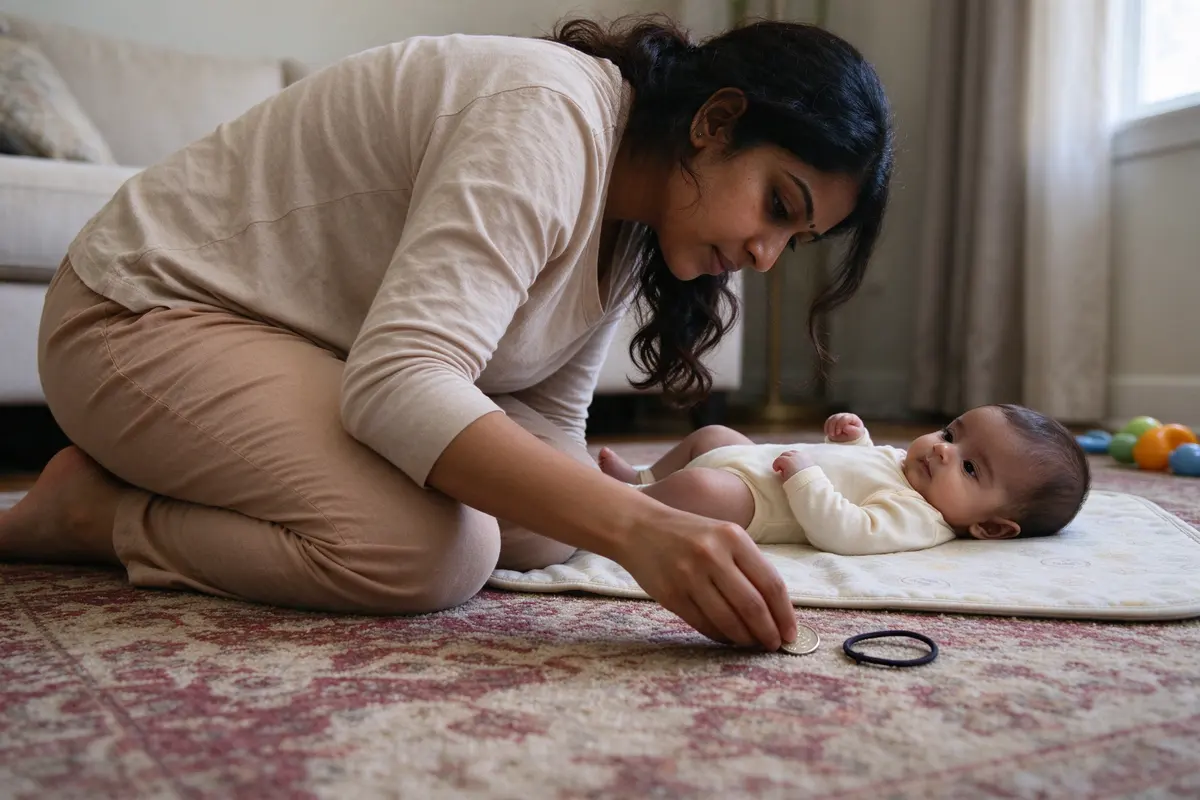
A sweep of the floor at baby height. Get down on your knees, where your baby's hands are, and look across the rug: a coin, a hair tie, a sibling's bead, a dropped pill. Small, sharp, or hot things are the ones to clear (CDC). It takes five minutes, and it turns floor play into something you can relax into instead of police.
If kneeling or getting back up still hurts, that's worth saying out loud at your postpartum visit; ACOG wants that visit done no later than 12 weeks after birth (ACOG, 2018), which is next week.
If you're the partner: the sweep is yours tonight, and again every few days. Then you own what's on the floor, and she can stop scanning it.
Sources
- Wusthoff CJ. "Movement Milestones: Birth to 3 Months." HealthyChildren.org, 2020. https://www.healthychildren.org/English/ages-stages/baby/Pages/Movement-Birth-to-Three-Months.aspx
- Centers for Disease Control and Prevention. "Milestones by 4 Months." Learn the Signs. Act Early., 2026. https://www.cdc.gov/act-early/milestones/4-months.html
- Shu J. "Drooling Baby? Here's Why Spit Happens." HealthyChildren.org, 2026. https://www.healthychildren.org/English/ages-stages/baby/teething-tooth-care/Pages/Drooling-and-Your-Baby.aspx
- American Academy of Pediatrics. "Teething Pain Relief: How to Soothe Your Baby's Discomfort." HealthyChildren.org, 2025. https://www.healthychildren.org/English/ages-stages/baby/teething-tooth-care/Pages/Teething-Pain.aspx
- American Academy of Pediatrics. "Baby Pacifiers & Thumb Sucking: What Parents Need to Know." HealthyChildren.org, 2026. https://www.healthychildren.org/English/ages-stages/baby/crying-colic/Pages/Pacifiers-and-Thumb-Sucking.aspx
- American Academy of Pediatrics. "Teething Necklaces and Beads: A Caution for Parents." HealthyChildren.org, 2018. https://www.healthychildren.org/English/ages-stages/baby/teething-tooth-care/Pages/Amber-Teething-Necklaces.aspx
- American Academy of Pediatrics. "Developmental Milestones: 1-4 Months Old." HealthyChildren.org, 2026. https://www.healthychildren.org/English/ages-stages/baby/Pages/Developmental-Milestones-3-Months.aspx
- Moon RY. "How to Keep Your Sleeping Baby Safe: AAP Policy Explained." HealthyChildren.org, 2026. https://www.healthychildren.org/English/ages-stages/baby/sleep/Pages/a-parents-guide-to-safe-sleep.aspx
- American Academy of Pediatrics. "Breathing Trouble" (symptom checker). HealthyChildren.org, 2026. https://www.healthychildren.org/English/tips-tools/symptom-checker/Pages/symptomviewer.aspx?symptom=Breathing+Trouble
- Jain S, Bunik M. "How Often and How Much Should Your Baby Eat?" HealthyChildren.org, 2024. https://www.healthychildren.org/English/ages-stages/baby/feeding-nutrition/Pages/How-Often-and-How-Much-Should-Your-Baby-Eat.aspx
- Nationwide Children's Hospital. "Newborn Warning Signs." 2023. https://www.nationwidechildrens.org/conditions/health-library/newborn-warning-signs
- American College of Obstetricians and Gynecologists. "ACOG Committee Opinion No. 736: Optimizing Postpartum Care." Obstetrics & Gynecology, 2018. https://pubmed.ncbi.nlm.nih.gov/29683911/
This guide is general education that summarizes published research and guidance from groups like the American Academy of Pediatrics, the CDC, and the WHO. It isn’t medical advice, and every child develops on their own timeline. Your pediatrician knows your child; if something feels wrong, call them. In an emergency, call 911.
Get each day’s note the morning it applies
Add your baby to a free Chorevia household with their date of birth, and every morning for 120 days the day’s note arrives in the app and by email: what’s developing, one thing to try, what to watch for, and a word for you.
Create your household