Day 76 of 120 · Week 11
Child care
Last reviewed · 3 min read · 12 sources · Plain-text version
The numbers that make a good infant room, why a written safe sleep policy matters more than the decor, what to hand over about your baby, and a visit to do before the first day.

If someone outside the family will care for your baby soon, this is the day to look at the place with a nurse's eyes rather than a parent's heart. Both matter; the numbers come first.
Heart
For babies 12 months and younger, the AAP lists a maximum of 3 babies per caregiver and 6 per group, and says to ask about CPR training (AAP) and whether the program is licensed (AAP). Ask for a written safe sleep policy (AAP), and share what calms your baby (AAP). A place that answers these easily is a place that has been asked before.
Head
Why the sleep policy is the question to insist on. In 1990s data from 11 states, 20.4% of SIDS deaths happened in child care, and babies who died there were more likely than others to have been put down on their stomachs when they usually slept on their backs or sides (Moon et al., 2000). This is still the highest-risk window: 72% of SIDS deaths happen in months 1 to 4 (NICHD). "Back to sleep, every caregiver" isn't a slogan; it's the one rule that has to travel with your baby.
Body
Two practical things. Many centers don't swaddle, and babies swaddled for the first time at an older age may have a harder time waking (Moon & Glassy, AAP); if you haven't made the sleep-sack switch yet, the center will make it for you. And your baby is sorting out who's who: familiar people get the big smiles, sitters may get a hesitant one, and strangers a curious stare (AAP). A caregiver who gets the stare on day one is getting the normal welcome.
Try today
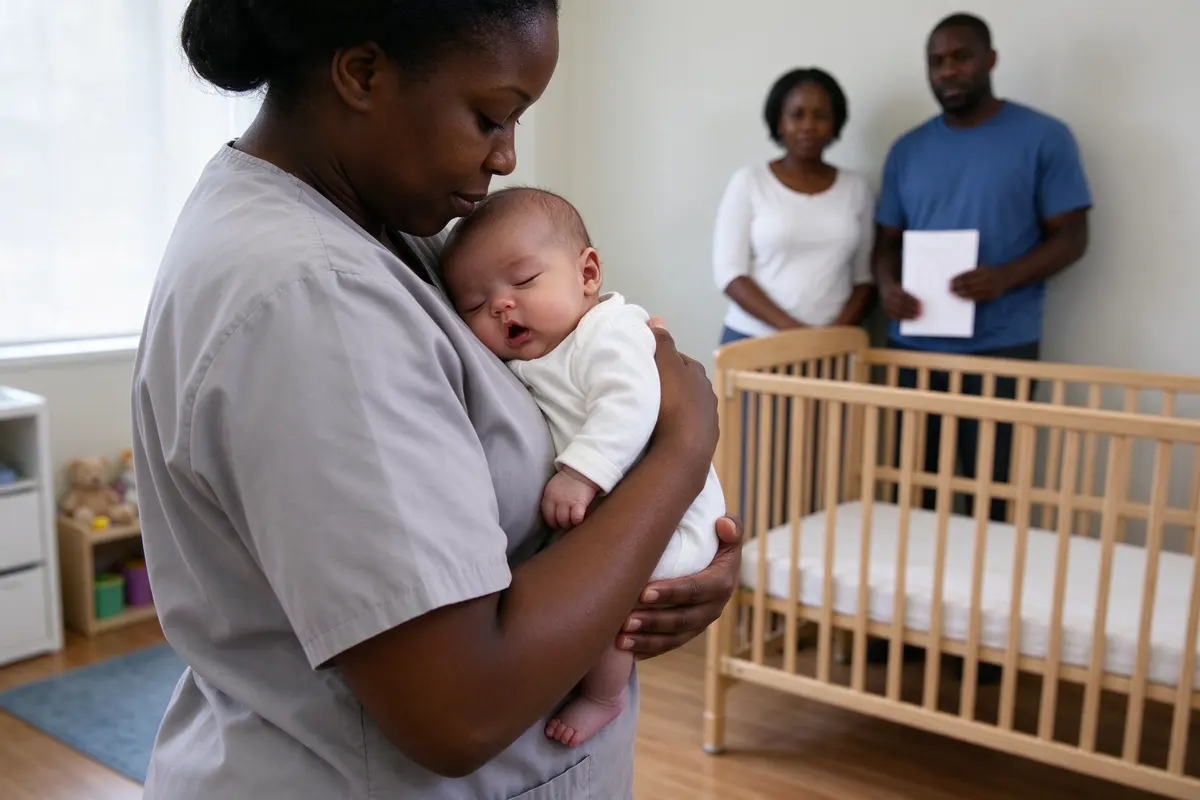
The handover visit
Time: 30 minutes, before the first day · Back to work: pumping, bottles, and child care in the guide
Bring your baby and one handwritten page: what calms them, how they feed, how they sleep, and what their tired cry sounds like (AAP).
Ask to see where the babies sleep, and ask for the written safe sleep policy (AAP). Bare cribs, babies on their backs.
Ask how many babies each caregiver has and who is CPR-trained (AAP).
Hand your baby over, step back, and watch one settle from across the room.
Make it work:If the answers to steps 2 and 3 aren't quick and clear, that's your answer too.
Watch for
Normal
a hesitant smile or a long stare for a new caregiver (AAP).
Bring it up with your pediatrician, don't wait,
if your baby doesn't smile at you or look at your face (CDC).
Normal
a fussier evening after a new place and new voices.
Call your pediatrician right away
if your baby cries nonstop for more than 2 hours and can't be consoled (AAP).
Normal
falling asleep in the car seat on the way home; move them to their back on a firm, flat surface as soon as you can (Moon, AAP).
Call 911
if you can't wake your baby enough to feed (Nationwide Children's).
For you

The first morning apart is a plan, not a verdict. Decide now what you'll do in the first hour: drive, call someone, cry in the parking lot, all three. None of it means the decision was wrong. What does need attention is a mood that stays down: low mood, anxiety, or emptiness that is severe or lasts more than 2 weeks may be postpartum depression, which usually doesn't improve without treatment but does respond to it (NIMH). Call or text 1-833-TLC-MAMA (1-833-852-6262), or 988 (CDC).
If you're staying home instead, and the visit today was only a look, you've still learned the questions. They apply to a grandparent's house too.
If you're the partner: do the first drop-off, or do the pickup. Whichever one she dreads more is yours.
Sources
- American Academy of Pediatrics. "Choosing a Child Care Center." HealthyChildren.org, updated 2022. https://www.healthychildren.org/English/family-life/work-and-child-care/Pages/choosing-a-child-care-center.aspx
- American Academy of Pediatrics. "Back to Sleep, Tummy to Play: Give Your Baby a Safe, Strong Start." HealthyChildren.org, updated 2026. https://www.healthychildren.org/English/ages-stages/baby/sleep/Pages/back-to-sleep-tummy-to-play.aspx
- American Academy of Pediatrics. "Emotional & Social Development: Birth Through 3 Months." HealthyChildren.org, updated 2026. https://www.healthychildren.org/English/ages-stages/baby/Pages/Emotional-and-Social-Development-Birth-to-3-Months.aspx
- Moon RY, Patel KM, Shaefer SJ. "Sudden infant death syndrome in child care settings." Pediatrics, 2000. https://pubmed.ncbi.nlm.nih.gov/10920154/
- Eunice Kennedy Shriver National Institute of Child Health and Human Development. "Infographic: SIDS by Baby's Age (Text Alternative)." Safe to Sleep, accessed 2026. https://safetosleep.nichd.nih.gov/resources/social-digital/sids-by-babys-age-infographic-text-alternative
- Moon RY, Glassy D. "Swaddling: Is it Safe for Your Baby?" HealthyChildren.org, updated 2022. https://www.healthychildren.org/English/ages-stages/baby/diapers-clothing/Pages/Swaddling-Is-it-Safe.aspx
- Centers for Disease Control and Prevention. "Milestones by 2 Months." Learn the Signs. Act Early., updated 2026. https://www.cdc.gov/act-early/milestones/2-months.html
- American Academy of Pediatrics. "Crying Baby - Before 3 Months Old" (symptom checker). HealthyChildren.org, accessed 2026. https://www.healthychildren.org/English/tips-tools/symptom-checker/Pages/symptomviewer.aspx?symptom=Crying+Baby+-+Before+3+Months+Old
- Moon RY. "How to Keep Your Sleeping Baby Safe: AAP Policy Explained." HealthyChildren.org, updated 2026. https://www.healthychildren.org/English/ages-stages/baby/sleep/Pages/a-parents-guide-to-safe-sleep.aspx
- Nationwide Children's Hospital. "Newborn Warning Signs." 2023. https://www.nationwidechildrens.org/conditions/health-library/newborn-warning-signs
- National Institute of Mental Health. "Perinatal Depression." Accessed 2026. https://www.nimh.nih.gov/health/publications/perinatal-depression
- Centers for Disease Control and Prevention. "Symptoms of Depression Among Women." 2024. https://www.cdc.gov/reproductive-health/depression/index.html
This guide is general education that summarizes published research and guidance from groups like the American Academy of Pediatrics, the CDC, and the WHO. It isn’t medical advice, and every child develops on their own timeline. Your pediatrician knows your child; if something feels wrong, call them. In an emergency, call 911.
Get each day’s note the morning it applies
Add your baby to a free Chorevia household with their date of birth, and every morning for 120 days the day’s note arrives in the app and by email: what’s developing, one thing to try, what to watch for, and a word for you.
Create your household