Day 60 of 60 · Two months
Two months
Last reviewed · 3 min read · 12 sources · Plain-text version
Two months in. The CDC list as a 'by about now' celebration, the crying curve bending for most families, and a short video to make today.

Two months. The last note in the series is mostly one sentence: look what you did.
Heart
By about now, most babies calm down when spoken to or picked up, look at your face, seem happy to see you, and smile when you talk to or smile at them; make sounds other than crying; watch you as you move; hold their head up on their tummy; and open their hands briefly (CDC). If your baby was born early, count from the due date (AAP).
The smile is the headline: by the second month, early expressions turn into genuine signals of pleasure and friendliness, a new way besides crying to tell you what they need (AAP).
Head
The crying curve bends. Across 28 diary studies, fussing and crying averaged about 2 hours a day for the first 6 weeks, then fell to about 1 hour a day by 10 to 12 weeks, when only 0.6% of babies met the definition of colic (Wolke et al., 2017). The AAP says colic usually stops by 3 to 4 months (AAP). If you're still in the thick of it, it has an end date.
Body
Sixty days built this: tummy time worked up toward 15 to 30 minutes a day (AAP), and a baby who knows your face and voice. Keep two things exactly as they are: 400 IU of vitamin D a day if your baby gets any breast milk (AAP), and back to sleep, every sleep, on a firm, flat, bare surface, in your room but not your bed (Moon et al., 2022).
Try today
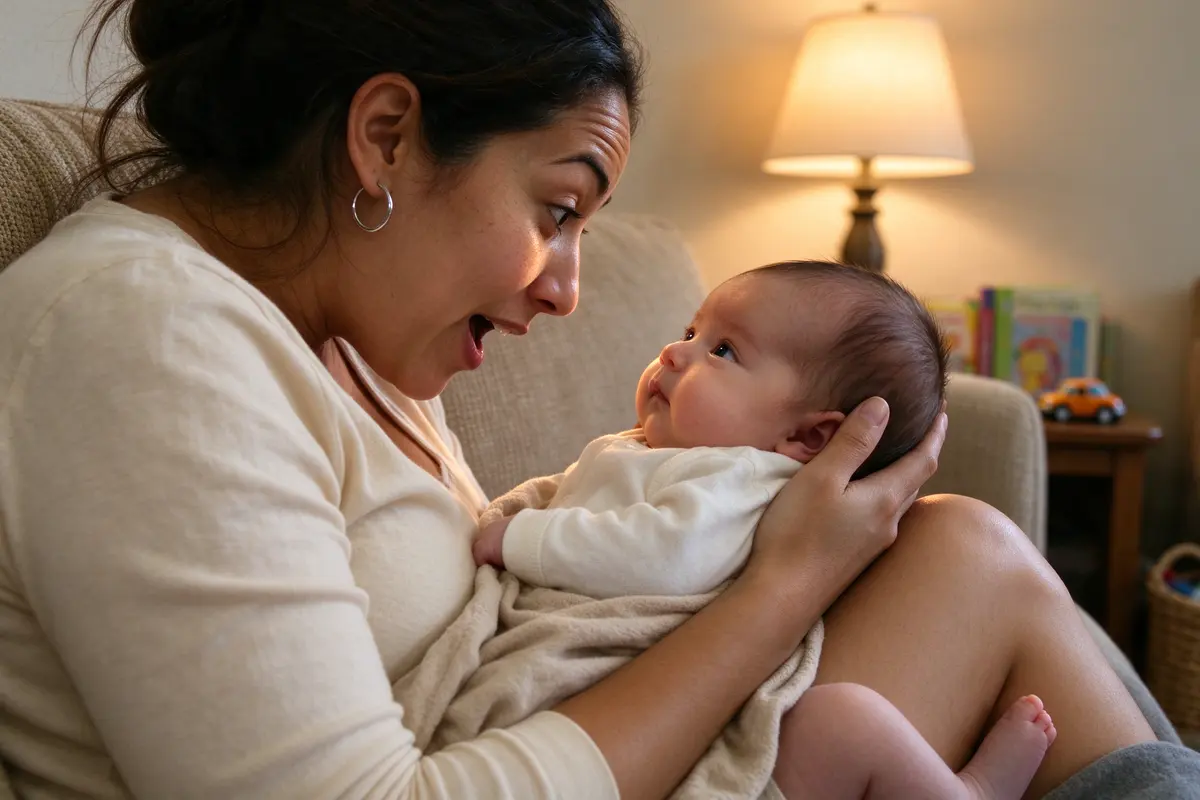
The first-smile video
Time: A few minutes, when your baby is alert · Smile conversations in the guide
Prop the phone up or hand it to someone; you stay face to face.
Smile, raise your eyebrows, say hello. When your baby smiles, smile bigger, say a few words, then pause (AAP).
Keep it to a minute or two and stop when they look away.
Save it with the date and send it to the people who'd cry.
Make it work:The video is for you; babies this young learn from real-world interactions (Munzer, AAP). Keep the phone out of their line of sight.
Watch for
Normal
a baby who settles when you pick them up or talk.
Tell your pediatrician
if being picked up or spoken to doesn't settle your baby (CDC).
Normal
an easier evening than last month.
Call 911
for a baby who is limp, floppy, or not moving (Nationwide Children's).
Normal
knowing this baby better than anyone alive.
Call anyway
if your baby just doesn't seem right to you. Trust your instincts; two months of practice have sharpened them (Lurie Children's).
For you

You did two months. Through the heaviest crying stretch, on broken sleep, you kept showing up. That's the whole job.
Keep the two numbers in your phone. If a hard day becomes a hard week, call or text the National Maternal Mental Health Hotline at 1-833-TLC-MAMA (1-833-852-6262), or call or text 988 (CDC).
If you're the partner: watch the video with her tonight and name one thing that's hers.
Months two to three are in the next guide: 2 months.
Sources
- Centers for Disease Control and Prevention. "Milestones by 2 Months." Learn the Signs. Act Early. program, 2026. https://www.cdc.gov/act-early/milestones/2-months.html
- American Academy of Pediatrics. "Corrected Age For Preemies." HealthyChildren.org, 2018. https://www.healthychildren.org/English/ages-stages/baby/preemie/Pages/Corrected-Age-For-Preemies.aspx
- American Academy of Pediatrics. "Emotional & Social Development: Birth Through 3 Months." HealthyChildren.org, 2026. https://www.healthychildren.org/English/ages-stages/baby/Pages/Emotional-and-Social-Development-Birth-to-3-Months.aspx
- Wolke D, Bilgin A, Samara M. "Systematic Review and Meta-Analysis: Fussing and Crying Durations and Prevalence of Colic in Infants." Journal of Pediatrics, 2017. https://pubmed.ncbi.nlm.nih.gov/28385295/
- American Academy of Pediatrics. "Colic Relief Tips for Parents." HealthyChildren.org, 2024. https://www.healthychildren.org/English/ages-stages/baby/crying-colic/Pages/Colic.aspx
- American Academy of Pediatrics. "Back to Sleep, Tummy to Play." HealthyChildren.org, 2026. https://www.healthychildren.org/English/ages-stages/baby/sleep/Pages/back-to-sleep-tummy-to-play.aspx
- American Academy of Pediatrics Section on Gastroenterology, Hepatology and Nutrition. "Vitamin D for Babies, Children & Adolescents." HealthyChildren.org, 2022. https://www.healthychildren.org/English/healthy-living/nutrition/Pages/vitamin-d-on-the-double.aspx
- Moon RY, Carlin RF, Hand I. "Sleep-Related Infant Deaths: Updated 2022 Recommendations for Reducing Infant Deaths in the Sleep Environment." Pediatrics, 2022. https://pubmed.ncbi.nlm.nih.gov/35726558/
- Munzer T. "Helping Kids Thrive in a Digital World: AAP Policy Explained." HealthyChildren.org, 2026. https://www.healthychildren.org/English/family-life/Media/Pages/helping-kids-thrive-in-a-digital-world-AAP-policy-explained.aspx
- Nationwide Children's Hospital. "Newborn Warning Signs." 2023. https://www.nationwidechildrens.org/conditions/health-library/newborn-warning-signs
- Lurie Children's Hospital of Chicago. "When to Call the Pediatrician for Your Newborn." 2022. https://www.luriechildrens.org/en/blog/when-to-call-the-pediatrician-for-your-newborn/
- Centers for Disease Control and Prevention. "Symptoms of Depression Among Women." 2024. https://www.cdc.gov/reproductive-health/depression/index.html
This guide is general education that summarizes published research and guidance from groups like the American Academy of Pediatrics, the CDC, and the WHO. It isn’t medical advice, and every child develops on their own timeline. Your pediatrician knows your child; if something feels wrong, call them. In an emergency, call 911.
Get each day’s note the morning it applies
Add your baby to a free Chorevia household with their date of birth, and every morning for 60 days the day’s note arrives in the app and by email: what’s developing, one thing to try, what to watch for, and a word for you.
Create your household