Day 53 of 60 · Week 8
The safe play spot
Last reviewed · 3 min read · 12 sources · Plain-text version
Some babies start working on rolling at 2 months. Stop swaddling at the first signs, never leave your baby alone on a raised surface, and set up a floor spot today.
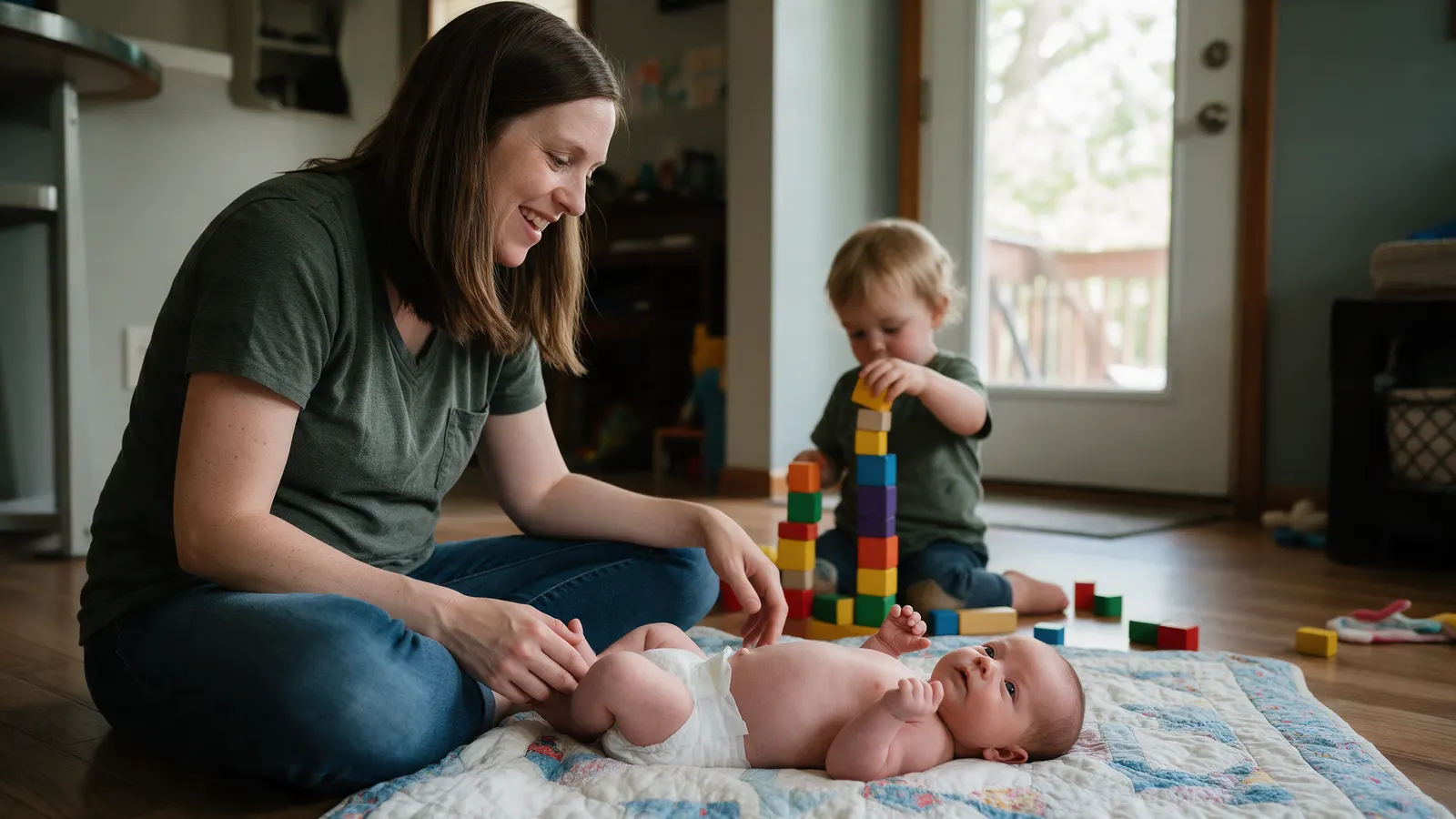
A baby who couldn't roll yesterday may push off today. Today is about two surfaces: the floor, for play, and the crib, for walking away.
Heart
Head
Body
The floor is the safest place for an awake baby: nothing to fall from. Floor tummy time, on a firm, flat surface, is one of the four ways (AAP), and the target is 15 to 30 minutes a day in short sessions by 7 weeks (AAP). The AAP suggests changing your baby's position every 10 to 15 minutes during playtime and staying with them (AAP). Toys stay on the floor; the crib stays bare, a fitted sheet only (AAP).
Try today

Floor time: the safe play spot
Time: 10 minutes to set up, then a few minutes of play · Tummy time, four ways in the guide
Pick a spot on a firm floor away from stairs, cords, pets, and anything that could tip; lay down a blanket.
Put a toy or two within reach and a rolled towel for side-lying.
Lay your baby on their back, then their tummy, then their side, switching every few minutes, with you down there too (AAP).
When they tire, move them to their back in their own sleep space and leave the toys behind (AAP).
Make it work:A sibling or a pet doesn't change the rule: floor play is watched play.
Watch for
Normal
wriggling, kicking, and rocking onto one side during play.
Stop swaddling
at the first signs of trying to roll (AAP).
Normal
a baby who moves both arms and both legs, unevenly and in bursts.
Tell your pediatrician
if one arm or leg moves much less than the other, or your baby seems to use one side only (AAP).
Normal
a soft spot that looks flat and may pulse.
Call your pediatrician right away
for a bulging or swollen soft spot (AAP).
For you
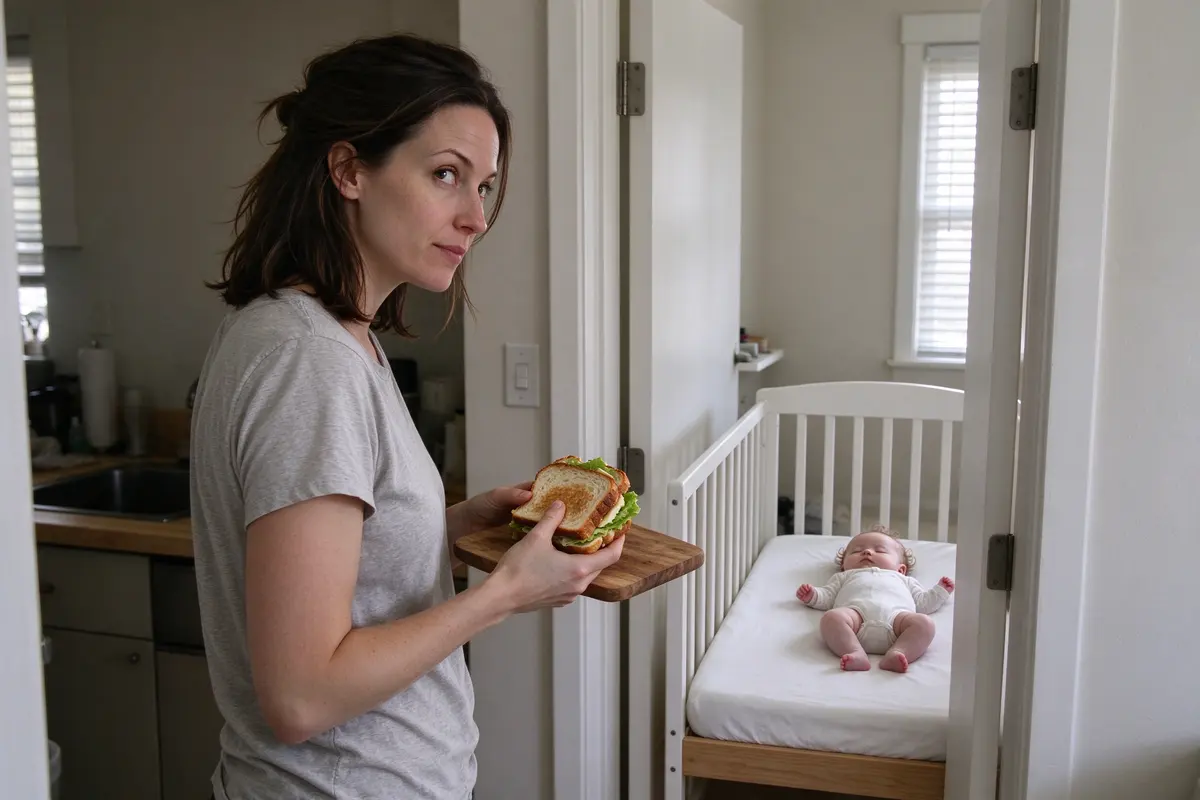
Two safe spots, two uses. The floor blanket is for play with you there. The bare crib, baby on their back, is where you can leave the room: for the bathroom, a sandwich, or the moment crying gets to be too much. If you feel yourself losing control, put your baby on their back in the crib, leave the room for 10 to 15 minutes, and call someone (AAP). A safe spot is permission, not neglect.
Floor to standing is work for a healing body. After a C-section, don't lift anything heavier than your baby for the first 6 to 8 weeks, and expect most regular activities to return in 4 to 8 weeks (MedlinePlus). Bend at the knees, not the waist, to pick things up (AAP).
If you're the partner: set up the floor spot, then take a floor session yourself, daily.
Sources
- American Academy of Pediatrics. "Swaddling: Is it Safe for Your Baby?" HealthyChildren.org, 2022. https://www.healthychildren.org/English/ages-stages/baby/diapers-clothing/Pages/Swaddling-Is-it-Safe.aspx
- American Academy of Pediatrics. "Newborn Reflexes." HealthyChildren.org, 2022. https://www.healthychildren.org/English/ages-stages/baby/Pages/newborn-reflexes.aspx
- National Health Service (UK). "Baby and toddler safety." 2026. https://www.nhs.uk/baby/first-aid-and-safety/safety/baby-and-toddler-safety/
- American Academy of Pediatrics. "Changing Table Safety." HealthyChildren.org, 2009. https://www.healthychildren.org/English/safety-prevention/at-home/Pages/Changing-Table-Safety.aspx
- American Academy of Pediatrics. "3 Tummy Time Activities to Try With Your Baby." HealthyChildren.org, 2023. https://www.healthychildren.org/English/ages-stages/baby/sleep/Pages/The-Importance-of-Tummy-Time.aspx
- American Academy of Pediatrics. "Back to Sleep, Tummy to Play." HealthyChildren.org, 2026. https://www.healthychildren.org/English/ages-stages/baby/sleep/Pages/back-to-sleep-tummy-to-play.aspx
- Moon RY. "How to Keep Your Sleeping Baby Safe: AAP Policy Explained." HealthyChildren.org, 2026. https://www.healthychildren.org/English/ages-stages/baby/sleep/Pages/a-parents-guide-to-safe-sleep.aspx
- American Academy of Pediatrics. "Movement Milestones: Birth to 3 Months." HealthyChildren.org, 2020. https://www.healthychildren.org/English/ages-stages/baby/Pages/Movement-Birth-to-Three-Months.aspx
- American Academy of Pediatrics. "Crying Baby - Before 3 Months Old" (symptom checker). HealthyChildren.org, 2026. https://www.healthychildren.org/English/tips-tools/symptom-checker/Pages/symptomviewer.aspx?symptom=Crying+Baby+-+Before+3+Months+Old
- American Academy of Pediatrics. "Shaken Baby Syndrome: Protect Your Infant from Abusive Head Trauma." HealthyChildren.org, 2025. https://www.healthychildren.org/English/safety-prevention/at-home/Pages/Abusive-Head-Trauma-Shaken-Baby-Syndrome.aspx
- MedlinePlus. "Going home after a C-section." National Library of Medicine. https://medlineplus.gov/ency/patientinstructions/000624.htm
- American Academy of Pediatrics. "Baby Carriers: Backpacks, Front Packs & Slings." HealthyChildren.org, 2025. https://www.healthychildren.org/English/safety-prevention/on-the-go/Pages/Baby-Carriers.aspx
This guide is general education that summarizes published research and guidance from groups like the American Academy of Pediatrics, the CDC, and the WHO. It isn’t medical advice, and every child develops on their own timeline. Your pediatrician knows your child; if something feels wrong, call them. In an emergency, call 911.
Get each day’s note the morning it applies
Add your baby to a free Chorevia household with their date of birth, and every morning for 60 days the day’s note arrives in the app and by email: what’s developing, one thing to try, what to watch for, and a word for you.
Create your household