Day 36 of 60 · Week 5
Coos
Last reviewed · 3 min read · 12 sources · Plain-text version
Sounds other than crying arrive this month. What the turn-taking research found, how to leave room for your baby's reply, and why you should speak up too.

Listen this week for a sound that isn't a cry. A squeak, a sigh with a vowel in it, a small "ah." That's the start of a conversation that will run for the rest of your lives.
Heart
Making sounds other than crying is a 2-month milestone (CDC). Long "oooo" and "aahh" coos are a 4-month milestone, so they may still be coming (AAP). Whatever your baby offers is a serve. When a baby coos, cries, or gazes and an adult responds with eye contact, words, or a hug, those exchanges help build neural connections (Harvard Center on the Developing Child).
Head
Babies take turns earlier than you'd think. In recordings of 51 mother-baby pairs, babies 8 to 21 weeks old joined in and often started vocal "protoconversations" (Gratier et al., 2015). In a study of 48 Japanese babies, 3- and 4-month-olds paused after making a sound, as if listening for a reply (Masataka, 1993). Small studies, and the babies were older than yours. The practical lesson is the same: talk, then pause, and leave room for your baby's turn.
Body
The pause is the hard part for adults. Babies respond slowly. Count three in your head after you speak, and keep your face on theirs while you wait. A raised eyebrow holds the floor open. Making sounds other than crying is a 2-month milestone (CDC); the gap you leave is the invitation.
Try today
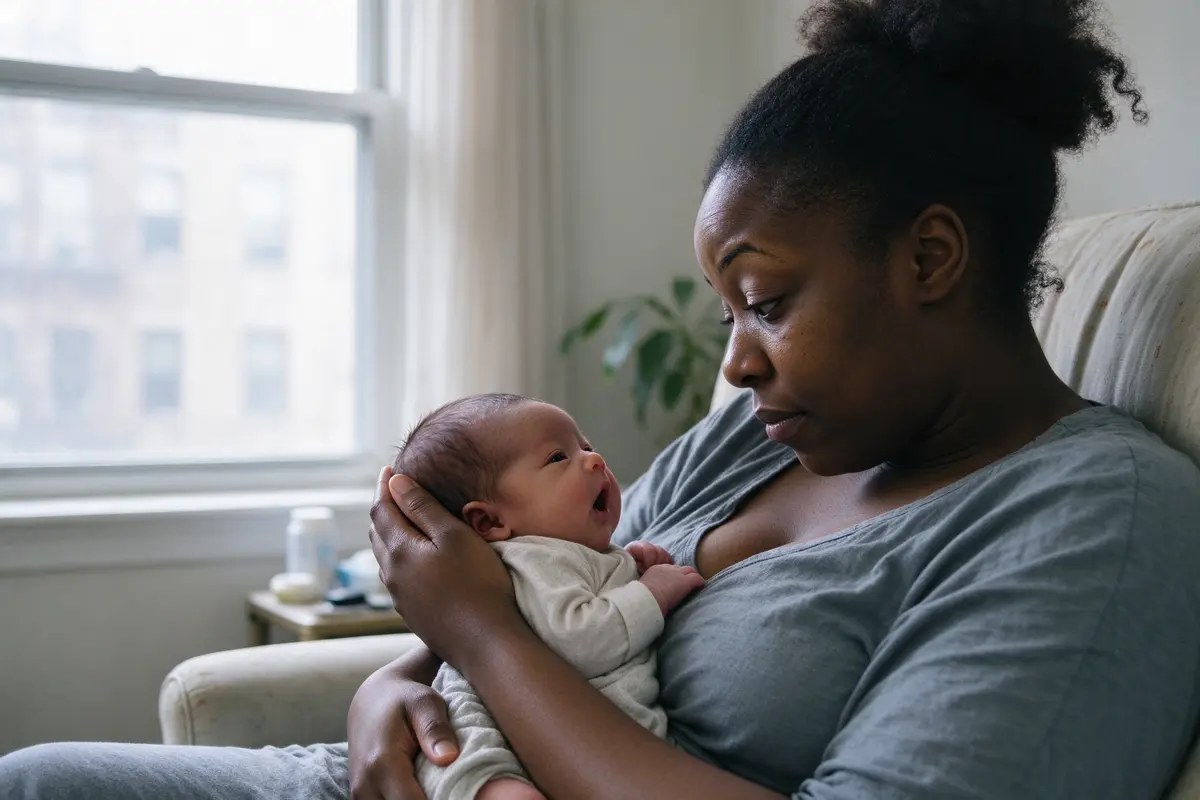
Cooing back and forth
Time: 2 to 5 minutes, during calm, alert times · Cooing back and forth in the guide
Wait for your baby to make a sound.
Copy it back softly, with a smile; CDC suggests copying your baby's sounds (CDC).
Pause and see if your baby "answers."
If nothing comes, say a word or two in a warm, slow voice and wait again.
Make it work:Small studies show babies 2 to 5 months old take part in vocal turn-taking (Gratier et al., 2015; Masataka, 1993); long-term benefits haven't been tested. Stop when your baby looks away or fusses.
Watch for
Normal
a quiet baby some days and a squeaky one on others.
Tell your pediatrician
if your baby makes no sounds other than crying, or doesn't react to loud sounds; CDC's advice is not to wait (CDC).
Normal
a baby who passed the hearing screen and startles at a slammed door.
Book the full hearing test before 3 months
if your baby didn't pass the newborn screen and it hasn't happened yet (CDC).
Normal
squeaks and sighs, awake and asleep (AAP).
Call 911
if your baby is struggling to breathe, or has new grunting, wheezing, or whistling sounds (Nationwide Children's).
For you
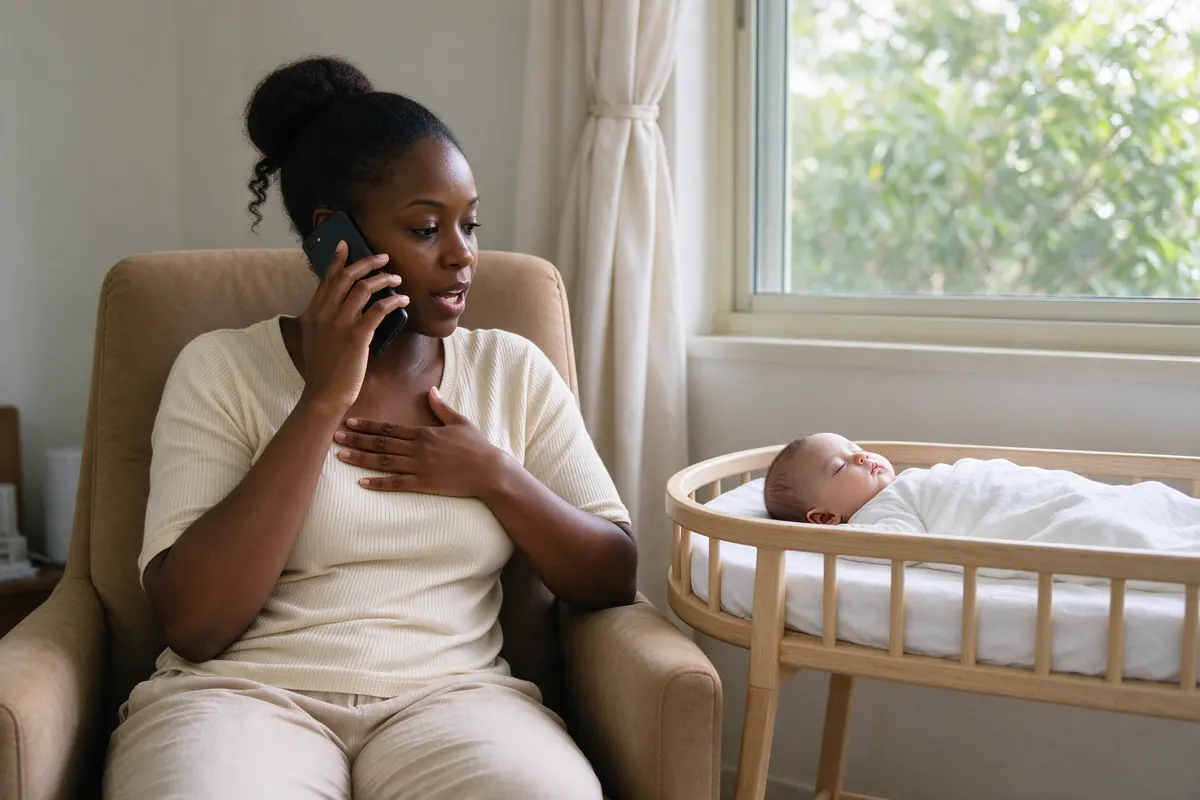
Say something out loud too. Not to the baby: to a person. A friend, your mother, the nurse line. The AAP recommends that pediatricians screen mothers at the 1-, 2-, 4-, and 6-month visits because perinatal depression can be treated effectively (Earls et al., 2019), but you don't have to wait for a visit to start the sentence. About 1 in 8 women report symptoms of postpartum depression after a birth (CDC). If sadness lasts more than two weeks, go to the doctor; don't wait for the postpartum visit (OWH).
Partners count. In a meta-analysis of 43 studies, about 10% of fathers had depression during pregnancy or the year after birth, with higher rates 3 to 6 months after (Paulson & Bazemore, 2010). If you're the partner: the same sentence, out loud, to someone.
Help now: call or text the National Maternal Mental Health Hotline at 1-833-TLC-MAMA (1-833-852-6262), or call or text 988 (CDC).
Sources
- Centers for Disease Control and Prevention. "Milestones by 2 Months." Learn the Signs. Act Early. program, updated 2026. https://www.cdc.gov/act-early/milestones/2-months.html
- American Academy of Pediatrics. "Developmental Milestones: 1-4 Months Old." HealthyChildren.org, updated 2026. https://www.healthychildren.org/English/ages-stages/baby/Pages/Developmental-Milestones-3-Months.aspx
- Center on the Developing Child at Harvard University. "Serve and Return." Accessed 2026. https://developingchild.harvard.edu/key-concept/serve-and-return/
- Gratier M, Devouche E, Guellai B, et al. "Early development of turn-taking in vocal interaction between mothers and infants." Frontiers in Psychology, 2015. https://pubmed.ncbi.nlm.nih.gov/26388790/
- Masataka N. "Effects of contingent and noncontingent maternal stimulation on the vocal behaviour of three- to four-month-old Japanese infants." Journal of Child Language, 1993. https://pubmed.ncbi.nlm.nih.gov/8376471/
- Centers for Disease Control and Prevention. "Newborn Hearing Screening." 2024. https://www.cdc.gov/hearing-loss-children-guide/parents-guide/newborn-hearing-screening.html
- American Academy of Pediatrics. "How Your Newborn Behaves." HealthyChildren.org, updated 2021. https://www.healthychildren.org/English/ages-stages/baby/Pages/How-Your-Newborn-Behaves.aspx
- Nationwide Children's Hospital. "Newborn Warning Signs." 2023. https://www.nationwidechildrens.org/conditions/health-library/newborn-warning-signs
- Earls MF, Yogman MW, Mattson G, Rafferty J; AAP Committee on Psychosocial Aspects of Child and Family Health. "Incorporating Recognition and Management of Perinatal Depression Into Pediatric Practice." Pediatrics, 2019. https://pubmed.ncbi.nlm.nih.gov/30559120/
- Centers for Disease Control and Prevention. "Symptoms of Depression Among Women." 2024. https://www.cdc.gov/reproductive-health/depression/index.html
- Office on Women's Health, US Department of Health and Human Services. "Recovering from birth." https://womenshealth.gov/pregnancy/childbirth-and-beyond/recovering-birth
- Paulson JF, Bazemore SD. "Prenatal and postpartum depression in fathers and its association with maternal depression: a meta-analysis." JAMA, 2010. https://pubmed.ncbi.nlm.nih.gov/20483973/
This guide is general education that summarizes published research and guidance from groups like the American Academy of Pediatrics, the CDC, and the WHO. It isn’t medical advice, and every child develops on their own timeline. Your pediatrician knows your child; if something feels wrong, call them. In an emergency, call 911.
Get each day’s note the morning it applies
Add your baby to a free Chorevia household with their date of birth, and every morning for 60 days the day’s note arrives in the app and by email: what’s developing, one thing to try, what to watch for, and a word for you.
Create your household