Day 32 of 60 · Week 5
The witching hour
Last reviewed · 3 min read · 17 sources · Plain-text version
Evening crying is at its heaviest this month. What colic actually means, how common it is, and a carrier walk for the hour when nothing else works.
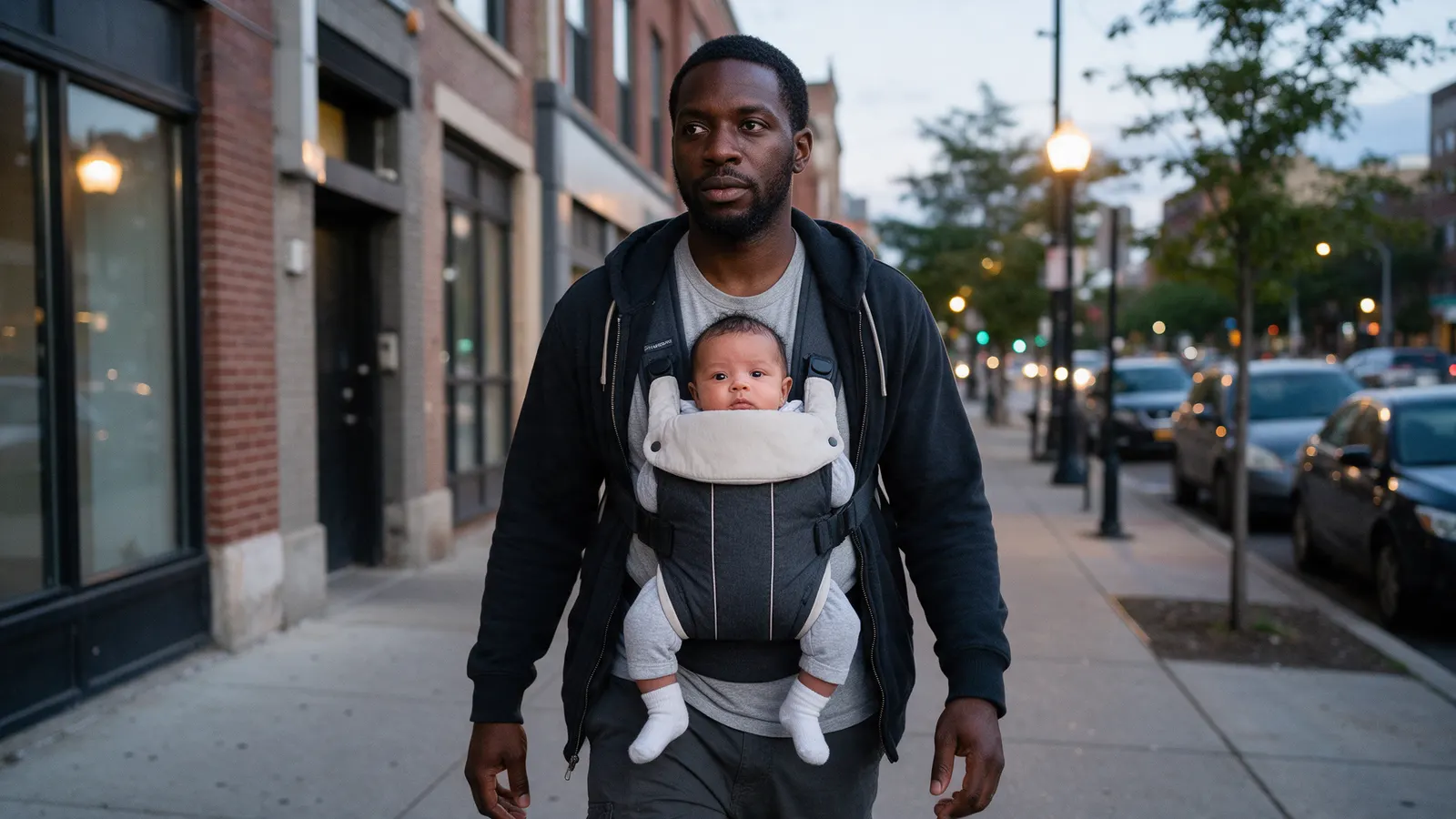
Some evening this week the crying will start around dinner and keep going. This note is for that hour: what it is, and one more thing to try.
Heart
PURPLE crying materials describe the most crying in month 2, often in the evening (Seattle Children's). It's a stage, not a verdict on you or your baby. Some crying resists soothing no matter what you try (Seattle Children's). Answering it is still right: babies whose cries are answered cry less overall (AAP).
Head
Numbers help. Fussing and crying averaged about 2 hours a day for the first 6 weeks across 28 diary studies, then fell to about 1 hour a day by 10 to 12 weeks (Wolke et al., 2017). Colic is usually defined as crying 3 or more hours a day, at least 3 days a week, for at least 3 weeks (Gordon et al., 2018), and affected 17% to 25% of babies in the first 6 weeks (Wolke et al., 2017). The AAP says colic usually stops by 3 to 4 months (AAP). Named or not, the arc is the same: up for now, then down.
Body
Once your pediatrician has checked your baby, the AAP's colic tips are: walk with your baby in a carrier, rock, add steady sound like a fan, offer a pacifier, or lay your baby tummy-down across your knees and rub their back (AAP). Walking may add something: in a small lab study of 12 babies 1 to 6 months old, babies cried less and their heart rates slowed when their mother walked while carrying them, compared with sitting (Esposito et al., 2013).
Try today
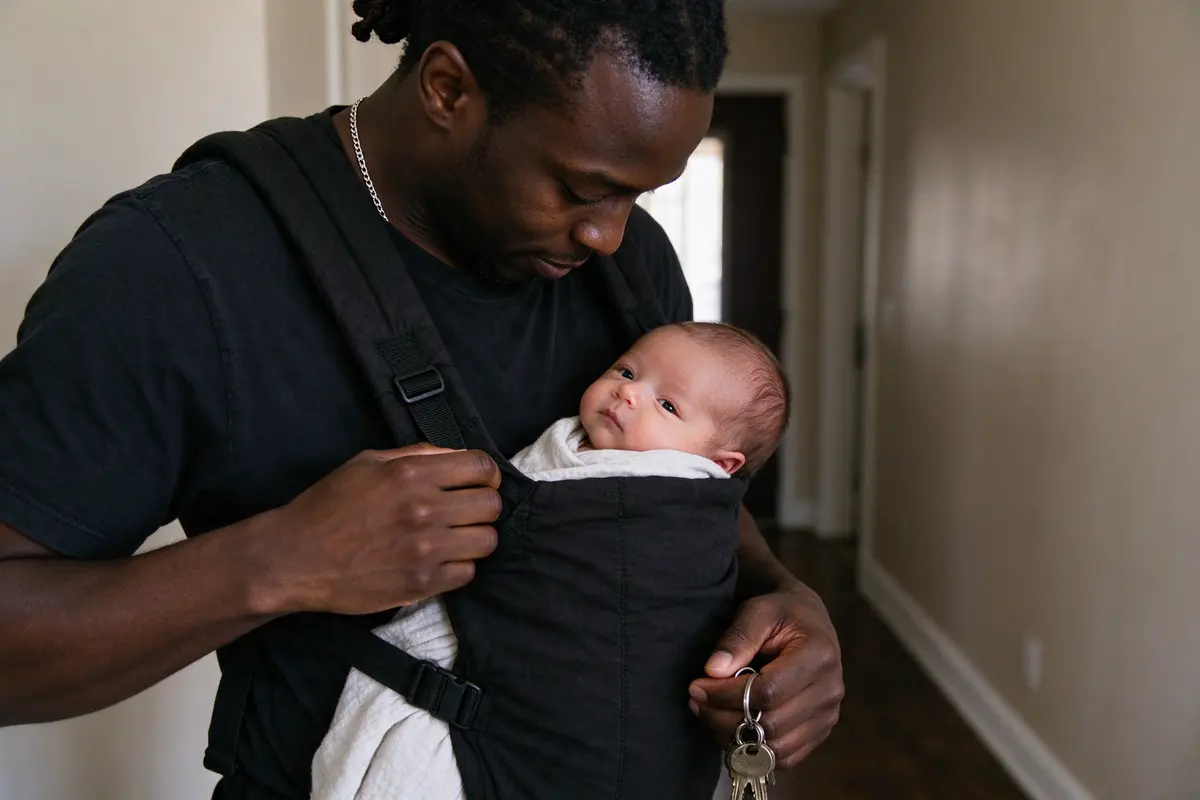
Babywearing walk at the witching hour
Time: 15 to 30 minutes, up to about an hour at a stretch · Babywearing walk in the guide
Put the carrier on and follow T.I.C.K.S.: Tight, In view at all times, Close enough to kiss, Keep chin off chest, Supported back (Mankato Clinic).
Check that you can see your baby's face and nothing blocks their nose and mouth (CPSC), then walk: the block, the kitchen, the hall.
Keep your voice low and your steps steady.
If your baby falls asleep, move them to their back on a firm, flat surface when you can (AAP).
Make it work:CPSC urges extra care with slings for babies under 4 months, preemies, low-birthweight babies, and babies with colds (CPSC). WHO advises not keeping babies strapped in a carrier or stroller more than 1 hour at a time (WHO). The evidence that extra carrying cuts crying is mixed: one 1986 trial found less crying (Hunziker & Barr, 1986); later trials didn't repeat it (St James-Roberts et al., 1995; Barr et al., 1991).
Watch for
Normal
an hour or two of evening crying that resists everything.
Call your pediatrician right away
if your baby has a fever, vomits, or cries when touched or moved, or if you're afraid someone might shake your baby (AAP).
Normal
a baby who is alert and watchful between spells.
Go to the ER now
if your baby isn't alert when awake, or seems "out of it" (AAP).
Normal
a red, furious face mid-cry.
Call 911
if your baby has bluish lips or face (AAP).
For you
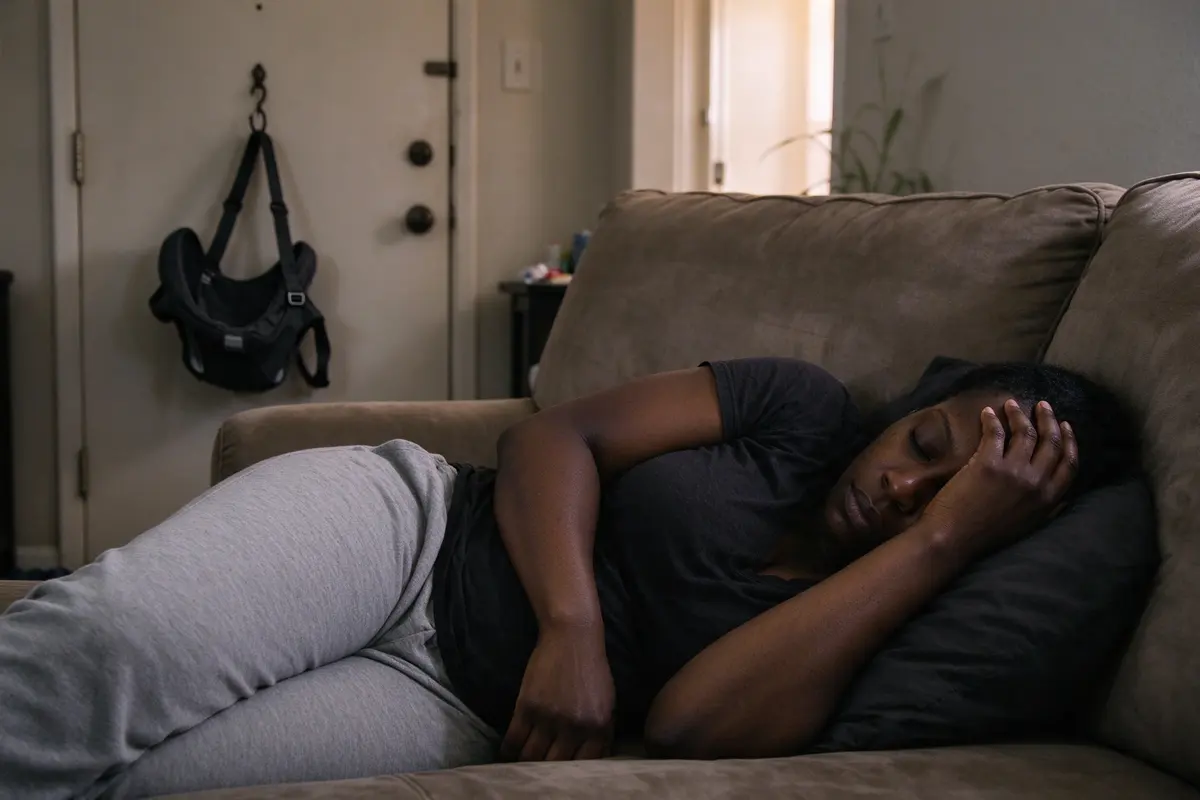
The walk-away plan, again, because month 2 is when it's needed. Shaking often happens in response to crying (Barr et al., 2009), and it is never safe to shake, throw, hit, slam, or jerk a baby. If you feel yourself losing control, put your baby on their back in the crib, leave the room for 10 to 15 minutes, and call someone (AAP).
"Worn out from the crying" is a reason to call, on its own: the AAP says to call your pediatrician within a day if you're worn out from the crying (AAP). That isn't weakness. It's the system working.
If you're the partner: the evening is yours. Take the carrier at the first wail, every night this week.
Sources
- Seattle Children's Hospital. "Period of PURPLE Crying." Accessed 2026. https://www.seattlechildrens.org/health-safety/parenting/purple-education-crying/
- American Academy of Pediatrics. "Responding to Your Baby's Cries." HealthyChildren.org, updated 2025. https://www.healthychildren.org/English/ages-stages/baby/crying-colic/Pages/Responding-to-Your-Babys-Cries.aspx
- Wolke D, Bilgin A, Samara M. "Systematic Review and Meta-Analysis: Fussing and Crying Durations and Prevalence of Colic in Infants." Journal of Pediatrics, 2017. https://pubmed.ncbi.nlm.nih.gov/28385295/
- Gordon M, Biagioli E, Sorrenti M, et al. "Dietary modifications for infantile colic." Cochrane Database of Systematic Reviews, 2018. https://pubmed.ncbi.nlm.nih.gov/30306546/
- American Academy of Pediatrics. "Colic Relief Tips for Parents." HealthyChildren.org, updated 2024. https://www.healthychildren.org/English/ages-stages/baby/crying-colic/Pages/Colic.aspx
- Esposito G, Yoshida S, Ohnishi R, et al. "Infant calming responses during maternal carrying in humans and mice." Current Biology, 2013. https://pubmed.ncbi.nlm.nih.gov/23602481/
- Mankato Clinic. "The T.I.C.K.S. Rule for Safe Babywearing." 2017. https://www.mankatoclinic.com/wp-content/uploads/TICKS-Rule-for-Safe-Babywearing-MC2188.pdf
- US Consumer Product Safety Commission. "CPSC Educates New Parents on Safe Babywearing." 2010. https://www.cpsc.gov/Newsroom/News-Releases/2011/CPSC-Educates-New-Parents-on-Safe-BabywearingInfant-suffocation-deaths-in-slings-prompt-renewed-effort-to-warn-moms-and-dads
- Moon RY. "How to Keep Your Sleeping Baby Safe: AAP Policy Explained." HealthyChildren.org, updated 2026. https://www.healthychildren.org/English/ages-stages/baby/sleep/Pages/a-parents-guide-to-safe-sleep.aspx
- World Health Organization. "To grow up healthy, children need to sit less and play more." 2019. https://www.who.int/news/item/24-04-2019-to-grow-up-healthy-children-need-to-sit-less-and-play-more
- Hunziker UA, Barr RG. "Increased carrying reduces infant crying: a randomized controlled trial." Pediatrics, 1986. https://pubmed.ncbi.nlm.nih.gov/3517799/
- St James-Roberts I, Hurry J, Bowyer J, Barr RG. "Supplementary carrying compared with advice to increase responsive parenting as interventions to prevent persistent infant crying." Pediatrics, 1995. https://pubmed.ncbi.nlm.nih.gov/7862477/
- Barr RG, McMullan SJ, Spiess H, et al. "Carrying as colic 'therapy': a randomized controlled trial." Pediatrics, 1991. https://pubmed.ncbi.nlm.nih.gov/2020506/
- American Academy of Pediatrics. "Crying Baby - Before 3 Months Old" (symptom checker). HealthyChildren.org, accessed 2026. https://www.healthychildren.org/English/tips-tools/symptom-checker/Pages/symptomviewer.aspx?symptom=Crying+Baby+-+Before+3+Months+Old
- American Academy of Pediatrics. "Breathing Trouble" (symptom checker). HealthyChildren.org, accessed 2026. https://www.healthychildren.org/English/tips-tools/symptom-checker/Pages/symptomviewer.aspx?symptom=Breathing+Trouble
- Barr RG, Barr M, Fujiwara T, et al. "Do educational materials change knowledge and behaviour about crying and shaken baby syndrome? A randomized controlled trial." CMAJ, 2009. https://pubmed.ncbi.nlm.nih.gov/19255065/
- American Academy of Pediatrics. "Shaken Baby Syndrome: Protect Your Infant from Abusive Head Trauma." HealthyChildren.org, updated 2025. https://www.healthychildren.org/English/safety-prevention/at-home/Pages/Abusive-Head-Trauma-Shaken-Baby-Syndrome.aspx
This guide is general education that summarizes published research and guidance from groups like the American Academy of Pediatrics, the CDC, and the WHO. It isn’t medical advice, and every child develops on their own timeline. Your pediatrician knows your child; if something feels wrong, call them. In an emergency, call 911.
Get each day’s note the morning it applies
Add your baby to a free Chorevia household with their date of birth, and every morning for 60 days the day’s note arrives in the app and by email: what’s developing, one thing to try, what to watch for, and a word for you.
Create your household