Day 52 of 60 · Week 8
Shot day is coming
Last reviewed · 3 min read · 17 sources · Plain-text version
What the 2-month visit covers, the vaccines the AAP lists and why to ask which schedule your pediatrician follows, and a soothing routine to practice before the shots.

The 2-month checkup is close, and it brings the first full round of shots. Today: what to expect, what to ask, and a routine to practice now.
Heart
Head
The AAP recommends vaccines at 2 months against diphtheria, tetanus, and whooping cough (DTaP), Hib, polio, pneumococcal disease, and rotavirus, plus a second hepatitis B dose between 1 and 2 months (AAP). For the 2026-2027 season it also recommends RSV protection for babies under 8 months in their first RSV season, unless the birthing parent got an RSV vaccine during pregnancy (AAP).
US guidance has been changing: the AAP and CDC schedules have differed in 2026 (AAP), and federal vaccine changes have been challenged in court (STAT, 2026). Ask which schedule your pediatrician follows, and write it down.
Body
In a trial of 230 babies getting 2- and 4-month shots, the "5 S's" (swaddling, side or stomach position, shushing, swinging, sucking) lowered pain scores and crying (Harrington et al., 2012). Side and stomach positions are only for a baby you're holding; for sleep it's always the back, on a firm, flat surface (AAP). Practice today, while nothing hurts.
Try today

The 5 S's, practiced for shot day
Time: 2 to 3 minutes, a few times before the visit · Respond to crying in the guide
Swaddle snugly with the hips loose (AAP).
Hold them on their side in your arms, head supported, face clear.
Shush steadily near their ear, a little louder than the cry.
Sway, small and smooth; never shake (AAP).
Offer a pacifier or a clean finger to suck (Harrington et al., 2012).
Make it work:Stop swaddling at the first signs of trying to roll, and skip weighted swaddles (AAP). The side hold is for your arms only.
Watch for
Normal
hard crying through a shot that settles in your arms within minutes.
Call your pediatrician right away
if crying goes on nonstop for more than 2 hours, or touching or moving your baby sets it off (AAP).
Normal
taking a temperature when you're unsure.
Normal
a feed soon after the shots.
Call your pediatrician right away
if your baby is feeding poorly or has a weak suck (Nationwide Children's).
For you
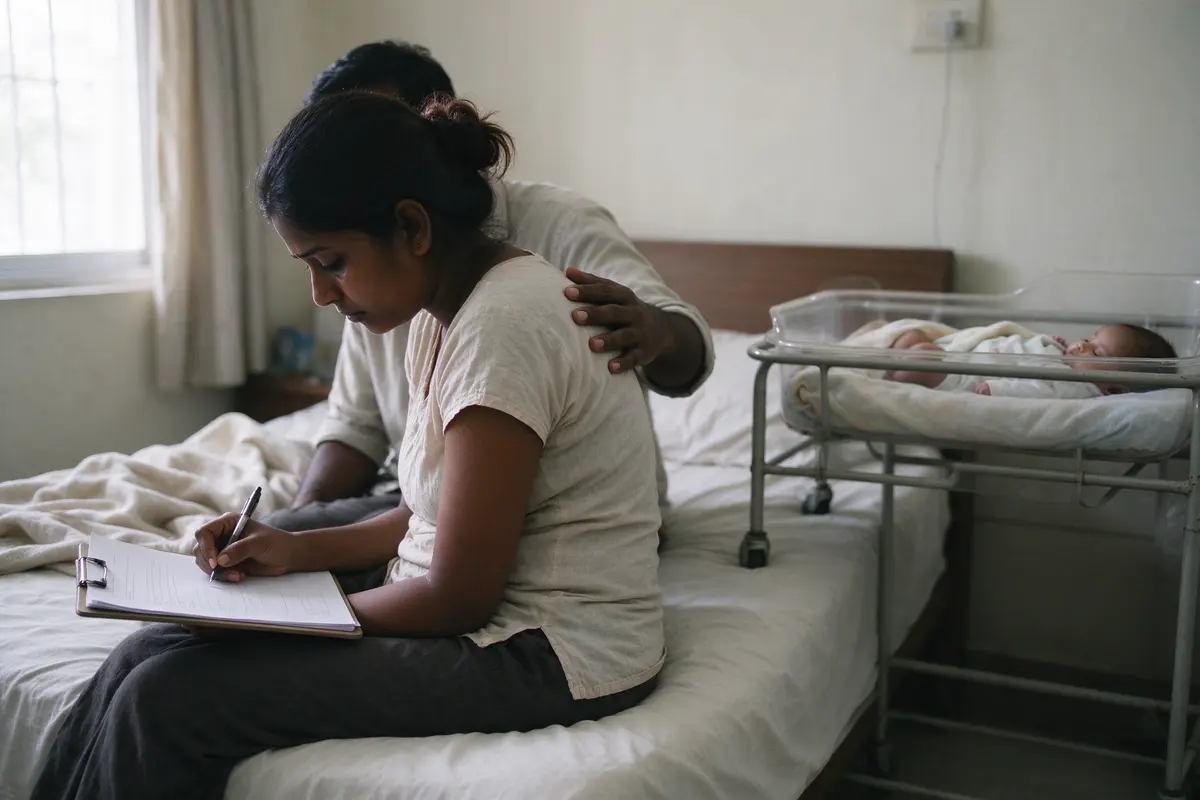
Answer the screen honestly; perinatal depression can be treated effectively (Earls et al., 2019). If a sentence helps: "I'm not sleeping even when the baby sleeps, and I feel numb. Is that normal?" About 1 in 8 women report symptoms of postpartum depression after a birth (CDC). If sadness has lasted more than two weeks, go to the doctor; don't wait for the postpartum visit (OWH).
If you're the partner: come if you can; one adult holds, the other asks. The screen isn't for you, but about 10% of fathers have depression around a birth (Paulson & Bazemore, 2010), so tell the pediatrician how you're doing too.
Sources
- American Academy of Pediatrics. "Checkup Checklist: 2 Months Old." HealthyChildren.org, 2021. https://www.healthychildren.org/English/ages-stages/Your-Childs-Checkups/Pages/Your-Checkup-Checklist-2-Months-Old.aspx
- American Academy of Pediatrics and Bright Futures. "Recommendations for Preventive Pediatric Health Care" (Periodicity Schedule). 2025. https://downloads.aap.org/AAP/PDF/periodicity_schedule.pdf
- Bracho-Sánchez E. "AAP Guide: Vaccines Your Child Needs by Age 6." HealthyChildren.org, 2026. https://www.healthychildren.org/English/safety-prevention/immunizations/Pages/Your-Babys-First-Vaccines.aspx
- American Academy of Pediatrics. "AAP Releases RSV Immunization Recommendations for 2026-2027 Season." HealthyChildren.org, 2026. https://www.healthychildren.org/English/news/Pages/aap-updates-rsv-immunization-recommendations-for-2026-2027-season.aspx
- American Academy of Pediatrics. "AAP Releases Recommended Childhood and Adolescent Immunization Schedule for 2026." HealthyChildren.org, 2026. https://www.healthychildren.org/English/news/Pages/AAPs-recommended-childhood-and-adolescent-immunization-schedule-for-2026.aspx
- STAT. "HHS appeals ruling that stalled many of Kennedy's vaccine policy changes." 2026. https://www.statnews.com/2026/04/29/hhs-appealing-acip-vaccine-policy-lawsuit-ruling/
- Harrington JW, Logan S, Harwell C, et al. "Effective analgesia using physical interventions for infant immunizations." Pediatrics, 2012. https://pubmed.ncbi.nlm.nih.gov/22508924/
- Moon RY. "How to Keep Your Sleeping Baby Safe: AAP Policy Explained." HealthyChildren.org, 2026. https://www.healthychildren.org/English/ages-stages/baby/sleep/Pages/a-parents-guide-to-safe-sleep.aspx
- American Academy of Pediatrics. "Swaddling: Is it Safe for Your Baby?" HealthyChildren.org, 2022. https://www.healthychildren.org/English/ages-stages/baby/diapers-clothing/Pages/Swaddling-Is-it-Safe.aspx
- American Academy of Pediatrics. "Shaken Baby Syndrome: Protect Your Infant from Abusive Head Trauma." HealthyChildren.org, 2025. https://www.healthychildren.org/English/safety-prevention/at-home/Pages/Abusive-Head-Trauma-Shaken-Baby-Syndrome.aspx
- American Academy of Pediatrics. "Crying Baby - Before 3 Months Old" (symptom checker). HealthyChildren.org, 2026. https://www.healthychildren.org/English/tips-tools/symptom-checker/Pages/symptomviewer.aspx?symptom=Crying+Baby+-+Before+3+Months+Old
- Nationwide Children's Hospital. "Newborn Warning Signs." 2023. https://www.nationwidechildrens.org/conditions/health-library/newborn-warning-signs
- American Academy of Pediatrics. "Fever and Your Baby." HealthyChildren.org, 2025. https://www.healthychildren.org/English/health-issues/conditions/fever/Pages/Fever-and-Your-Baby.aspx
- Earls MF, Yogman MW, Mattson G, Rafferty J. "Incorporating Recognition and Management of Perinatal Depression Into Pediatric Practice." Pediatrics, 2019. https://pubmed.ncbi.nlm.nih.gov/30559120/
- Centers for Disease Control and Prevention. "Symptoms of Depression Among Women." 2024. https://www.cdc.gov/reproductive-health/depression/index.html
- Office on Women's Health. "Recovering from birth." US Department of Health and Human Services. https://womenshealth.gov/pregnancy/childbirth-and-beyond/recovering-birth
- Paulson JF, Bazemore SD. "Prenatal and postpartum depression in fathers and its association with maternal depression: a meta-analysis." JAMA, 2010. https://pubmed.ncbi.nlm.nih.gov/20483973/
This guide is general education that summarizes published research and guidance from groups like the American Academy of Pediatrics, the CDC, and the WHO. It isn’t medical advice, and every child develops on their own timeline. Your pediatrician knows your child; if something feels wrong, call them. In an emergency, call 911.
Get each day’s note the morning it applies
Add your baby to a free Chorevia household with their date of birth, and every morning for 60 days the day’s note arrives in the app and by email: what’s developing, one thing to try, what to watch for, and a word for you.
Create your household