Day 33 of 60 · Week 5
Tummy time, four ways
Last reviewed · 3 min read · 11 sources · Plain-text version
Heads come up this month. Why tummy time matters now, how common flat spots are and how mild, and four positions so that short sessions add up.

Head up. Sometime this month most babies lift their head on their tummy, and today is about getting there in sessions short enough to fit a real day.
Heart
Head
Why bother: a systematic review of mostly observational studies linked tummy time to better gross motor development and less flattening at the back of the head (Hewitt et al., 2020), and the AAP and WHO both recommend it (AAP; WHO).
Flat spots are common. Nearly half of 440 healthy babies checked at 7 to 12 weeks in Calgary had some head flattening, mostly mild (Mawji et al., 2013). The AAP says positional flattening doesn't affect brain growth or intellectual development, and that it most often develops in the first 4 to 12 weeks (AAP), so now is the easy time to prevent it.
Body
The AAP's plan: start with 3 to 5 minutes, 2 to 3 times a day, and work up to 15 to 30 minutes a day by 7 weeks (AAP). Also alternate the arm you hold and feed with, and limit time in car seats, bouncers, and swings (AAP). Never leave a baby on their tummy unwatched; if they fall asleep, move them to their back in their own sleep space (AAP).
Try today

Tummy time, four ways
Time: 3 to 5 minutes, several times a day · Tummy time, four ways in the guide
Chest: while you're awake and reclined, lay your baby tummy-down on you and talk so they lift their head.
Lap: lay your baby tummy-down across your thighs and rub their back.
Floor: on a firm, flat surface, get face to face or put a toy just out of reach.
Side: if your baby protests, lay them on their side with a rolled towel behind their back (AAP).
Make it work:Several short sessions count toward the daily total. The AAP suggests changing your baby's position every 10 to 15 minutes during playtime (AAP). The towel is for awake play only; for sleep, the surface is bare.
Watch for
Normal
complaining a minute in, then settling on your lap.
Tell your pediatrician
if your baby can't hold their head up at all when on their tummy by the 2-month checkup (CDC).
Normal
pushing with both arms and kicking with both legs.
Bring it up
if your baby doesn't move both arms and both legs, or uses only one side (AAP).
Normal
a slightly flatter patch at the back of the head.
Mention a flat spot or a head tilt at the checkup
; a tight neck is often noticed in the first 6 to 8 weeks, and early stretching matters (AAP).
For you
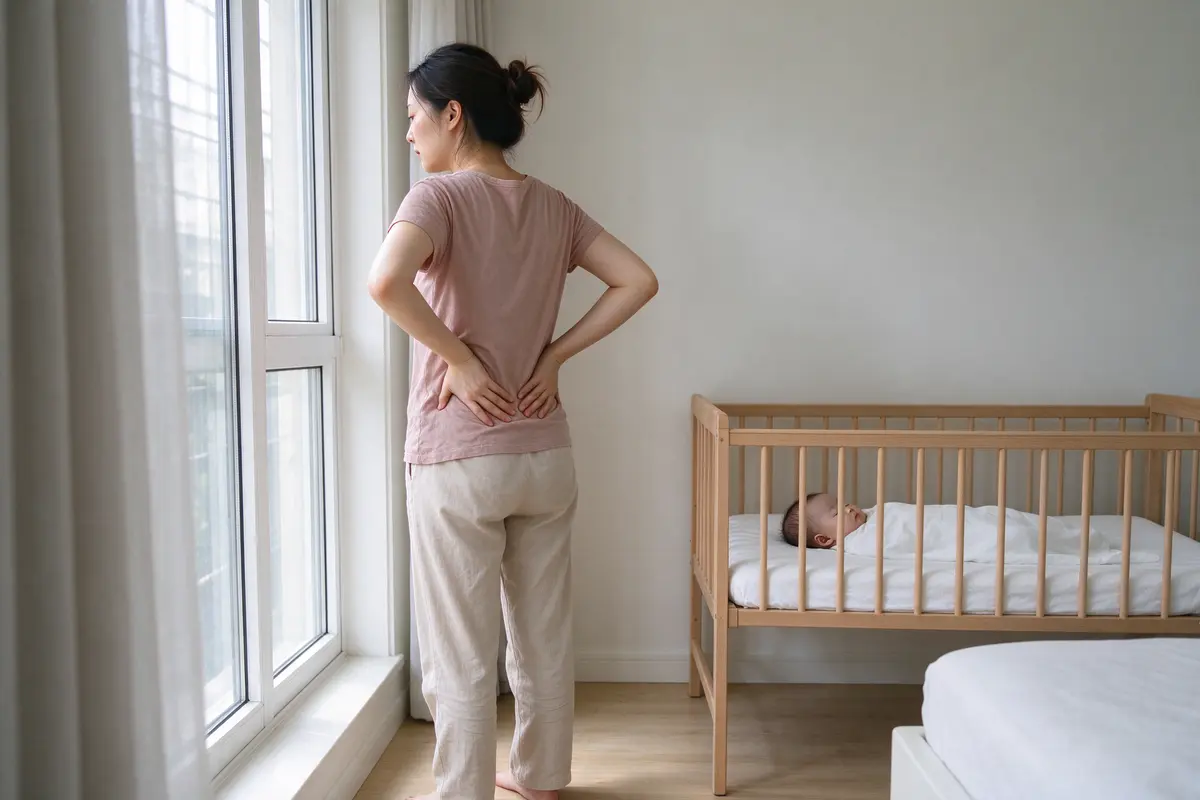
Your neck and back are doing tummy time too. Change your own position as often as the baby's. Get down to the floor by bending at the knees, not the waist, the AAP's rule for picking things up while carrying (AAP), and lie beside the baby rather than leaning over them.
If you had a C-section: don't lift anything heavier than your baby for the first 6 to 8 weeks, and expect most regular activities to come back in 4 to 8 weeks (MedlinePlus). Walking helps healing and helps prevent clots (MedlinePlus). The floor is fine; the laundry basket isn't yet.
If you're the partner: floor sessions are yours whenever you're home. Your face works as well as hers.
Sources
- Centers for Disease Control and Prevention. "Milestones by 2 Months." Learn the Signs. Act Early. program, updated 2026. https://www.cdc.gov/act-early/milestones/2-months.html
- American Academy of Pediatrics. "Movement Milestones: Birth to 3 Months." HealthyChildren.org, updated 2020. https://www.healthychildren.org/English/ages-stages/baby/Pages/Movement-Birth-to-Three-Months.aspx
- Hewitt L, Kerr E, Stanley RM, Okely AD. "Tummy Time and Infant Health Outcomes: A Systematic Review." Pediatrics, 2020. https://pubmed.ncbi.nlm.nih.gov/32371428/
- American Academy of Pediatrics. "3 Tummy Time Activities to Try With Your Baby." HealthyChildren.org, updated 2023. https://www.healthychildren.org/English/ages-stages/baby/sleep/Pages/The-Importance-of-Tummy-Time.aspx
- World Health Organization. "To grow up healthy, children need to sit less and play more." 2019. https://www.who.int/news/item/24-04-2019-to-grow-up-healthy-children-need-to-sit-less-and-play-more
- Mawji A, Vollman AR, Hatfield J, et al. "The incidence of positional plagiocephaly: a cohort study." Pediatrics, 2013. https://pubmed.ncbi.nlm.nih.gov/23837184/
- American Academy of Pediatrics. "When a Baby's Head is Misshapen: Positional Skull Deformities." HealthyChildren.org, updated 2022. https://www.healthychildren.org/English/health-issues/conditions/Cleft-Craniofacial/Pages/Positional-Skull-Deformities-and-Torticollis.aspx
- American Academy of Pediatrics. "Back to Sleep, Tummy to Play." HealthyChildren.org, updated 2026. https://www.healthychildren.org/English/ages-stages/baby/sleep/Pages/back-to-sleep-tummy-to-play.aspx
- American Academy of Pediatrics. "Head Tilt (Torticollis)." HealthyChildren.org, updated 2020. https://www.healthychildren.org/English/health-issues/conditions/Cleft-Craniofacial/Pages/Head-Tilt.aspx
- American Academy of Pediatrics. "Baby Carriers: Backpacks, Front Packs & Slings." HealthyChildren.org, updated 2025. https://www.healthychildren.org/English/safety-prevention/on-the-go/Pages/Baby-Carriers.aspx
- MedlinePlus. "Going home after a C-section." National Library of Medicine. https://medlineplus.gov/ency/patientinstructions/000624.htm
This guide is general education that summarizes published research and guidance from groups like the American Academy of Pediatrics, the CDC, and the WHO. It isn’t medical advice, and every child develops on their own timeline. Your pediatrician knows your child; if something feels wrong, call them. In an emergency, call 911.
Get each day’s note the morning it applies
Add your baby to a free Chorevia household with their date of birth, and every morning for 60 days the day’s note arrives in the app and by email: what’s developing, one thing to try, what to watch for, and a word for you.
Create your household