Day 45 of 60 · Week 7
Bath time
Last reviewed · 3 min read · 8 sources · Plain-text version
Tub baths are routine by seven weeks: two inches of water, one hand on the baby, three a week is plenty. Plus cradle cap, baby acne, and a long shower for you.

By seven weeks the cord stump is long gone and baths have stopped being an event. Today: the rules that still hold, two skin things you'll probably see, and a long shower for you.
Heart
A warm bath is on the AAP's list of ways to soothe a crying baby (AAP). It's also one of the easiest places to talk to your baby: they're awake, undressed, and looking straight at you. Naming body parts as you wash is language and touch at the same time.
Head
The firm rules haven't moved. About 2 inches of warm, not hot, water, tested with the inside of your wrist or elbow. One hand on your baby the whole time. Never alone in the bath, even for an instant (AAP). Three baths a week may be enough, since bathing more often can dry out the skin (AAP). Gather everything before you start so you never have to step away.
Body
Two things you may see. Cradle cap, a scaly scalp rash, usually starts between 3 weeks and 2 months; washing every other day with a mild baby shampoo helps (AAP). Baby acne is common, can last until 4 to 6 months, and needs no treatment; oils and creams can make it worse (AAP). Neither is a reason to scrub harder.
Try today

Bath-time chat
Time: 5 to 10 minutes, a few times a week · Bath-time chat in the guide
Fill the tub with about 2 inches of warm water and test it with your wrist or elbow (AAP).
Keep one hand on your baby, supporting the head and shoulders (AAP).
Name body parts as you wash: "Here's your hand. Here are your toes."
Pause between phrases; if they coo or kick, answer.
Lift out, pat dry, and dress before they get cold.
Make it work:If the phone rings, it rings. Never leave your baby alone in the bath (AAP).
Watch for
Normal
flakes on the scalp and pimples on the cheeks.
Call your pediatrician right away
about tiny blisters, purple or blood-colored spots, infected-looking skin, or a rash with a fever (AAP).
Normal
cool skin straight out of the water that warms once dressed and held.
Call your pediatrician right away
for a rectal temperature below 96.8°F (36.0°C) that doesn't come up with warming (Seattle Children's).
Normal
a baby who hates the bath and cries through it.
Call your pediatrician right away
if your baby cries and can't be comforted in a way that's new or worries you (Nationwide Children's).
For you
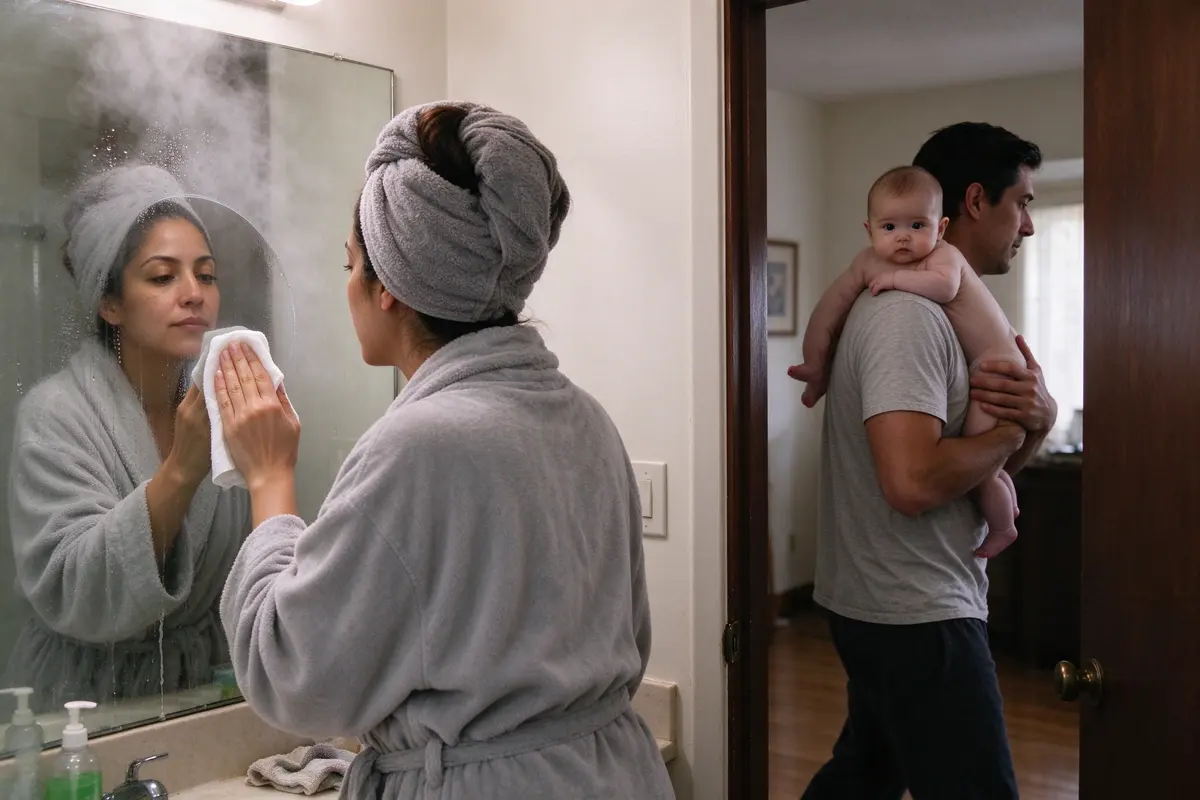
Your turn. A long shower, door closed, with someone else holding the baby. If you had a C-section, soaking in a tub was off the table until your provider said otherwise, usually about 3 weeks, and the incision can stay tender for 3 weeks or more (MedlinePlus). At seven weeks that's usually behind you; if nobody has cleared you, ask. Call about any redness, warmth, swelling, drainage, or opening at the incision (MedlinePlus). After a vaginal birth, discharge that gets heavier or smells foul is a call too (MedlinePlus).
If you're the partner: bath duty is a good one to own. It's ten minutes of the baby's full attention, and her ten minutes of hot water.
Sources
- American Academy of Pediatrics. "Responding to Your Baby's Cries." HealthyChildren.org, 2025. https://www.healthychildren.org/English/ages-stages/baby/crying-colic/Pages/Responding-to-Your-Babys-Cries.aspx
- Navsaria D. "Bathing Your Baby." HealthyChildren.org, 2025. https://www.healthychildren.org/English/ages-stages/baby/bathing-skin-care/Pages/Bathing-Your-Newborn.aspx
- Stein S. "What is Cradle Cap?" HealthyChildren.org, 2023. https://www.healthychildren.org/English/ages-stages/baby/bathing-skin-care/Pages/Cradle-Cap.aspx
- American Academy of Pediatrics. "Newborn Rashes and Birthmarks" (symptom checker). HealthyChildren.org, 2026. https://www.healthychildren.org/English/tips-tools/symptom-checker/Pages/symptomviewer.aspx?symptom=Newborn+Rashes+and+Birthmarks
- Seattle Children's Hospital. "Newborn Illness - How to Recognize." https://www.seattlechildrens.org/conditions/a-z/newborn-illness---how-to-recognize/
- Nationwide Children's Hospital. "Newborn Warning Signs." 2023. https://www.nationwidechildrens.org/conditions/health-library/newborn-warning-signs
- MedlinePlus. "Going home after a C-section." National Library of Medicine. https://medlineplus.gov/ency/patientinstructions/000624.htm
- MedlinePlus. "Vaginal delivery - discharge." National Library of Medicine. https://medlineplus.gov/ency/patientinstructions/000628.htm
This guide is general education that summarizes published research and guidance from groups like the American Academy of Pediatrics, the CDC, and the WHO. It isn’t medical advice, and every child develops on their own timeline. Your pediatrician knows your child; if something feels wrong, call them. In an emergency, call 911.
Get each day’s note the morning it applies
Add your baby to a free Chorevia household with their date of birth, and every morning for 60 days the day’s note arrives in the app and by email: what’s developing, one thing to try, what to watch for, and a word for you.
Create your household