Day 47 of 60 · Week 7
Back to work, part one
Last reviewed · 3 min read · 12 sources · Plain-text version
If a return date is on the calendar: your pumping rights under the PUMP Act, practicing bottles now, and the paced way to give one so your baby stays in charge.
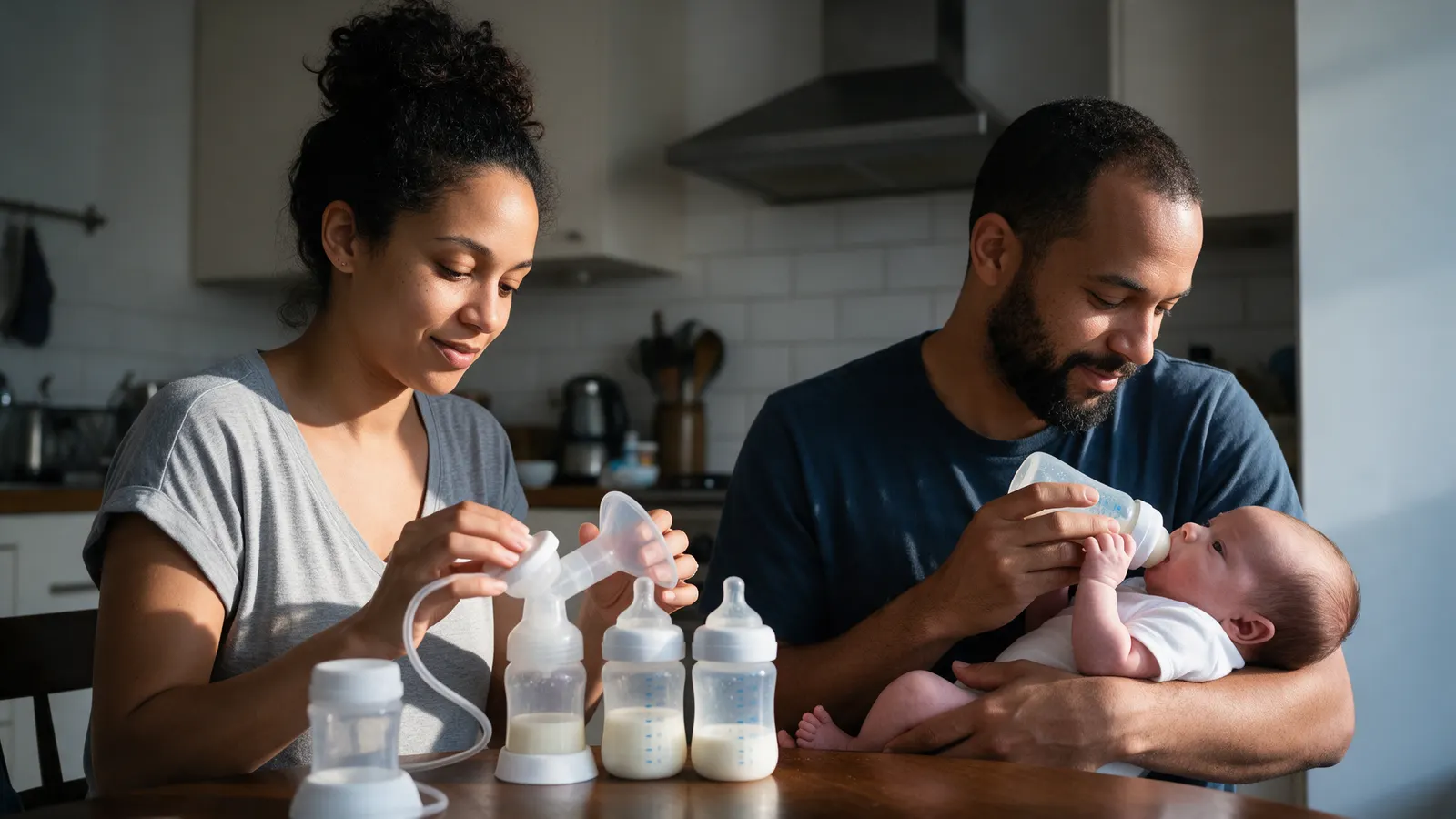
Not everyone goes back to work, and not everyone goes back soon. If you do, the first steps start now, while nothing is due.
Heart
You have rights. The federal PUMP Act requires employers to give reasonable break time to pump for a year after birth, in a private space that isn't a bathroom (CDC). And the CDC's advice for before you go back is practical: practice pumping, and let your baby practice bottles (CDC). Practice means low stakes. One bottle, from someone else, while you're in another room.
Head
Paced bottle feeding keeps your baby in charge of the feed. Hold them close and semi-upright (AAP), angle the bottle so milk flows only when the baby sucks, allow breaks, and stop at fullness cues (CDC). Never prop a bottle (CDC). It's widely taught but lightly tested: in one small study of 29 mothers, paced feeding slowed feeds without changing how much babies drank (Ventura et al., 2025). Full on a bottle looks like getting fidgety or easily distracted (AAP); stop when your baby turns away or seems full, even if the bottle isn't empty (CDC).
Body
Two housekeeping lines. If your baby gets any breast milk, keep giving 400 IU of vitamin D a day (AAP). And if child care is part of the plan, ask whether the program is licensed; for babies 12 months and younger, the AAP recommends no more than 3 babies per caregiver and no more than 6 in a group (AAP). That's part two. Today is the bottle.
Try today

Practice pump and bottle
Time: One feed, with you out of the room · Going back to work in the guide
Pump at the time of a feed you'd miss at work, and set the bottle aside.
Hand it to someone else, and go: another room, or outside.
Every so often, they tip the bottle down for a break (CDC).
Make it work:A refused bottle on the first try is normal. Try again another day, with a different person or at a different time. Never prop the bottle (CDC).
Watch for
Normal
a baby who takes less from the bottle than you expected.
Call your pediatrician within a day
if your baby isn't gaining weight or always seems hungry (AAP).
Normal
a little spit-up after a bottle, flowing out easily.
Call your pediatrician right away
if your baby vomits 2 or more times, not just spit-up (AAP).
Normal
a baby who sucks on their fingers between feeds; CDC suggests letting them, to self-soothe (CDC).
Call your pediatrician right away
for a new weak suck or poor feeding (Nationwide Children's).
For you
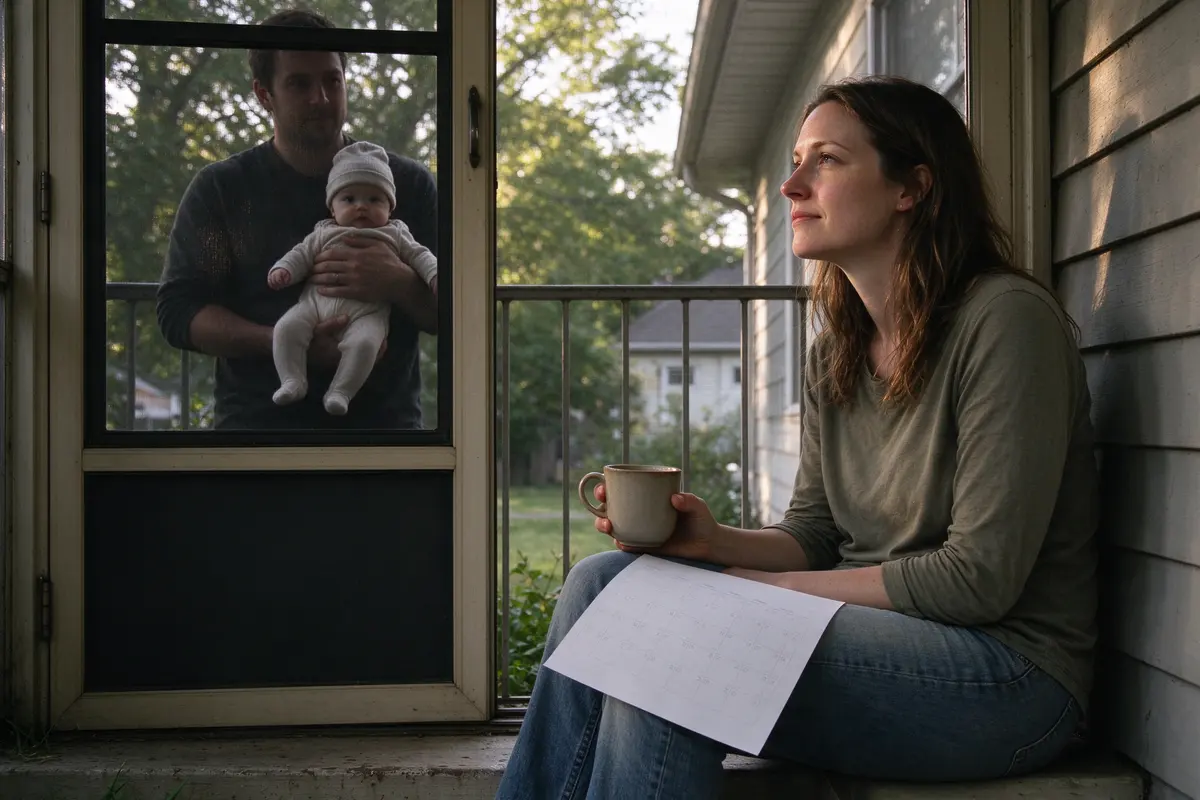
The return date, the plan, the pump. Write the date down, then count backward: when to start saving milk, when to try the first bottle, who gives it. Ask your employer, in writing, where you'll pump and when; the law is on your side (CDC). If you had a C-section, most regular activities come back in 4 to 8 weeks (MedlinePlus); check the date against that, and against how you actually feel.
If the plan is to stop breastfeeding when you go back, or not to pump at all, that's a plan too.
If you're the partner: own the practice bottle. It's the one job here you can do entirely without her.
Sources
- Centers for Disease Control and Prevention. "Breastfeeding and Returning to Your Workplace." 2026. https://www.cdc.gov/infant-toddler-nutrition/breastfeeding/returning-to-your-workplace.html
- American Academy of Pediatrics. "Bottle Feeding Basics." HealthyChildren.org, 2012. https://www.healthychildren.org/English/ages-stages/baby/feeding-nutrition/Pages/Bottle-Feeding-How-Its-Done.aspx
- Centers for Disease Control and Prevention. "About Feeding From a Bottle." 2026. https://www.cdc.gov/infant-toddler-nutrition/bottle-feeding/index.html
- Ventura AK, Drewelow VM, Richardson TN. "Does paced bottle-feeding improve the quality and outcome of bottle-feeding interactions?" Early Human Development, 2025. https://pubmed.ncbi.nlm.nih.gov/39693774/
- American Academy of Pediatrics. "Amount and Schedule of Baby Formula Feedings." HealthyChildren.org, 2022. https://www.healthychildren.org/English/ages-stages/baby/formula-feeding/Pages/amount-and-schedule-of-formula-feedings.aspx
- American Academy of Pediatrics Section on Gastroenterology, Hepatology and Nutrition. "Vitamin D for Babies, Children & Adolescents." HealthyChildren.org, 2022. https://www.healthychildren.org/English/healthy-living/nutrition/Pages/vitamin-d-on-the-double.aspx
- American Academy of Pediatrics. "Choosing a Child Care Center." HealthyChildren.org, 2022. https://www.healthychildren.org/English/family-life/work-and-child-care/Pages/choosing-a-child-care-center.aspx
- American Academy of Pediatrics. "Crying Baby - Before 3 Months Old" (symptom checker). HealthyChildren.org, 2026. https://www.healthychildren.org/English/tips-tools/symptom-checker/Pages/symptomviewer.aspx?symptom=Crying+Baby+-+Before+3+Months+Old
- American Academy of Pediatrics. "Vomiting Without Diarrhea" (symptom checker). HealthyChildren.org, 2026. https://www.healthychildren.org/English/tips-tools/symptom-checker/Pages/symptomviewer.aspx?symptom=Vomiting+Without+Diarrhea
- Centers for Disease Control and Prevention. "Milestones by 2 Months." Learn the Signs. Act Early., 2026. https://www.cdc.gov/act-early/milestones/2-months.html
- Nationwide Children's Hospital. "Newborn Warning Signs." 2023. https://www.nationwidechildrens.org/conditions/health-library/newborn-warning-signs
- MedlinePlus. "Going home after a C-section." National Library of Medicine. https://medlineplus.gov/ency/patientinstructions/000624.htm
This guide is general education that summarizes published research and guidance from groups like the American Academy of Pediatrics, the CDC, and the WHO. It isn’t medical advice, and every child develops on their own timeline. Your pediatrician knows your child; if something feels wrong, call them. In an emergency, call 911.
Get each day’s note the morning it applies
Add your baby to a free Chorevia household with their date of birth, and every morning for 60 days the day’s note arrives in the app and by email: what’s developing, one thing to try, what to watch for, and a word for you.
Create your household