Day 48 of 60 · Week 7
Toys and attention
Last reviewed · 3 min read · 12 sources · Plain-text version
Looking at a toy for several seconds is a 2-month milestone. Today: the floor, one bold toy, the right distance, and why nothing ever goes in the crib.

Looking at a toy for several seconds is on CDC's 2-month list (CDC). It's a small thing with a big name: attention. Today: where to play, what to hold up, and how far away.
Heart
Your face is still the best toy. Newborns prefer the human face to other patterns (AAP), and watching you as you move is a 2-month milestone too (CDC). But somewhere around now a bright object can hold your baby's gaze as well. Both are attention, and attention is what the rest of learning gets built on.
Head
Distance and contrast matter. Newborns see best at 8 to 12 inches (AAP), and babies under 5 days old already looked longer at black-and-white patterns than at plain colored surfaces (Fantz, 1963). By about 8 weeks, babies focus more easily on nearby faces (AOA), and their eyes are starting to follow moving objects (AAP). The AAP expects a baby to follow a moving object by about 3 months (AAP), so a toy that gets a long look today may get followed next month.
Body
The place is the floor: a firm, flat surface, face to face or with a toy just out of reach (AAP). Change your baby's position every 10 to 15 minutes during playtime and stay with them the whole time (AAP). Not the swing or the seat for long: limit time in car seats, bouncers, and swings (AAP), and WHO advises not keeping babies strapped in a carrier or stroller more than 1 hour at a time (WHO). And never the crib: a bare crib means a fitted sheet only, with no toys (AAP).
Try today
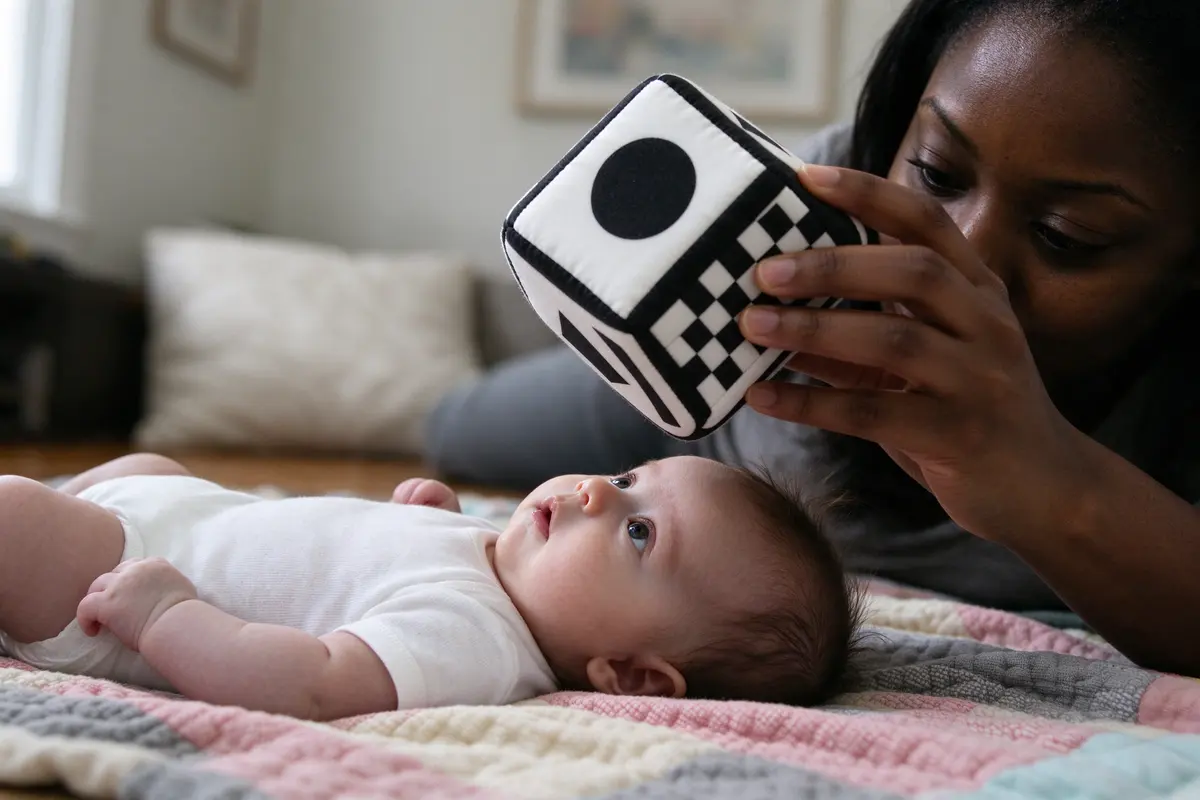
Toy watching on the mat
Time: 2 to 5 minutes · What's developing in the guide
Spread a blanket on the floor, lay your baby on their back, and get down there with them.
Hold one bold toy, like a black-and-white block or a red ring, 8 to 12 inches above their face (AAP).
Hold it still and count how long they look. Several seconds is the milestone (CDC).
Move it slowly to one side, then back.
Swap the toy for your face and talk.
Make it work:One toy at a time, and stop when they look away. Toys stay out of the crib (AAP).
Watch for
Normal
a look that lasts a few seconds, then drifts.
Bring it up now
if your baby doesn't look at your face or watch you as you move (CDC).
Normal
eyes that cross now and then while they try to track; that should fade by 2 to 3 months.
Tell your pediatrician
if the eyes often cross or wander, or your baby isn't following a moving object by 3 months (AAP).
Normal
a day with less interest in anything, usually tiredness.
Go to the ER now
if your baby isn't alert when awake, or seems "out of it" (AAP).
For you
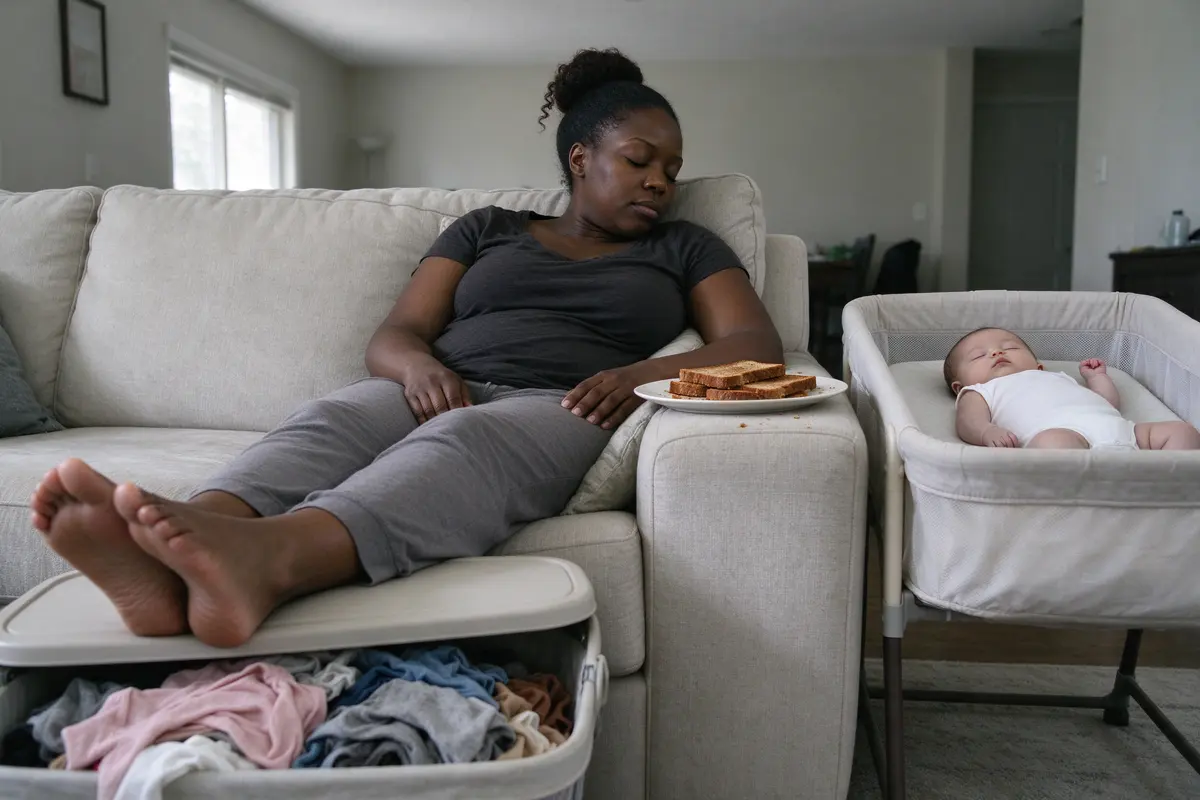
The house doesn't need to be tidy for this. It needs one blanket-sized patch of clear floor. The laundry can stay in the basket, the dishes can stay in the sink, and the baby will not notice either. If a visitor would, that's a visitor problem. One line to keep: overwhelming tiredness, the kind that goes beyond ordinary new-parent tired, is on the CDC's list of urgent maternal warning signs; seek care if that is what this is (CDC).
Seven weeks in, the gap between the house you imagined and the house you have is normal. Sit on the floor anyway.
If you're the partner: your job tonight is the floor, not the vacuum. Lie down across from the baby and let her sit on the sofa with her feet up.
Sources
- Centers for Disease Control and Prevention. "Milestones by 2 Months." Learn the Signs. Act Early., 2026. https://www.cdc.gov/act-early/milestones/2-months.html
- American Academy of Pediatrics. "Developmental Milestones at 1 Month Old." HealthyChildren.org, 2026. https://www.healthychildren.org/English/ages-stages/baby/Pages/Developmental-Milestones-1-Month.aspx
- American Academy of Pediatrics. "Infant Vision Development: What Can Babies See?" HealthyChildren.org, 2024. https://www.healthychildren.org/English/ages-stages/baby/Pages/Babys-Vision-Development.aspx
- Fantz RL. "Pattern Vision in Newborn Infants." Science, 1963. https://pubmed.ncbi.nlm.nih.gov/17788054/
- American Optometric Association. "Infant Vision: Birth to 24 Months of Age." https://www.aoa.org/healthy-eyes/eye-health-for-life/infant-vision
- American Academy of Pediatrics. "Developmental Milestones: 1-4 Months Old." HealthyChildren.org, 2026. https://www.healthychildren.org/English/ages-stages/baby/Pages/Developmental-Milestones-3-Months.aspx
- American Academy of Pediatrics. "3 Tummy Time Activities to Try With Your Baby." HealthyChildren.org, 2023. https://www.healthychildren.org/English/ages-stages/baby/sleep/Pages/The-Importance-of-Tummy-Time.aspx
- American Academy of Pediatrics. "When a Baby's Head is Misshapen: Positional Skull Deformities." HealthyChildren.org, 2022. https://www.healthychildren.org/English/health-issues/conditions/Cleft-Craniofacial/Pages/Positional-Skull-Deformities-and-Torticollis.aspx
- World Health Organization. "To grow up healthy, children need to sit less and play more." 2019. https://www.who.int/news/item/24-04-2019-to-grow-up-healthy-children-need-to-sit-less-and-play-more
- Moon RY. "How to Keep Your Sleeping Baby Safe: AAP Policy Explained." HealthyChildren.org, 2026. https://www.healthychildren.org/English/ages-stages/baby/sleep/Pages/a-parents-guide-to-safe-sleep.aspx
- American Academy of Pediatrics. "Crying Baby - Before 3 Months Old" (symptom checker). HealthyChildren.org, 2026. https://www.healthychildren.org/English/tips-tools/symptom-checker/Pages/symptomviewer.aspx?symptom=Crying+Baby+-+Before+3+Months+Old
- Centers for Disease Control and Prevention. "Urgent Maternal Warning Signs and Symptoms." HEAR HER campaign. https://www.cdc.gov/hearher/maternal-warning-signs/index.html
This guide is general education that summarizes published research and guidance from groups like the American Academy of Pediatrics, the CDC, and the WHO. It isn’t medical advice, and every child develops on their own timeline. Your pediatrician knows your child; if something feels wrong, call them. In an emergency, call 911.
Get each day’s note the morning it applies
Add your baby to a free Chorevia household with their date of birth, and every morning for 60 days the day’s note arrives in the app and by email: what’s developing, one thing to try, what to watch for, and a word for you.
Create your household