Day 38 of 60 · Week 6
Sleep, without training
Last reviewed · 3 min read · 14 sources · Plain-text version
How much sleep a baby this age needs, why night waking is still expected, what the sleep training research actually studied, and a wind-down you can repeat.
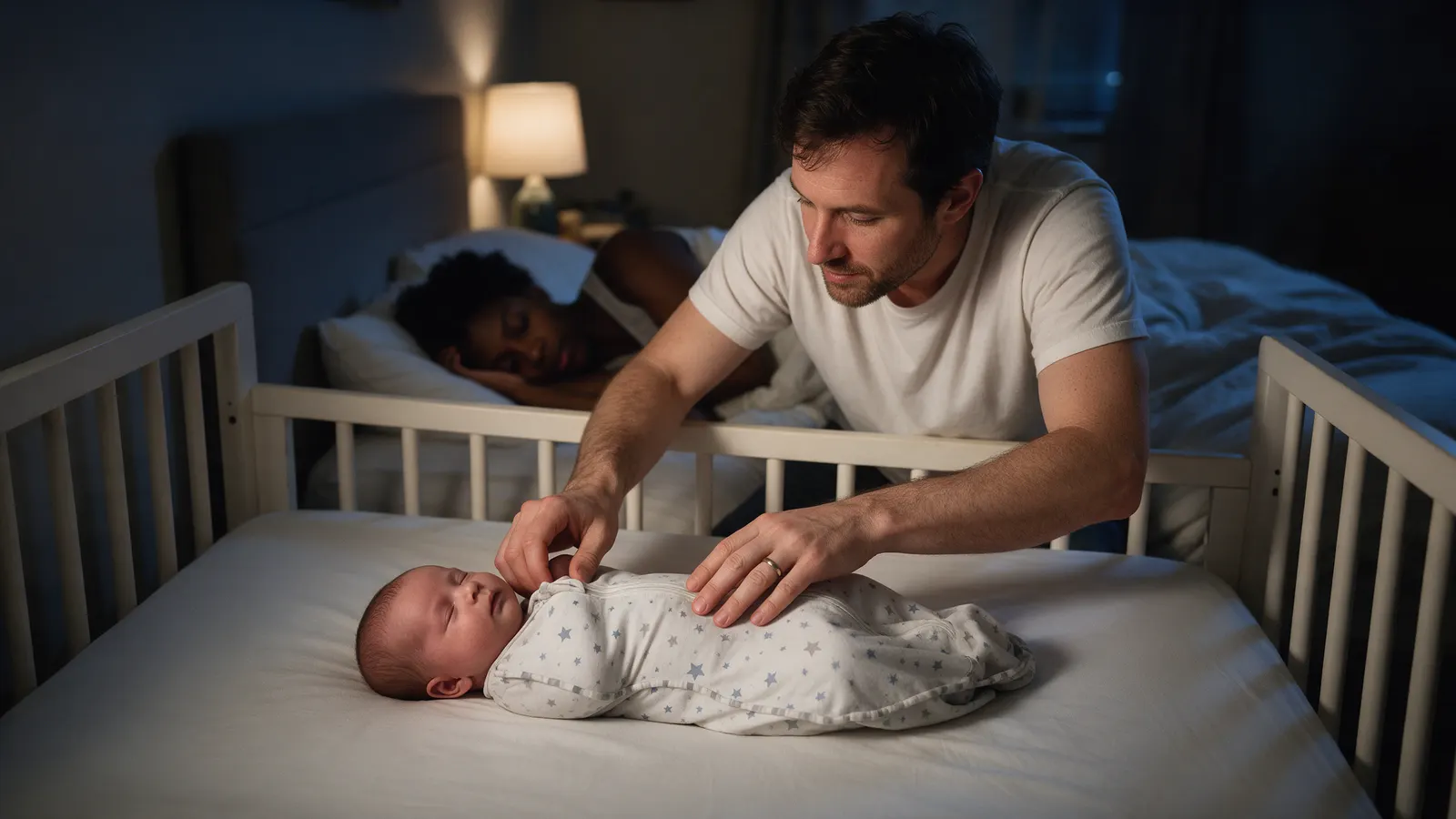
Week six begins, and by now someone has told you to sleep train. Today: what babies this age need, what the research actually studied, and a routine that isn't training.
Heart
Head
It's too early for formal sleep training. The AAP's advice about putting babies down drowsy and not rushing in to soothe is written for babies 4 months and older, and the AAP doesn't name a starting age for sleep training (AAP). A well-known trial taught sleep techniques at 8 to 10 months and found no lasting harms or benefits by age 6 (Price et al., 2012), and one children's hospital says pediatricians generally give the okay at 3 or 4 months (Lurie Children's). None of that research is about a 6-week-old.
Body
What helps now: make days lively and nights boring. Keep nights calm and quiet and save play for daytime (AAP); by day, open the curtains, and at night keep the lights low (NHS). Healthy, growing babies usually don't need waking to eat; check with your pediatrician first (AAP). Safe sleep is unchanged: back for every sleep, a firm, flat surface with nothing else in the crib, your room but never your bed (AAP).
Try today
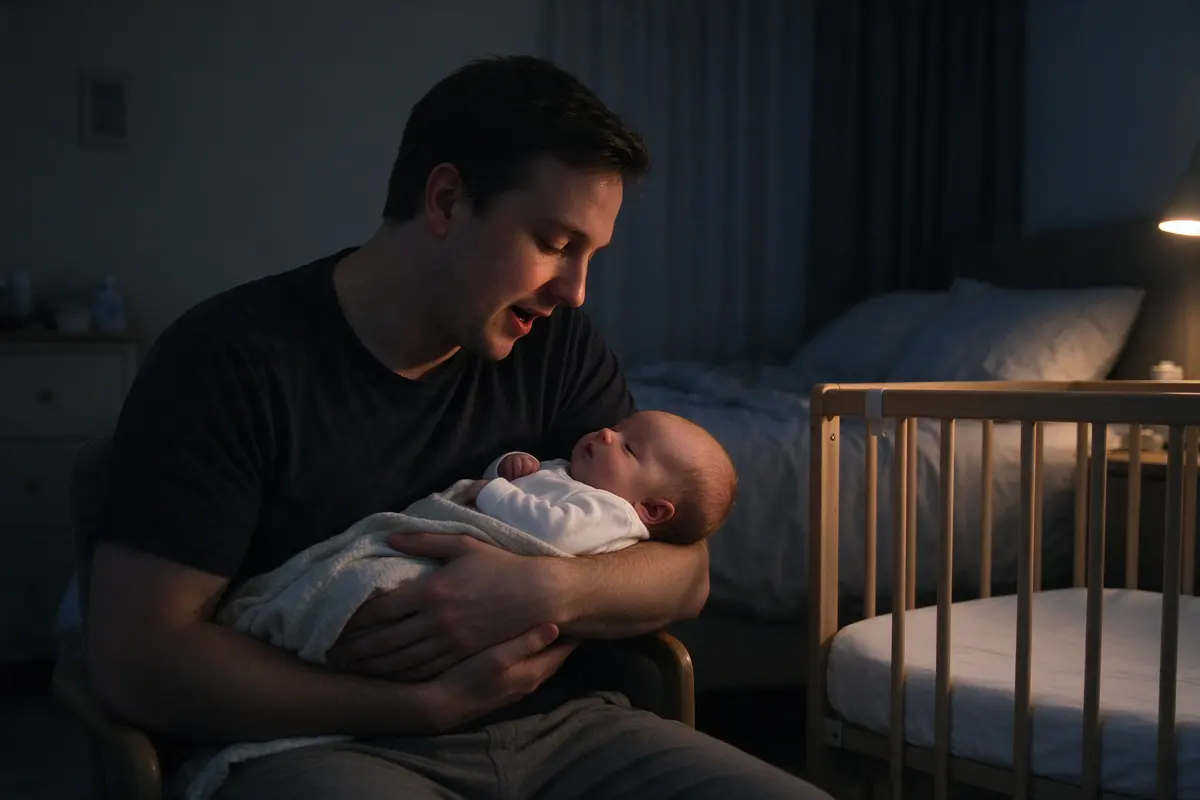
Bedtime wind-down, month two
Time: A few minutes before the night's first long sleep · Bedtime wind-down in the guide
Pick 2 or 3 steps you can repeat: a fresh diaper, a feed, a song.
Dim the lights and keep your voice low.
Do the steps in the same order, at about the same time, each night.
Lay your baby on their back in their own sleep space.
Make it work:A survey of more than 10,000 mothers of children up to age 5 linked consistent bedtime routines with better sleep, but it can't prove cause (Mindell et al., 2015). The NHS suggests steps like a bath, a story, dim lights, and a lullaby (NHS). It's a habit, not a schedule; expect nothing from it tonight.
Watch for
Normal
waking every few hours to feed, around the clock.
Call your pediatrician right away
if your baby drinks very little or nothing for more than 8 hours, or has had no wet diaper in more than 8 hours (AAP).
Normal
stretching, grunting, and shifting in sleep.
Go to the ER now
if pauses in breathing last longer than about 10 seconds, breathing stays faster than 60 breaths a minute, or the ribs pull in with each breath (AAP).
Normal
cool hands at night in a baby whose chest or the back of their neck feels warm when you check (NHS).
Call your pediatrician right away
for a rectal temperature below 96.8°F (36.0°C) that doesn't go up with warming (Seattle Children's).
For you
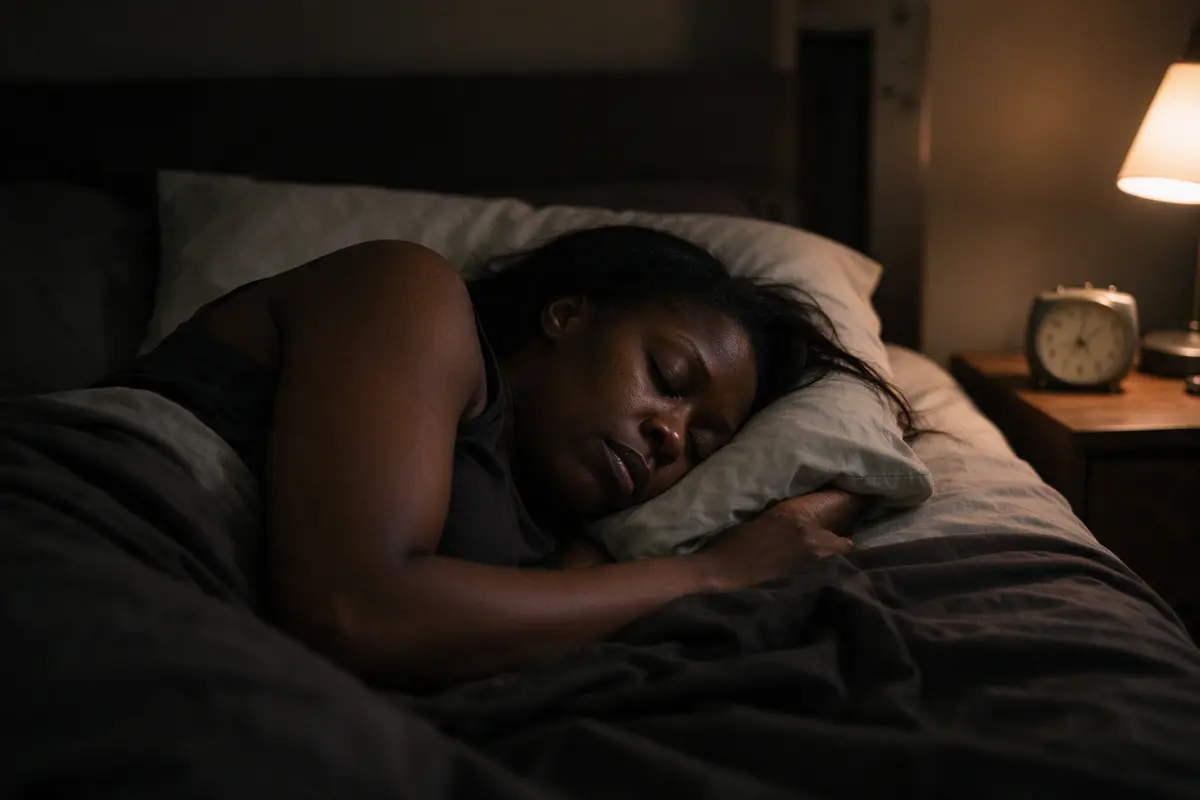
The protected stretch. Split the night so each adult gets one longer stretch of sleep, and say it out loud: "I've got everything until 2 a.m. You sleep. Then we switch." Avoid feeding on a couch or armchair, and if you doze off while feeding, put your baby on their back in their own space as soon as you wake (AAP). The AAP advises against bed-sharing under any circumstances (AAP).
Ordinary exhaustion is expected at six weeks. Overwhelming tiredness is on the CDC's list of urgent maternal warning signs, so if it feels like more than tired, tell a provider (CDC).
If you're the partner: tonight's first shift is yours. Set the alarm, not her.
Sources
- World Health Organization. "To grow up healthy, children need to sit less and play more." 2019. https://www.who.int/news/item/24-04-2019-to-grow-up-healthy-children-need-to-sit-less-and-play-more
- American Academy of Pediatrics. "Getting Your Baby to Sleep." HealthyChildren.org, updated 2024. https://www.healthychildren.org/English/ages-stages/baby/sleep/Pages/getting-your-baby-to-sleep.aspx
- Price AMH, Wake M, Ukoumunne OC, Hiscock H. "Five-year follow-up of harms and benefits of behavioral infant sleep intervention: randomized trial." Pediatrics, 2012. https://pubmed.ncbi.nlm.nih.gov/22966034/
- Freeman I. "How to Sleep Train Your Baby." Lurie Children's Hospital of Chicago, 2022. https://www.luriechildrens.org/en/blog/sleep-training-for-babies/
- National Health Service (UK). "Helping your baby to sleep." Accessed 2026. https://www.nhs.uk/baby/caring-for-a-newborn/helping-your-baby-to-sleep/
- American Academy of Pediatrics. "Sleeping Through the Night." HealthyChildren.org, updated 2013. https://www.healthychildren.org/English/ages-stages/baby/sleep/Pages/Sleeping-Through-the-Night.aspx
- Moon RY. "How to Keep Your Sleeping Baby Safe: AAP Policy Explained." HealthyChildren.org, updated 2026. https://www.healthychildren.org/English/ages-stages/baby/sleep/Pages/a-parents-guide-to-safe-sleep.aspx
- Mindell JA, Li AM, Sadeh A, Kwon R, Goh DY. "Bedtime routines for young children: a dose-dependent association with sleep outcomes." Sleep, 2015. https://pubmed.ncbi.nlm.nih.gov/25325483/
- American Academy of Pediatrics. "Crying Baby - Before 3 Months Old" (symptom checker). HealthyChildren.org, accessed 2026. https://www.healthychildren.org/English/tips-tools/symptom-checker/Pages/symptomviewer.aspx?symptom=Crying+Baby+-+Before+3+Months+Old
- American Academy of Pediatrics. "Breathing Trouble" (symptom checker). HealthyChildren.org, accessed 2026. https://www.healthychildren.org/English/tips-tools/symptom-checker/Pages/symptomviewer.aspx?symptom=Breathing+Trouble
- National Health Service (UK). "Sudden infant death syndrome (SIDS)." 2025. https://www.nhs.uk/conditions/sudden-infant-death-syndrome-sids/
- Seattle Children's Hospital. "Newborn Illness - How to Recognize." https://www.seattlechildrens.org/conditions/a-z/newborn-illness---how-to-recognize/
- Moon RY. "Safe Sleep Tips for Sleep-Deprived New Parents." HealthyChildren.org, updated 2026. https://www.healthychildren.org/English/ages-stages/baby/sleep/Pages/safe-sleep-tips-for-sleep-deprived-parents.aspx
- Centers for Disease Control and Prevention. "Urgent Maternal Warning Signs and Symptoms." HEAR HER campaign. https://www.cdc.gov/hearher/maternal-warning-signs/index.html
This guide is general education that summarizes published research and guidance from groups like the American Academy of Pediatrics, the CDC, and the WHO. It isn’t medical advice, and every child develops on their own timeline. Your pediatrician knows your child; if something feels wrong, call them. In an emergency, call 911.
Get each day’s note the morning it applies
Add your baby to a free Chorevia household with their date of birth, and every morning for 60 days the day’s note arrives in the app and by email: what’s developing, one thing to try, what to watch for, and a word for you.
Create your household