Day 40 of 60 · Week 6
Your face, when it stops
Last reviewed · 3 min read · 8 sources · Plain-text version
The still-face experiment shows babies from about one month notice when you stop responding. A two-second version to play, and why the return is what matters.

Today's note is about an experiment, and about the ordinary moments when your attention drifts. Both end the same way: with you coming back.
Heart
In the "still-face" experiment, a parent briefly goes expressionless. A review of more than 80 still-face studies found that babies smile less, look away more, and get more upset, and that the effect shows up from about 1 month of age (Mesman et al., 2009). Your baby is tuned to your face. That isn't pressure. It's proof that the thousand small responses you've made since birth have landed.
Head
Why responses matter so much: when a baby coos, cries, or gazes and an adult responds with eye contact, words, or a hug, those exchanges help build neural connections, and consistently missing responses can disrupt development (Harvard Center on the Developing Child). The AAP says responding quickly and with enthusiasm tells your baby they're important, they can trust you, and they have some control over their world (AAP). Nobody responds every time. The research is about patterns, not moments.
Body
In the lab, the still face lasts a couple of minutes and the baby works hard to get the parent back. Today's game shrinks the pause to a breath and makes the return the whole point. It is not the experiment. If your baby fusses at any pause, the game is over for today. Looking away or fussing can mean "done for now" (Harvard Center on the Developing Child), and that ending is the baby's to call.
Try today
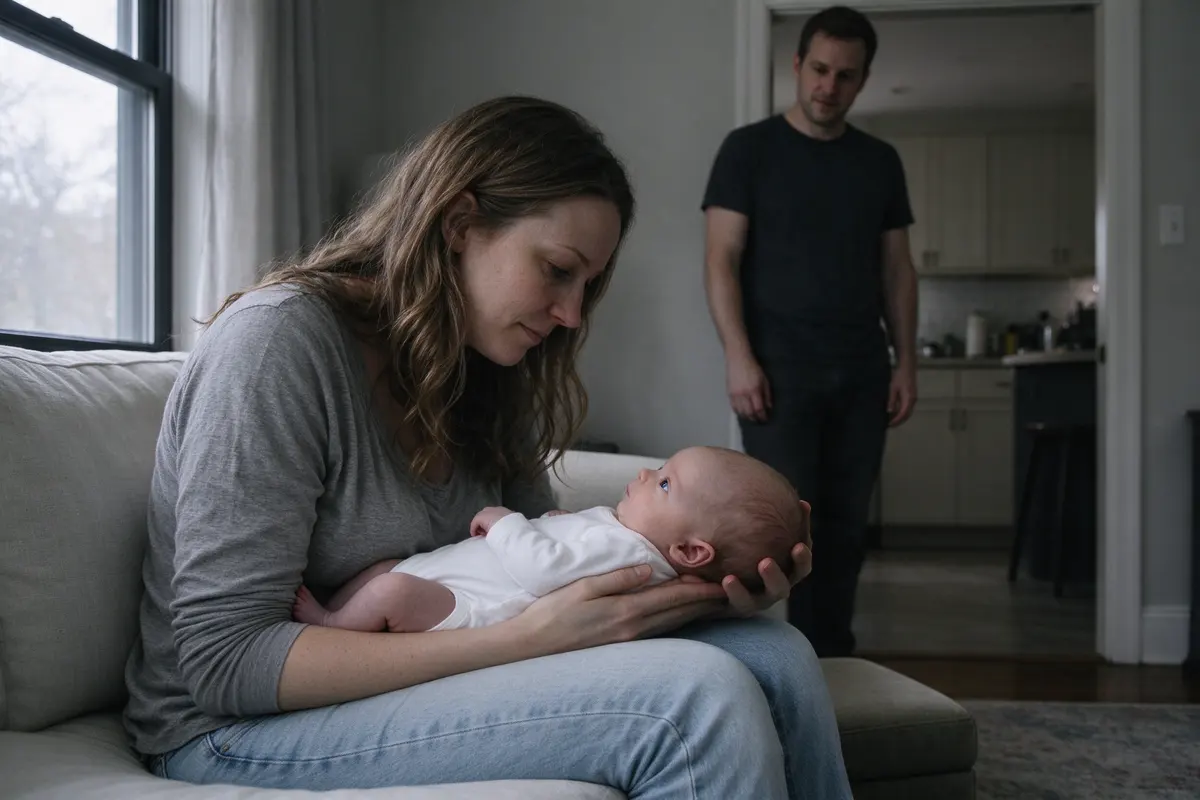
The pause-and-return game
Time: 2 to 3 minutes, when your baby is alert and calm · Smile conversations in the guide
Get face to face and talk, smile, and raise your eyebrows, as in smile conversations.
Go quiet and still for two or three seconds, no longer.
Come back big: a wide smile, "Here I am!", a gentle touch.
Watch what your baby does at the return, and stop the game if they fuss.
Make it work:Still-face studies show babies from about 1 month notice when a parent stops responding (Mesman et al., 2009); the point here is the coming back. Never longer than a few seconds, never when your baby is already upset, and let looking away mean "done for now."
Watch for
- Normal: looking away mid-game; it can mean "done for now" (Harvard Center on the Developing Child). Tell your pediatrician if your baby has lost skills they used to have (CDC).
- Normal: a baby who takes a few tries to settle. Bring it up if your baby doesn't calm down when spoken to or picked up (CDC).
- Normal: a drowsy, hard-to-engage baby after a feed. Call 911 if your baby can't be woken up (AAP).
- Trust your instincts. If your baby just doesn't seem right to you, call (Lurie Children's).
For you
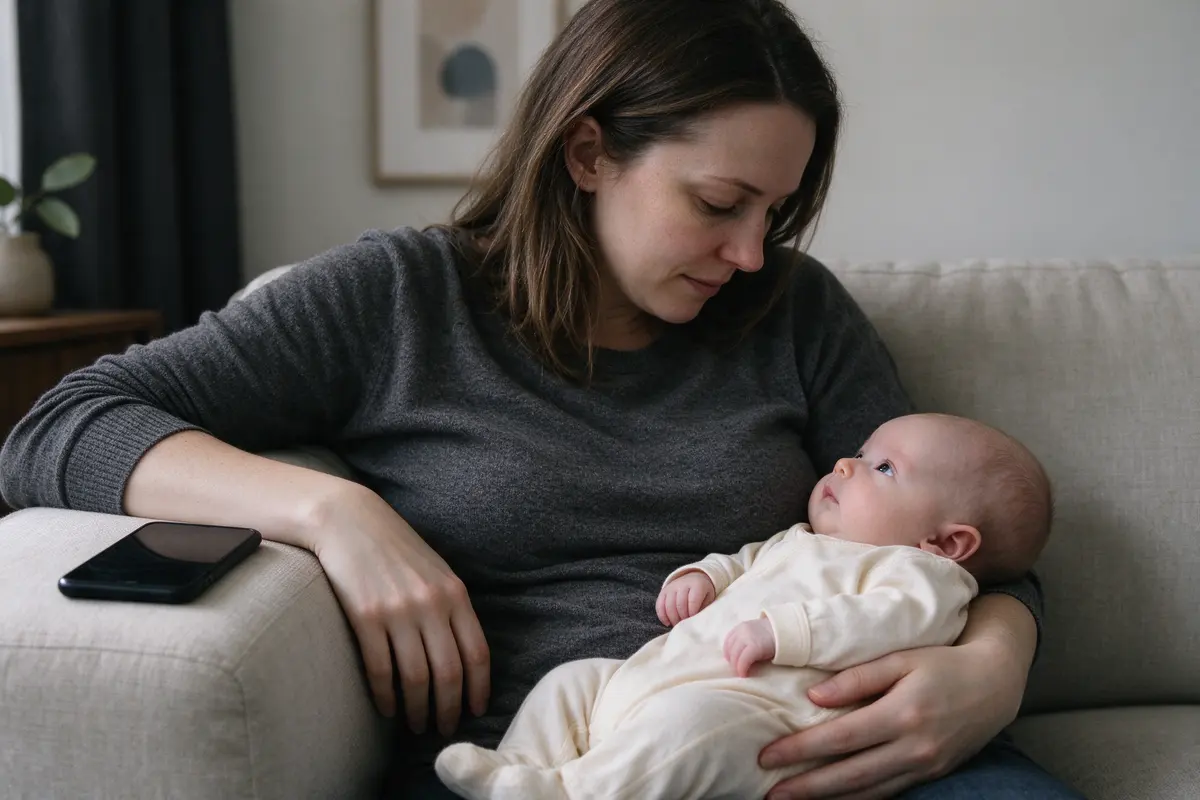
Scrolling with the baby in your lap is normal. The phone is how you stay a person this month: it's the friend, the nurse line, the grocery order. The AAP's caution is about patterns: background TV or your phone can crowd out the face-to-face time babies learn from (AAP), and the research above is about missing responses consistently, not once (Harvard Center on the Developing Child). The point is the return: look up, catch their eyes, say a word, go back to the screen. That's the game, played all day.
If you're the partner: the same return goes for you, and for her. When you walk in the door, the first face you make is for the baby. The second is for her.
Sources
- Mesman J, van IJzendoorn MH, Bakermans-Kranenburg MJ. "The many faces of the Still-Face Paradigm: A review and meta-analysis." Developmental Review, 2009. https://doi.org/10.1016/j.dr.2009.02.001
- Center on the Developing Child at Harvard University. "Serve and Return." Accessed 2026. https://developingchild.harvard.edu/key-concept/serve-and-return/
- American Academy of Pediatrics. "Emotional & Social Development: Birth Through 3 Months." HealthyChildren.org, updated 2026. https://www.healthychildren.org/English/ages-stages/baby/Pages/Emotional-and-Social-Development-Birth-to-3-Months.aspx
- Center on the Developing Child at Harvard University. "5 Steps for Brain-Building Serve and Return." 2019. https://developingchild.harvard.edu/wp-content/uploads/2024/10/HCDC_ServeReturn_for_Parents_Caregivers_2019.pdf
- Centers for Disease Control and Prevention. "Milestones by 2 Months." Learn the Signs. Act Early. program, updated 2026. https://www.cdc.gov/act-early/milestones/2-months.html
- American Academy of Pediatrics. "Vomiting Without Diarrhea" (symptom checker). HealthyChildren.org, accessed 2026. https://www.healthychildren.org/English/tips-tools/symptom-checker/Pages/symptomviewer.aspx?symptom=Vomiting+Without+Diarrhea
- Lurie Children's Hospital of Chicago. "When to Call the Pediatrician for Your Newborn." 2022. https://www.luriechildrens.org/en/blog/when-to-call-the-pediatrician-for-your-newborn/
- AAP Center of Excellence on Social Media and Youth Mental Health. "Kids & Screen Time: The 5 C's Questions to Ask for Infants." HealthyChildren.org, updated 2024. https://www.healthychildren.org/English/family-life/Media/Pages/infants-and-screen-time-5-cs-questions-to-ask.aspx
This guide is general education that summarizes published research and guidance from groups like the American Academy of Pediatrics, the CDC, and the WHO. It isn’t medical advice, and every child develops on their own timeline. Your pediatrician knows your child; if something feels wrong, call them. In an emergency, call 911.
Get each day’s note the morning it applies
Add your baby to a free Chorevia household with their date of birth, and every morning for 60 days the day’s note arrives in the app and by email: what’s developing, one thing to try, what to watch for, and a word for you.
Create your household