Day 59 of 60 · Two months
What's next
Last reviewed · 3 min read · 15 sources · Plain-text version
A look ahead at months two to three: longer coos, steadier tracking, more smiles. A doorway game for today, and the 12-week deadline for your own visit.

Tomorrow is two months. Today is a look at what's coming, so the next few weeks feel like a road you can see, plus a game about how far your voice carries.
Heart
What's ahead, from the next guide: long "oooo" and "aahh" coos are a 4-month milestone, so they may still be coming; your baby's eyes are starting to follow moving objects (AAP); and color vision improves by about 4 months (AAP). The whole stretch is covered in the 2-months guide.
Head
The pauses you've been leaving will get answered more. In recordings of 51 mother-baby pairs, babies 8 to 21 weeks old joined in and often started vocal "protoconversations" (Gratier et al., 2015), and in a study of 48 Japanese babies, 3- and 4-month-olds paused after making a sound, as if listening for a reply (Masataka, 1993). Small studies, but the habit they describe is one you already have.
Body
Reacting to loud sounds is on the 2-month list (CDC), and by about one month babies may look or turn toward familiar sounds and voices (AAP). The turn is slow: in a small lab study, most of 21 alert newborns turned toward a sound played to one side, but the turn took a median of 2.5 seconds to start (Muir & Field, 1979). Give today's game that long.
Try today
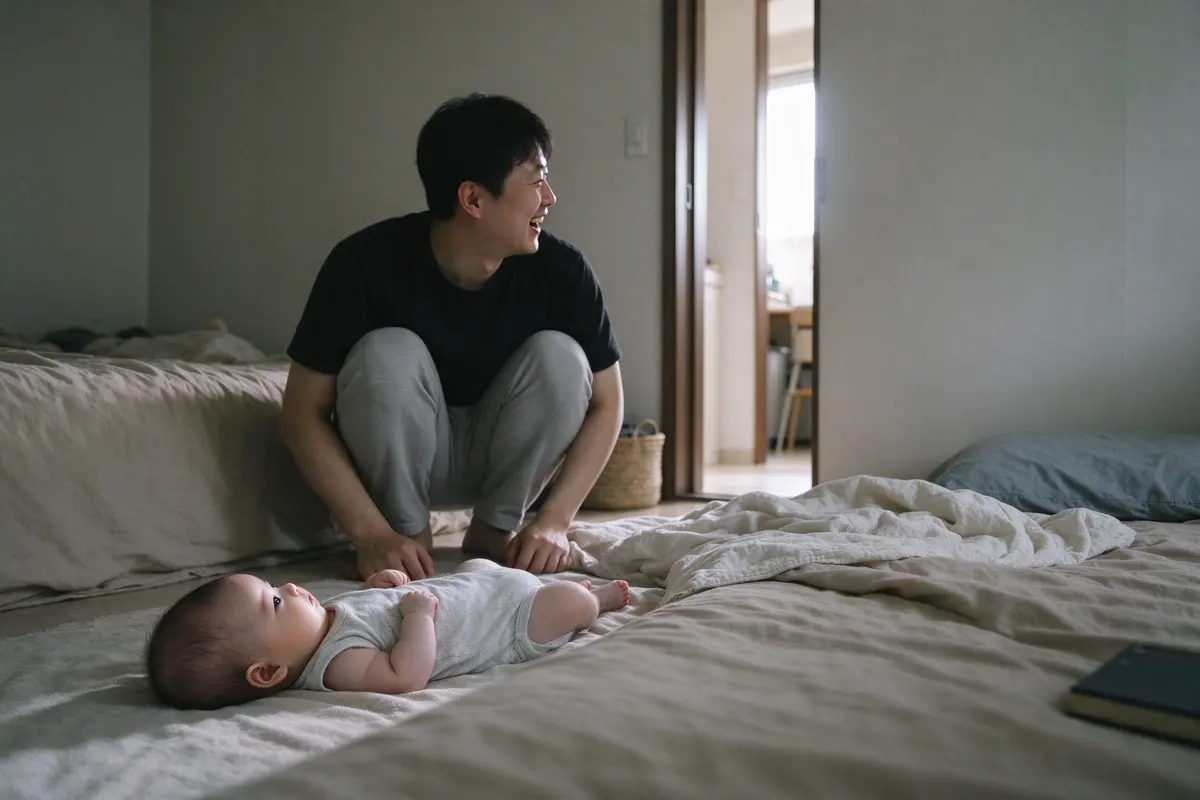
Your voice from across the room
Time: 2 minutes, a few tries · Rattle sound hunt in the guide
Lay your baby on their back on the floor blanket, facing away from the door, with someone beside them.
From the doorway, say their name in your ordinary voice, then wait several seconds (Muir & Field, 1979).
If they go still, or turn their eyes or head, walk in talking so they find you.
Try again from the other side of the room.
Make it work:Keep it gentle; loud sounds startle (AAP). No turn on some tries is normal.
Watch for
For you
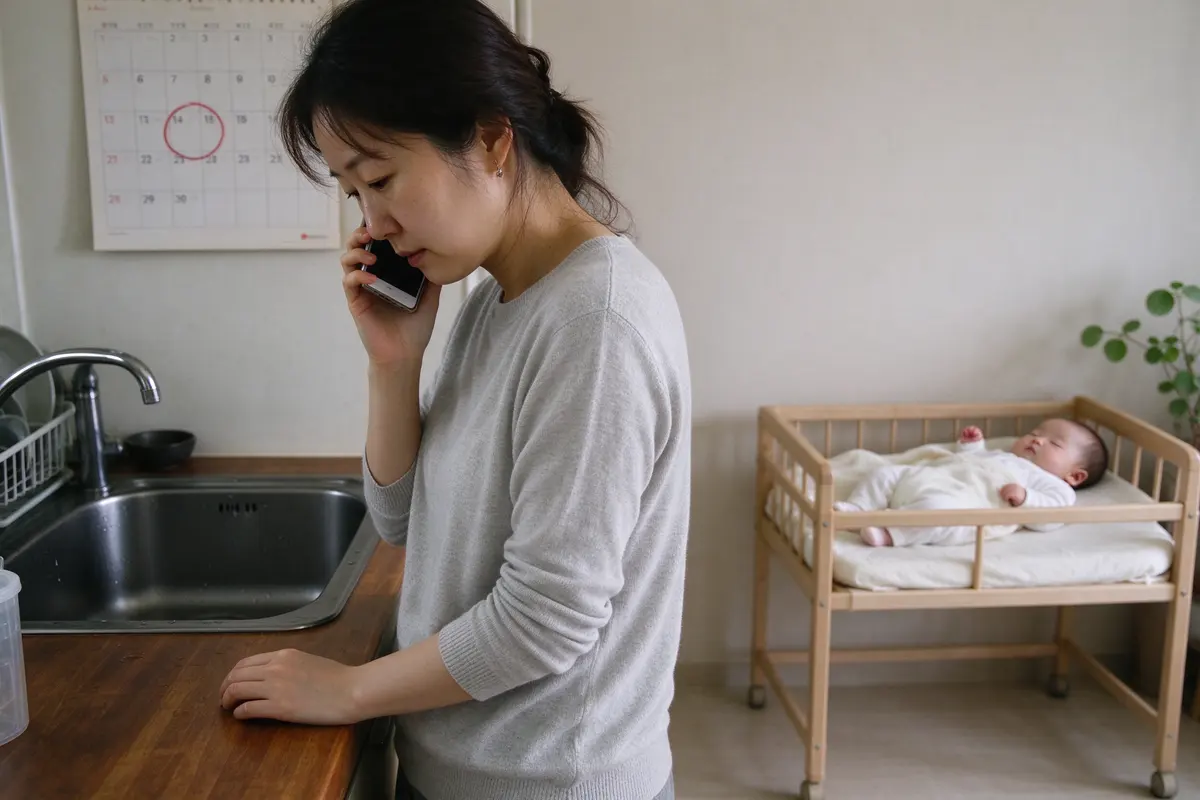
Your own deadline is coming. ACOG recommends contact with your obstetric provider within 3 weeks of birth and a full postpartum visit no later than 12 weeks, covering mood, sleep, recovery, contraception, and chronic conditions (ACOG, 2018). The visit usually lands about six weeks after birth (OWH). If it hasn't happened, book it today, and put contraception and sex on the list in writing so you don't skip them in the room.
Some things shouldn't wait for it: if sadness has lasted more than two weeks, go to the doctor now (OWH), and for a persistent headache, vision changes, or swelling of your hands or face, seek care immediately (CDC).
If you're the partner: about 10% of fathers have depression around a birth, with higher rates 3 to 6 months after (Paulson & Bazemore, 2010). Your next few months count too.
Sources
- American Academy of Pediatrics. "Developmental Milestones: 1-4 Months Old." HealthyChildren.org, 2026. https://www.healthychildren.org/English/ages-stages/baby/Pages/Developmental-Milestones-3-Months.aspx
- American Academy of Pediatrics. "Infant Vision Development: What Can Babies See?" HealthyChildren.org, 2024. https://www.healthychildren.org/English/ages-stages/baby/Pages/Babys-Vision-Development.aspx
- Gratier M, Devouche E, Guellai B, et al. "Early development of turn-taking in vocal interaction between mothers and infants." Frontiers in Psychology, 2015. https://pubmed.ncbi.nlm.nih.gov/26388790/
- Masataka N. "Effects of contingent and noncontingent maternal stimulation on the vocal behaviour of three- to four-month-old Japanese infants." Journal of Child Language, 1993. https://pubmed.ncbi.nlm.nih.gov/8376471/
- Centers for Disease Control and Prevention. "Milestones by 2 Months." Learn the Signs. Act Early. program, 2026. https://www.cdc.gov/act-early/milestones/2-months.html
- American Academy of Pediatrics. "Developmental Milestones at 1 Month Old." HealthyChildren.org, 2026. https://www.healthychildren.org/English/ages-stages/baby/Pages/Developmental-Milestones-1-Month.aspx
- Muir D, Field J. "Newborn infants orient to sounds." Child Development, 1979. https://pubmed.ncbi.nlm.nih.gov/487883/
- American Academy of Pediatrics. "Newborn Reflexes." HealthyChildren.org, 2022. https://www.healthychildren.org/English/ages-stages/baby/Pages/newborn-reflexes.aspx
- Centers for Disease Control and Prevention. "Newborn Hearing Screening." 2024. https://www.cdc.gov/hearing-loss-children-guide/parents-guide/newborn-hearing-screening.html
- Centers for Disease Control and Prevention. "Hearing Loss in Children: Screening." 2024. https://www.cdc.gov/hearing-loss-children/screening/index.html
- American Academy of Pediatrics. "Crying Baby - Before 3 Months Old" (symptom checker). HealthyChildren.org, 2026. https://www.healthychildren.org/English/tips-tools/symptom-checker/Pages/symptomviewer.aspx?symptom=Crying+Baby+-+Before+3+Months+Old
- American College of Obstetricians and Gynecologists. "ACOG Committee Opinion No. 736: Optimizing Postpartum Care." Obstetrics & Gynecology, 2018. https://pubmed.ncbi.nlm.nih.gov/29683911/
- Office on Women's Health. "Recovering from birth." US Department of Health and Human Services. https://womenshealth.gov/pregnancy/childbirth-and-beyond/recovering-birth
- Centers for Disease Control and Prevention. "Urgent Maternal Warning Signs and Symptoms." HEAR HER campaign. https://www.cdc.gov/hearher/maternal-warning-signs/index.html
- Paulson JF, Bazemore SD. "Prenatal and postpartum depression in fathers and its association with maternal depression: a meta-analysis." JAMA, 2010. https://pubmed.ncbi.nlm.nih.gov/20483973/
This guide is general education that summarizes published research and guidance from groups like the American Academy of Pediatrics, the CDC, and the WHO. It isn’t medical advice, and every child develops on their own timeline. Your pediatrician knows your child; if something feels wrong, call them. In an emergency, call 911.
Get each day’s note the morning it applies
Add your baby to a free Chorevia household with their date of birth, and every morning for 60 days the day’s note arrives in the app and by email: what’s developing, one thing to try, what to watch for, and a word for you.
Create your household