Day 43 of 60 · Week 6
Words
Last reviewed · 3 min read · 10 sources · Plain-text version
Your baby can't follow a story yet, and reading to them still counts. Today: picture talk, why the AAP says to start at birth, and a warm, free place to do it.
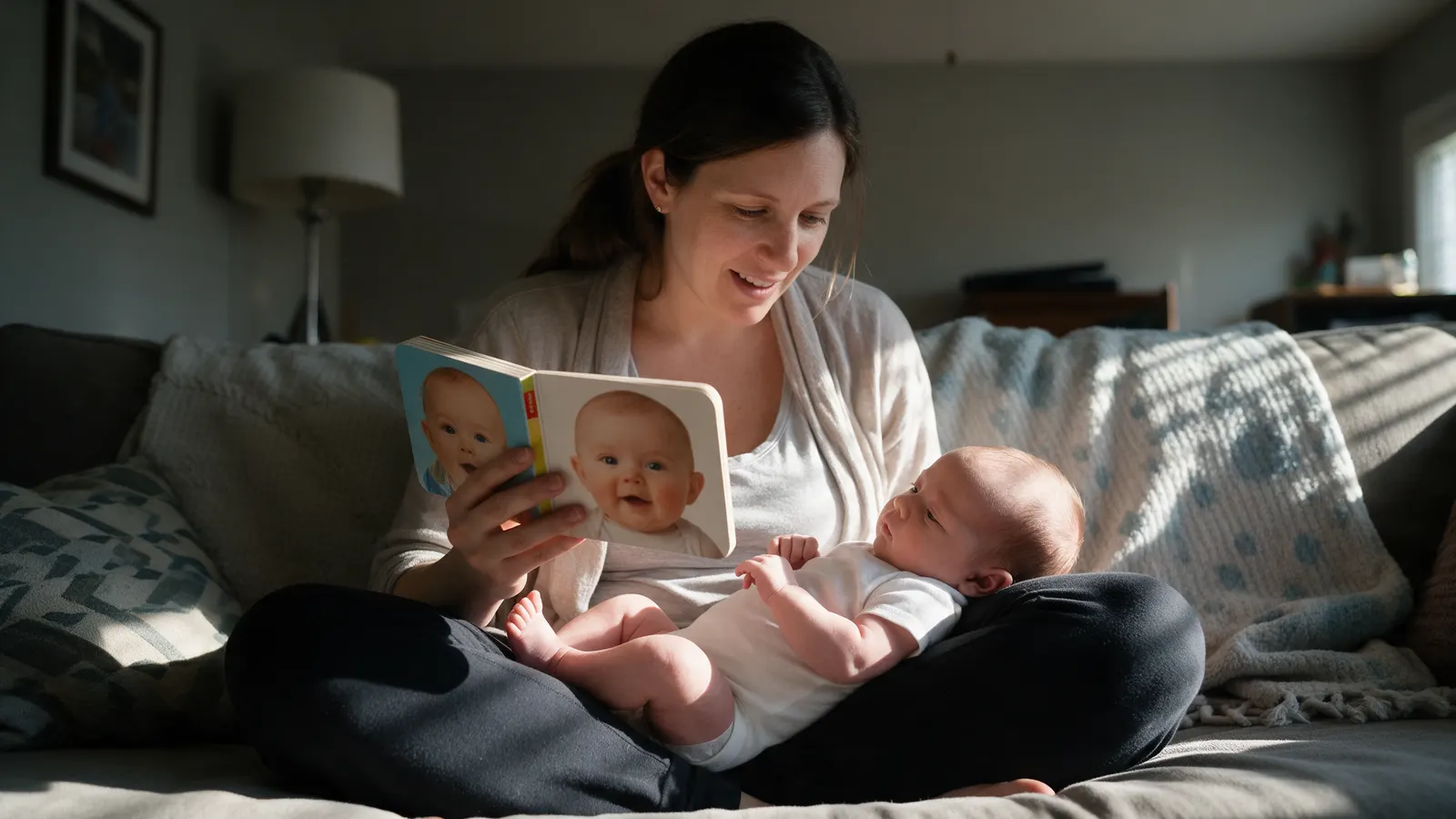
Nobody expects a six-week-old to follow a plot. Today is about why reading and talking count anyway, and about one of the few free, warm places you can take a baby on a weekday morning.
Heart
The AAP recommends shared reading from birth, based on research with young children (Klass et al., 2024). CDC suggests looking at bright pictures or faces together and talking about them (CDC). What your baby gets from it isn't the story. It's your voice, close and slow, and a page held where they can see it.
Head
Why words now? Back-and-forth talk is the heart of serve and return, the everyday exchanges that help build connections in the brain (Harvard Center on the Developing Child). The outcome research is with older babies: observational studies tie back-and-forth talk to later language, most strongly at 18 to 24 months (Gilkerson et al., 2018). For a baby this age, the benefit is inferred, and the cost is nothing. Babies like high-pitched voices, so a slower, sing-song version of how you normally talk is what holds them (AAP).
Body
Where to hold the page: newborns see best at 8 to 12 inches (AAP), and by about 8 weeks babies focus more easily on nearby faces (AOA). So a book of faces, held close, is the right book. Making sounds other than crying is a 2-month milestone (CDC); if your baby answers a page with a squeak, that's your cue to answer back.
Try today
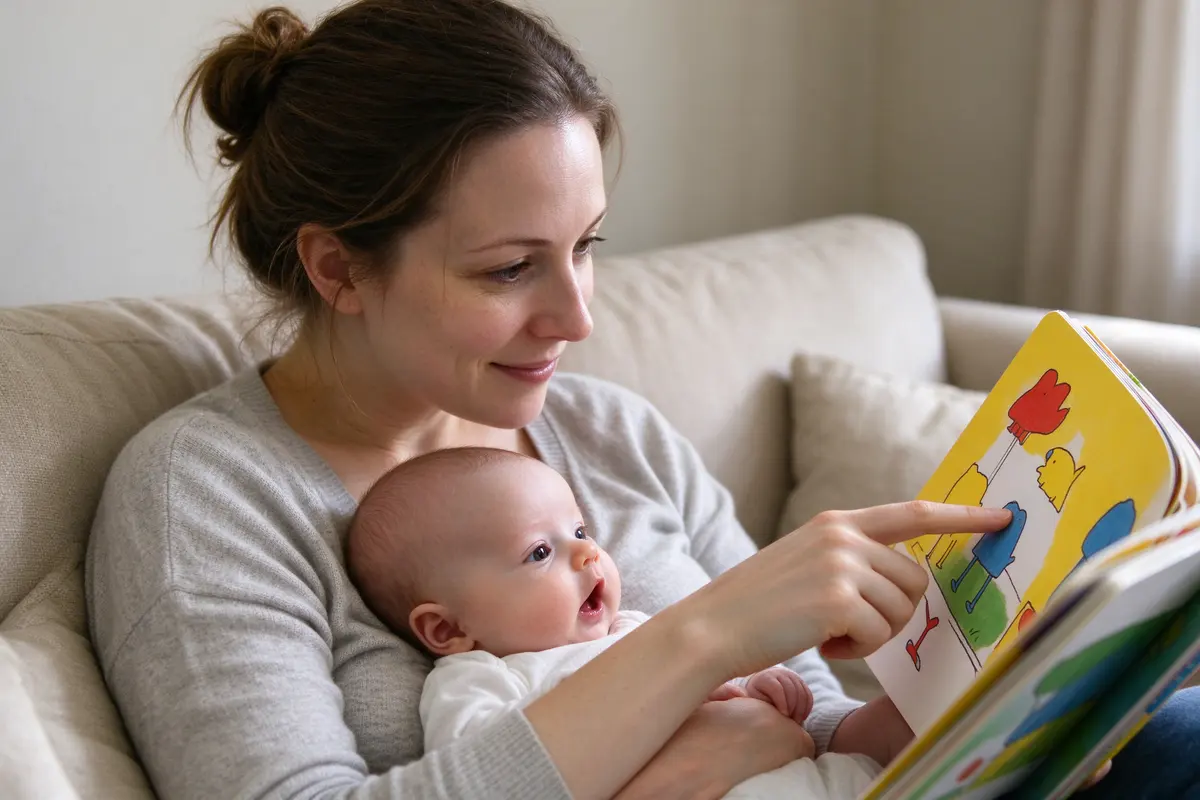
Picture talk and reading
Time: About 5 minutes, once or twice a day · Picture talk and reading in the guide
Pick a board book with faces or bold, bright pictures (CDC).
Hold it 8 to 12 inches from your baby's face (AAP), point, and name what's there.
Read in a sing-song voice and follow your baby's gaze; if they lock onto one page, stay there.
When they make a sound, stop, copy it back, and wait (CDC).
Make it work:Stop when they look away or fuss. The same book every day is fine; repetition is the point, not variety.
Watch for
Normal
a baby who makes a few small sounds, and days when they don't.
Bring it up now rather than waiting
if your baby makes no sounds other than crying by 2 months (CDC).
Normal
a baby who falls asleep mid-book. Lay them on their back in their own sleep space, not the sofa.
Call 911
if your baby can't be woken up (AAP).
Normal
a shorter feed on a sleepy afternoon.
Call your pediatrician right away
if your baby drinks very little or nothing for more than 8 hours, or has had no wet diaper in more than 8 hours (AAP).
For you
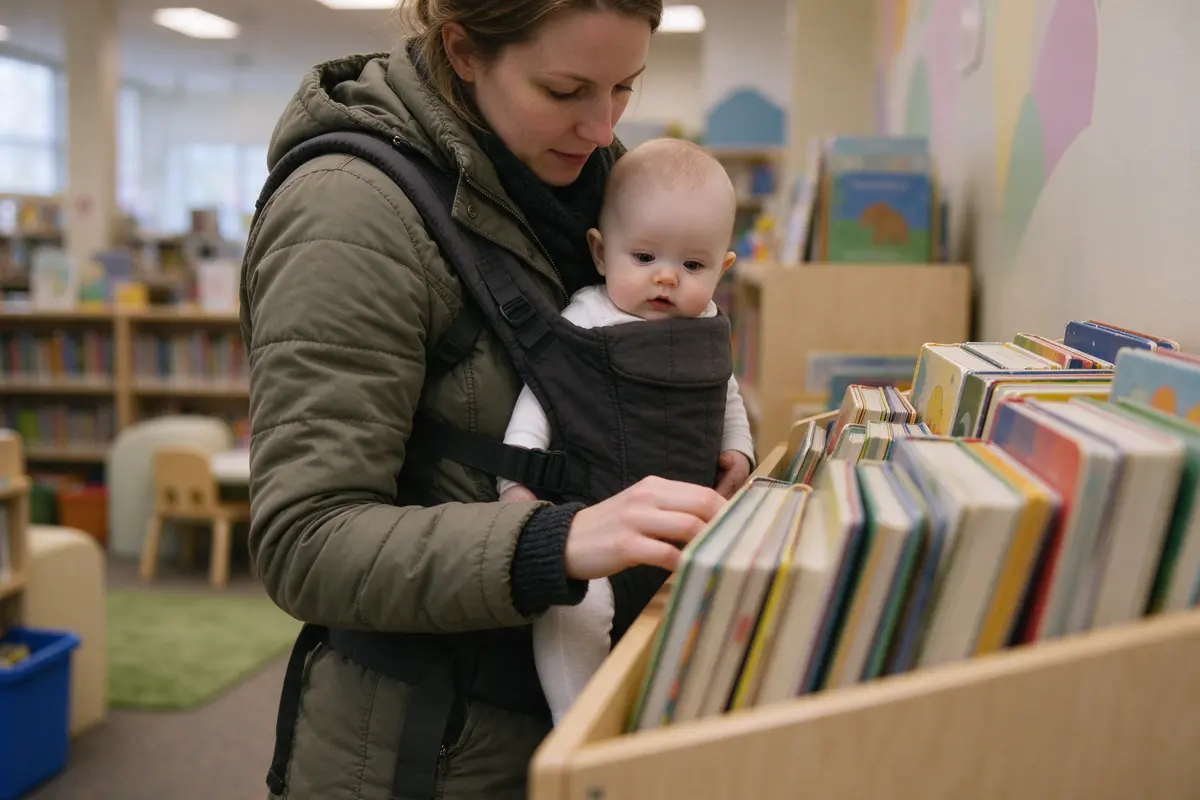
The library is free and warm. It's open on weekday mornings when the house feels smallest, nobody there minds a baby who cries, and the board books are at stroller height. You don't have to check anything out. Sitting in a chair with the baby and a stack of books you didn't pay for is an outing. And if the house feels small for a harder reason, if sadness has lasted more than two weeks, go to the doctor; don't wait for the postpartum visit (Office on Women's Health).
If you're the partner: tonight's reading is yours. Anything counts, including whatever you're already reading. The baby hears a voice they know, slowed down, and she gets ten minutes.
Sources
- Klass P, Miller-Fitzwater A, High PC; AAP Council on Early Childhood. "Literacy Promotion: An Essential Component of Primary Care Pediatric Practice: Policy Statement." Pediatrics, 2024. https://pubmed.ncbi.nlm.nih.gov/39342414/
- Centers for Disease Control and Prevention. "Milestones by 2 Months." Learn the Signs. Act Early., 2026. https://www.cdc.gov/act-early/milestones/2-months.html
- Center on the Developing Child at Harvard University. "Serve and Return." https://developingchild.harvard.edu/key-concept/serve-and-return/
- Gilkerson J, Richards JA, Warren SF, et al. "Language Experience in the Second Year of Life and Language Outcomes in Late Childhood." Pediatrics, 2018. https://pubmed.ncbi.nlm.nih.gov/30201624/
- American Academy of Pediatrics. "Hearing & Making Sounds: Your Baby's Milestones." HealthyChildren.org, 2021. https://www.healthychildren.org/English/ages-stages/baby/pages/Hearing-and-Making-Sounds.aspx
- American Academy of Pediatrics. "Infant Vision Development: What Can Babies See?" HealthyChildren.org, 2024. https://www.healthychildren.org/English/ages-stages/baby/Pages/Babys-Vision-Development.aspx
- American Optometric Association. "Infant Vision: Birth to 24 Months of Age." https://www.aoa.org/healthy-eyes/eye-health-for-life/infant-vision
- American Academy of Pediatrics. "Vomiting Without Diarrhea" (symptom checker). HealthyChildren.org, 2026. https://www.healthychildren.org/English/tips-tools/symptom-checker/Pages/symptomviewer.aspx?symptom=Vomiting+Without+Diarrhea
- American Academy of Pediatrics. "Crying Baby - Before 3 Months Old" (symptom checker). HealthyChildren.org, 2026. https://www.healthychildren.org/English/tips-tools/symptom-checker/Pages/symptomviewer.aspx?symptom=Crying+Baby+-+Before+3+Months+Old
- Office on Women's Health. "Recovering from birth." U.S. Department of Health and Human Services. https://womenshealth.gov/pregnancy/childbirth-and-beyond/recovering-birth
This guide is general education that summarizes published research and guidance from groups like the American Academy of Pediatrics, the CDC, and the WHO. It isn’t medical advice, and every child develops on their own timeline. Your pediatrician knows your child; if something feels wrong, call them. In an emergency, call 911.
Get each day’s note the morning it applies
Add your baby to a free Chorevia household with their date of birth, and every morning for 60 days the day’s note arrives in the app and by email: what’s developing, one thing to try, what to watch for, and a word for you.
Create your household