Day 55 of 60 · Week 8
Open hands
Last reviewed · 3 min read · 12 sources · Plain-text version
Fists are loosening. Why hands open briefly now while the grasp reflex still holds on, and a one-minute palm game for diaper changes.
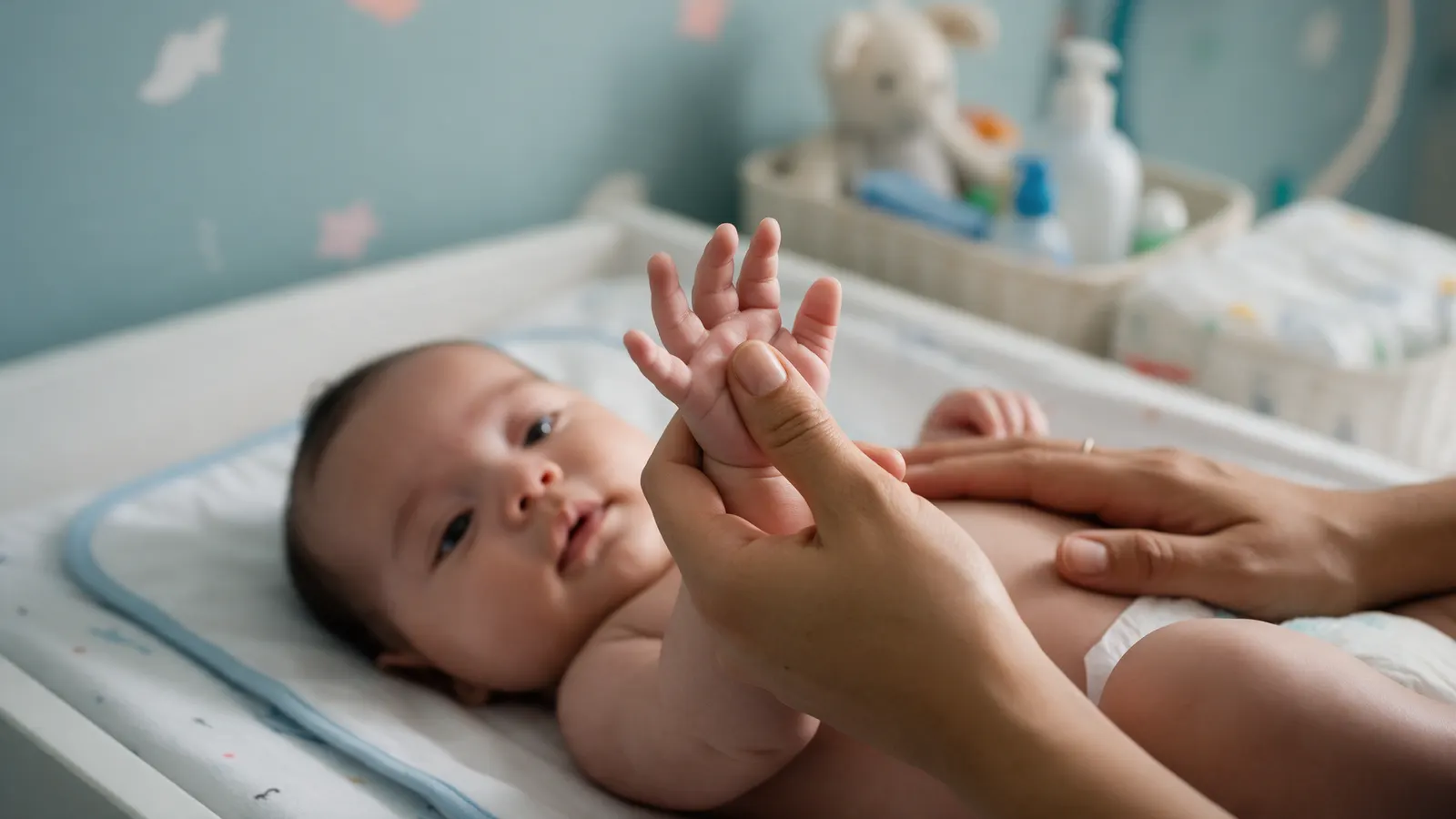
Those tight newborn fists are starting to loosen. Today is about the hands: what's automatic, what's new, and a small game you can play at every diaper change.
Heart
Opening their hands briefly is on CDC's 2-month list (CDC). Fists are still common, but hands start to catch your baby's attention, and some reach the mouth (AAP). Two things are true at once: the grasp reflex, that grip on a finger placed in the palm, is still there and fades around 5 to 6 months (AAP), and on top of it the first chosen openings are showing up.
Head
Body
Stroking a palm open is touch, not treatment. A Cochrane review of 34 studies found mostly poor-quality evidence and didn't support routine massage for healthy babies under 6 months (Bennett et al., 2013). So do it because it's pleasant, during a change you're already doing, with one hand on your baby the whole time, since a changing-table strap isn't enough on its own (AAP).
Try today

Open hands
Time: A minute, at diaper changes · Hand discovery in the guide
With your baby on their back and your free hand resting on them, stroke the back of one fist from wrist to knuckles.
When the fingers loosen, stroke the open palm slowly with your thumb and name it: "Hand. Fingers."
Place your finger in the palm and feel the grip (AAP), then let go and watch where the hand goes.
Bring both hands together over their chest (CDC).
Make it work:Stop when they fuss or turn away. The other hand gets its turn at the next change.
Watch for
Normal
fists most of the day, with brief openings.
Don't wait and see:
if your baby isn't meeting milestones or has lost skills, talk with your pediatrician and ask about developmental screening (CDC).
Normal
grunting and straining with poops, and sometimes a gap of days in a breastfed baby.
Normal
a scratch on the cheek from their own nails; trim or file them while they sleep (AAP).
Call 911
for bluish lips or a bluish face (AAP).
For you
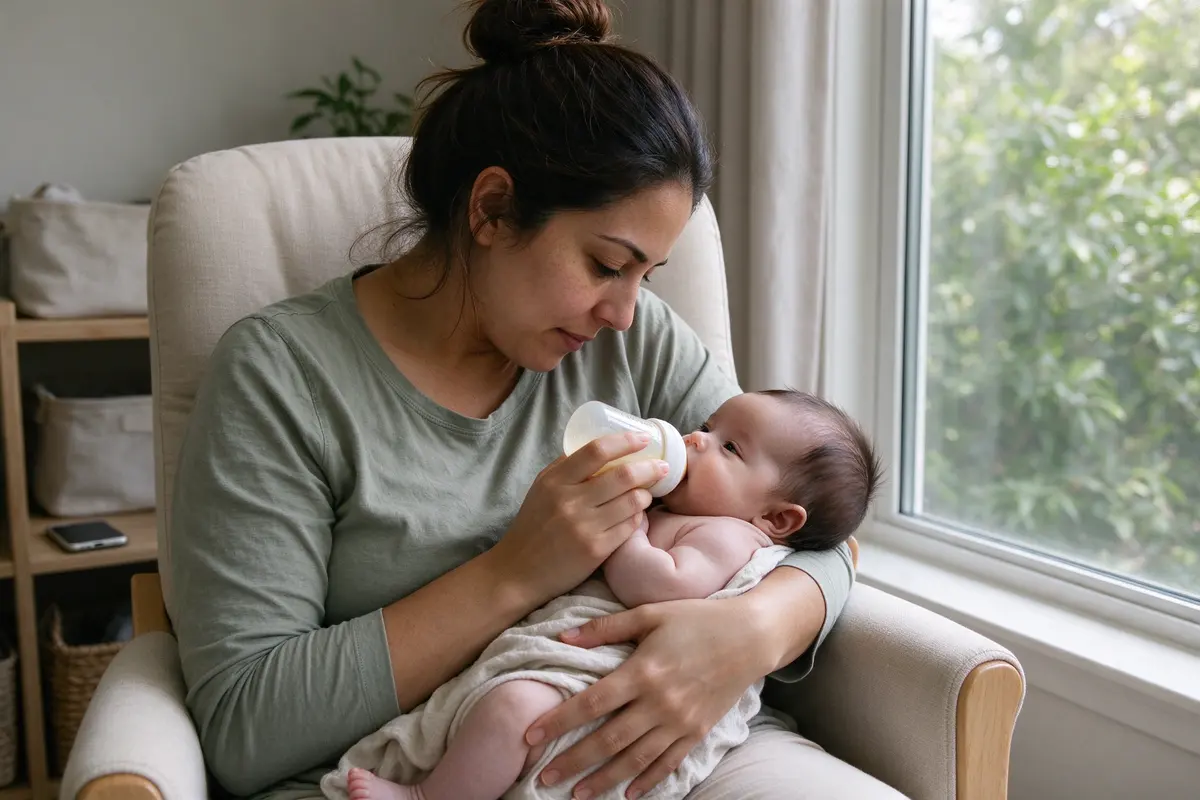
Hands off the phone for one feed. Not every feed; one. Background TV or your phone can crowd out the face-to-face time babies learn from (AAP), and in still-face studies, babies from about 1 month notice and get upset when a parent stops responding (Mesman et al., 2009). Scrolling through the other feeds is survival, not a failing. One feed with your eyes on their face is the whole assignment.
Your own hands count too. Extreme swelling of your hands or face is an urgent warning sign; seek care immediately (CDC).
If you're the partner: your one feed, or one long hold, with the phone in another room.
Sources
- Centers for Disease Control and Prevention. "Milestones by 2 Months." Learn the Signs. Act Early. program, 2026. https://www.cdc.gov/act-early/milestones/2-months.html
- American Academy of Pediatrics. "Movement Milestones: Birth to 3 Months." HealthyChildren.org, 2020. https://www.healthychildren.org/English/ages-stages/baby/Pages/Movement-Birth-to-Three-Months.aspx
- American Academy of Pediatrics. "Newborn Reflexes." HealthyChildren.org, 2022. https://www.healthychildren.org/English/ages-stages/baby/Pages/newborn-reflexes.aspx
- Bennett C, Underdown A, Barlow J. "Massage for promoting mental and physical health in typically developing infants under the age of six months." Cochrane Database of Systematic Reviews, 2013. https://pubmed.ncbi.nlm.nih.gov/23633323/
- American Academy of Pediatrics. "Changing Table Safety." HealthyChildren.org, 2009. https://www.healthychildren.org/English/safety-prevention/at-home/Pages/Changing-Table-Safety.aspx
- American Academy of Pediatrics. "How Can I Tell If My Baby is Constipated?" HealthyChildren.org, 2022. https://www.healthychildren.org/English/ages-stages/baby/diapers-clothing/Pages/Infant-Constipation.aspx
- American Academy of Pediatrics. "Stools - Blood In" (symptom checker). HealthyChildren.org, 2026. https://www.healthychildren.org/English/tips-tools/symptom-checker/Pages/symptomviewer.aspx?symptom=Stools+-+Blood+In
- Jana L, Shu J. "Nailing It: How to Trim Your Baby's Fingernails." HealthyChildren.org, 2020. https://www.healthychildren.org/English/ages-stages/baby/bathing-skin-care/Pages/Nails-Nails-Everywhere.aspx
- American Academy of Pediatrics. "Breathing Trouble" (symptom checker). HealthyChildren.org, 2026. https://www.healthychildren.org/English/tips-tools/symptom-checker/Pages/symptomviewer.aspx?symptom=Breathing+Trouble
- AAP Center of Excellence on Social Media and Youth Mental Health. "Kids & Screen Time: The 5 C's Questions to Ask for Infants." HealthyChildren.org, 2024. https://www.healthychildren.org/English/family-life/Media/Pages/infants-and-screen-time-5-cs-questions-to-ask.aspx
- Mesman J, van IJzendoorn MH, Bakermans-Kranenburg MJ. "The many faces of the Still-Face Paradigm: A review and meta-analysis." Developmental Review, 2009. https://doi.org/10.1016/j.dr.2009.02.001
- Centers for Disease Control and Prevention. "Urgent Maternal Warning Signs and Symptoms." HEAR HER campaign. https://www.cdc.gov/hearher/maternal-warning-signs/index.html
This guide is general education that summarizes published research and guidance from groups like the American Academy of Pediatrics, the CDC, and the WHO. It isn’t medical advice, and every child develops on their own timeline. Your pediatrician knows your child; if something feels wrong, call them. In an emergency, call 911.
Get each day’s note the morning it applies
Add your baby to a free Chorevia household with their date of birth, and every morning for 60 days the day’s note arrives in the app and by email: what’s developing, one thing to try, what to watch for, and a word for you.
Create your household