Day 41 of 60 · Week 6
A round head
Last reviewed · 4 min read · 8 sources · Plain-text version
Flat spots are common and mostly mild. Today: the small position changes that keep your baby's head round, and the head tilt worth mentioning at the checkup.

Six weeks in, your baby has spent a lot of hours on their back, which is exactly where they should sleep. Today is about the rest of the day: the small changes of position that help a head stay round.
Heart
Flat spots are common. In Calgary, nearly half of 440 healthy babies checked at 7 to 12 weeks had some head flattening, mostly mild (Mawji et al., 2013). It isn't a sign of anything you did wrong, and the AAP says positional flattening doesn't affect brain growth or intellectual development (AAP). Back to sleep stays the rule for every sleep (AAP).
Head
Why now: flattening most often develops in the first 4 to 12 weeks (AAP). The fix is position changes while your baby is awake: alternate the arm you hold and feed with, and limit time in car seats, bouncers, and swings (AAP). Supervised tummy time does the rest: a review of mostly observational studies linked it to less flattening at the back of the head (Hewitt et al., 2020), and the AAP's target is 15 to 30 minutes a day, in short sessions, by 7 weeks (AAP).
One more thing to look for: a head that tilts toward one shoulder or always turns the same way. That can be torticollis, tight neck muscles, often noticed in the first 6 to 8 weeks. Early stretching, sometimes with a physical therapist, matters (AAP).
Body
Look at your baby from above while they're on the floor. Do they favor one direction? Is the head evenly round from the top, or flatter on one side? You're not diagnosing, just collecting what to tell the pediatrician. A flat spot or a head that always tilts one way belongs on your list for the 2-month visit (AAP).
Try today

The crib-end swap
Time: Ten seconds at each sleep, plus a few switches through the day · Tummy time and head shape in the guide
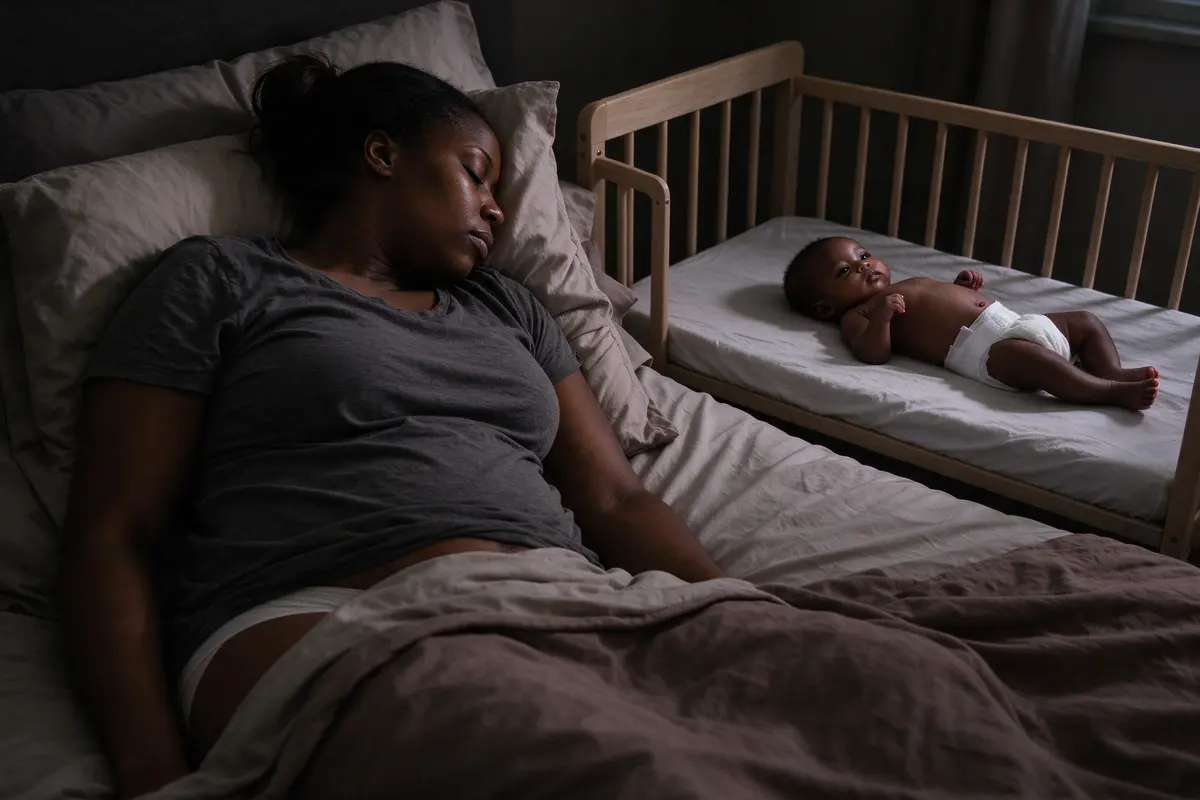
At the next sleep, lay your baby on their back as always, but with their head at the other end of the crib, so whatever they like to look at is now on their other side.
At the next feed, switch to the arm you use less, and offer the breast or bottle from that side (AAP).
When you carry your baby around the house, swap shoulders now and then.
Keep car seat, bouncer, and swing time short (AAP).
Add one short tummy time session on the floor, face to face (AAP).
Make it work:The sleep rules don't change: on the back, on a firm, flat surface, with nothing else in the crib (AAP). Only the direction changes.
Watch for
Normal
a slight preference for turning one way, and a mild flat spot.
Mention it at the checkup
if your baby always tilts their head to one side or always turns the same way; early treatment of a tight neck matters (AAP).
Normal
a head that still needs your hand under it when you lift.
Call 911
if your baby is not moving, or is very weak or floppy (AAP).
Normal
grumbling when you turn them to face the other way.
Call your pediatrician right away
if your baby cries nonstop for more than 2 hours (AAP).
For you
Your own posture, while we're on the subject. Six weeks of feeds have probably left you curled over the baby. Bring the baby up to you instead of bending down: a pillow under your elbow, feet on the floor or a stool, your back against something. Switching sides helps your neck as much as your baby's head.
A headache from a tight neck usually eases with a stretch, water, and rest. One that won't go away or gets worse, or comes with vision changes, is an urgent warning sign in the year after a birth; get care right away, and tell them you were recently pregnant (CDC).
If you're the partner: take the next bottle, or the next carry, on the side she uses less. Her neck gets a break and the baby gets a new view.
Sources
- Mawji A, Vollman AR, Hatfield J, et al. "The incidence of positional plagiocephaly: a cohort study." Pediatrics, 2013. https://pubmed.ncbi.nlm.nih.gov/23837184/
- American Academy of Pediatrics. "When a Baby's Head is Misshapen: Positional Skull Deformities." HealthyChildren.org, 2022. https://www.healthychildren.org/English/health-issues/conditions/Cleft-Craniofacial/Pages/Positional-Skull-Deformities-and-Torticollis.aspx
- Moon RY. "How to Keep Your Sleeping Baby Safe: AAP Policy Explained." HealthyChildren.org, 2026. https://www.healthychildren.org/English/ages-stages/baby/sleep/Pages/a-parents-guide-to-safe-sleep.aspx
- Hewitt L, Kerr E, Stanley RM, Okely AD. "Tummy Time and Infant Health Outcomes: A Systematic Review." Pediatrics, 2020. https://pubmed.ncbi.nlm.nih.gov/32371428/
- American Academy of Pediatrics. "Back to Sleep, Tummy to Play." HealthyChildren.org, 2026. https://www.healthychildren.org/English/ages-stages/baby/sleep/Pages/back-to-sleep-tummy-to-play.aspx
- American Academy of Pediatrics. "Head Tilt (Torticollis)." HealthyChildren.org, 2020. https://www.healthychildren.org/English/health-issues/conditions/Cleft-Craniofacial/Pages/Head-Tilt.aspx
- American Academy of Pediatrics. "Crying Baby - Before 3 Months Old" (symptom checker). HealthyChildren.org, 2026. https://www.healthychildren.org/English/tips-tools/symptom-checker/Pages/symptomviewer.aspx?symptom=Crying+Baby+-+Before+3+Months+Old
- Centers for Disease Control and Prevention. "Urgent Maternal Warning Signs and Symptoms." HEAR HER campaign. https://www.cdc.gov/hearher/maternal-warning-signs/index.html
This guide is general education that summarizes published research and guidance from groups like the American Academy of Pediatrics, the CDC, and the WHO. It isn’t medical advice, and every child develops on their own timeline. Your pediatrician knows your child; if something feels wrong, call them. In an emergency, call 911.
Get each day’s note the morning it applies
Add your baby to a free Chorevia household with their date of birth, and every morning for 60 days the day’s note arrives in the app and by email: what’s developing, one thing to try, what to watch for, and a word for you.
Create your household