Day 31 of 60 · Week 5
Month two
Last reviewed · 3 min read · 11 sources · Plain-text version
A new month: real smiles are on their way, crying is near its heaviest, and milestones now mean what most babies do by two months, not a test for today.

Thirty-one days. Month two has a different shape: more awake time, more crying for a while, and, sometime soon, the first real smile. Today is a map of the month.
Heart
The AAP says that by the second month, early expressions begin to turn into genuine signals of pleasure and friendliness, and that a smile gives your baby a new way, besides crying, to tell you what they need (AAP). Most babies smile when you talk to or smile at them by 2 months (CDC). It may be days away or weeks.
Head
A word about milestones, since you'll see lists everywhere this month. In 2022, an AAP expert group rewrote CDC's checklists to use only milestones that at least 75% of children reach by each age, and most milestones that changed ages moved later (Zubler et al., 2022). So "by 2 months" means what most babies do by then, not what yours should do today. A missed one is a reason to ask, not to panic.
Born early? Count from the due date. Use corrected age, age in weeks minus the weeks born early, for milestones until age 2 (AAP).
Body
The hard part first: crying. Across 28 diary studies of 8,690 babies, fussing and crying averaged about 2 hours a day for the first 6 weeks, then fell to about 1 hour a day by 10 to 12 weeks (Wolke et al., 2017). PURPLE crying materials describe the most crying in month 2, often in the evening (Seattle Children's). You're near the top of the hill. Tomorrow is about the evenings.
Try today
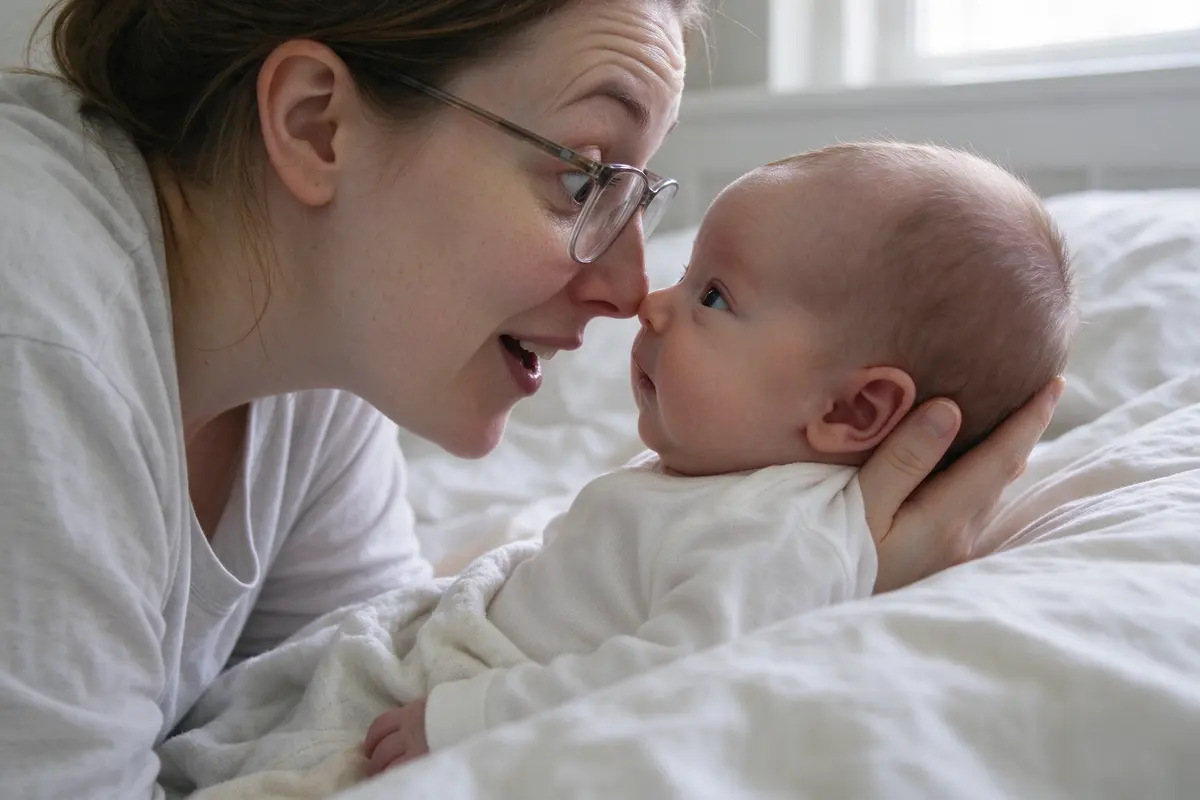
Smile conversations
Time: A few minutes, whenever your baby is alert · Smile conversations in the guide
Hold your baby face to face, close enough to see you clearly.
Smile, raise your eyebrows, and say hello.
When your baby smiles, or just stares, smile bigger, say a few words, then pause.
Try the AAP's script: "Oh, you're smiling at me! Hi there." (Pause.) "Are you telling me something?" (AAP)
Make it work:Respond quickly and warmly; the AAP says this tells your baby they can trust you and have some control over their world (AAP). No smile yet is fine. Babies from about 1 month notice when a parent stops responding (Mesman et al., 2009), so the conversation counts before the smile arrives.
Watch for
Normal
no social smile yet; it's a 2-month milestone.
Tell your pediatrician
if your baby isn't smiling at people by the 2-month checkup; CDC's advice is not to wait (CDC).
Normal
a warm baby after a feed in your arms.
Call your pediatrician immediately
for a rectal temperature of 100.4°F (38°C) or higher before 3 months, even if your baby seems fine (AAP).
Normal
long crying spells, especially in the evening.
Call your pediatrician right away
if your baby cries nonstop for more than 2 hours (AAP).
For you
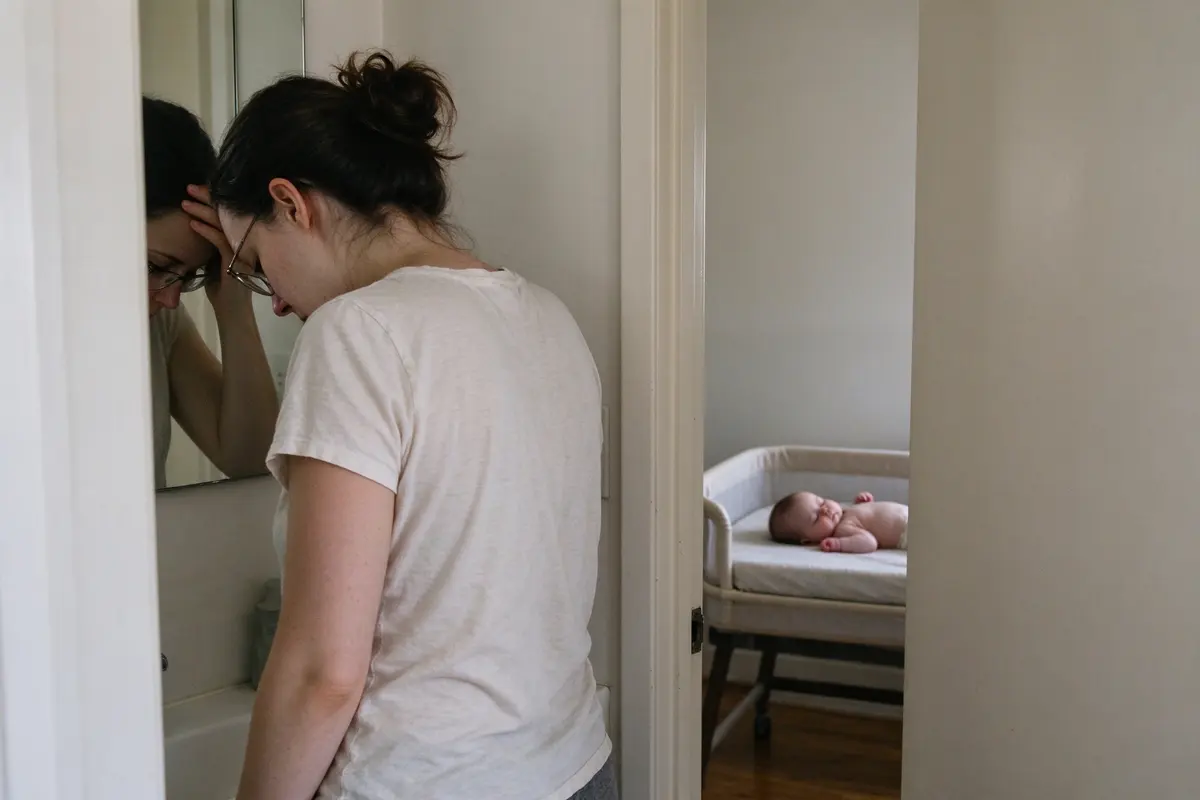
A new month for you too, with the same rules. Seek care immediately for a headache that won't go away or gets worse, dizziness or fainting, changes in vision, a fever of 100.4°F or higher, extreme swelling of your hands or face, trouble breathing, chest pain, severe belly pain that doesn't go away, heavy vaginal bleeding, severe swelling, redness, or pain in a leg or arm, overwhelming tiredness, or thoughts about harming yourself or your baby (CDC). The CDC's own line: "If you feel like something just isn't right, or you aren't sure if it's serious, talk to your health care provider." Tell any provider you were pregnant within the last year (CDC).
Bleeding may last up to 6 weeks, going from red to pink to yellow or white (MedlinePlus).
If you're the partner: you know those warning signs now too. She may wave off a headache. Don't.
Sources
- American Academy of Pediatrics. "Emotional & Social Development: Birth Through 3 Months." HealthyChildren.org, updated 2026. https://www.healthychildren.org/English/ages-stages/baby/Pages/Emotional-and-Social-Development-Birth-to-3-Months.aspx
- Centers for Disease Control and Prevention. "Milestones by 2 Months." Learn the Signs. Act Early. program, updated 2026. https://www.cdc.gov/act-early/milestones/2-months.html
- Zubler JM, Wiggins LD, Macias MM, et al. "Evidence-Informed Milestones for Developmental Surveillance Tools." Pediatrics, 2022. https://pubmed.ncbi.nlm.nih.gov/35132439/
- American Academy of Pediatrics. "Corrected Age For Preemies." HealthyChildren.org, updated 2018. https://www.healthychildren.org/English/ages-stages/baby/preemie/Pages/Corrected-Age-For-Preemies.aspx
- Wolke D, Bilgin A, Samara M. "Systematic Review and Meta-Analysis: Fussing and Crying Durations and Prevalence of Colic in Infants." Journal of Pediatrics, 2017. https://pubmed.ncbi.nlm.nih.gov/28385295/
- Seattle Children's Hospital. "Period of PURPLE Crying." Accessed 2026. https://www.seattlechildrens.org/health-safety/parenting/purple-education-crying/
- Mesman J, van IJzendoorn MH, Bakermans-Kranenburg MJ. "The many faces of the Still-Face Paradigm: A review and meta-analysis." Developmental Review, 2009. https://doi.org/10.1016/j.dr.2009.02.001
- American Academy of Pediatrics. "Fever and Your Baby." HealthyChildren.org, updated 2025. https://www.healthychildren.org/English/health-issues/conditions/fever/Pages/Fever-and-Your-Baby.aspx
- American Academy of Pediatrics. "Crying Baby - Before 3 Months Old" (symptom checker). HealthyChildren.org, accessed 2026. https://www.healthychildren.org/English/tips-tools/symptom-checker/Pages/symptomviewer.aspx?symptom=Crying+Baby+-+Before+3+Months+Old
- Centers for Disease Control and Prevention. "Urgent Maternal Warning Signs and Symptoms." HEAR HER campaign. https://www.cdc.gov/hearher/maternal-warning-signs/index.html
- MedlinePlus. "Vaginal delivery - discharge." National Library of Medicine. https://medlineplus.gov/ency/patientinstructions/000628.htm
This guide is general education that summarizes published research and guidance from groups like the American Academy of Pediatrics, the CDC, and the WHO. It isn’t medical advice, and every child develops on their own timeline. Your pediatrician knows your child; if something feels wrong, call them. In an emergency, call 911.
Get each day’s note the morning it applies
Add your baby to a free Chorevia household with their date of birth, and every morning for 60 days the day’s note arrives in the app and by email: what’s developing, one thing to try, what to watch for, and a word for you.
Create your household