Day 46 of 60 · Week 7
Faraway family
Last reviewed · 3 min read · 11 sources · Plain-text version
Video chat is the one screen the AAP allows for a baby this young. Today: how to make a call work for a six-week-old, and who else can hold the baby this week.

Grandparents three time zones away. A sibling overseas. A best friend who hasn't met the baby. Today is about the one screen that's allowed, and about the people who can be in the room.
Heart
The AAP calls TV and apps a bad idea before 18 months, with video chats with faraway family as the exception (Hill, AAP). The reason the exception exists is simple: on the other end is a live person who smiles, pauses, and answers. That's the thing your baby is built to notice.
Head
Honest limits. The research showing babies can learn from live video chat involved 12- to 25-month-olds, not babies this young (Myers et al., 2017), and the AAP says babies this young learn best from real-world interactions (Munzer, AAP). So a call is for the grandparents at least as much as for the baby, and that's a fine reason to make one. The rest of the day stays screen-free: background TV, or your phone, can crowd out the face-to-face time babies learn from (AAP).
Body
For the family who can come in person, the rules from the first month still stand. Anyone who holds your baby washes their hands first and stays away while they're sick (KidsHealth). The AAP suggests that relatives be up to date on vaccines, with Tdap finished at least 2 weeks before visiting (AAP). Crowded places like malls and airplanes can still wait a few months (KidsHealth).
Try today
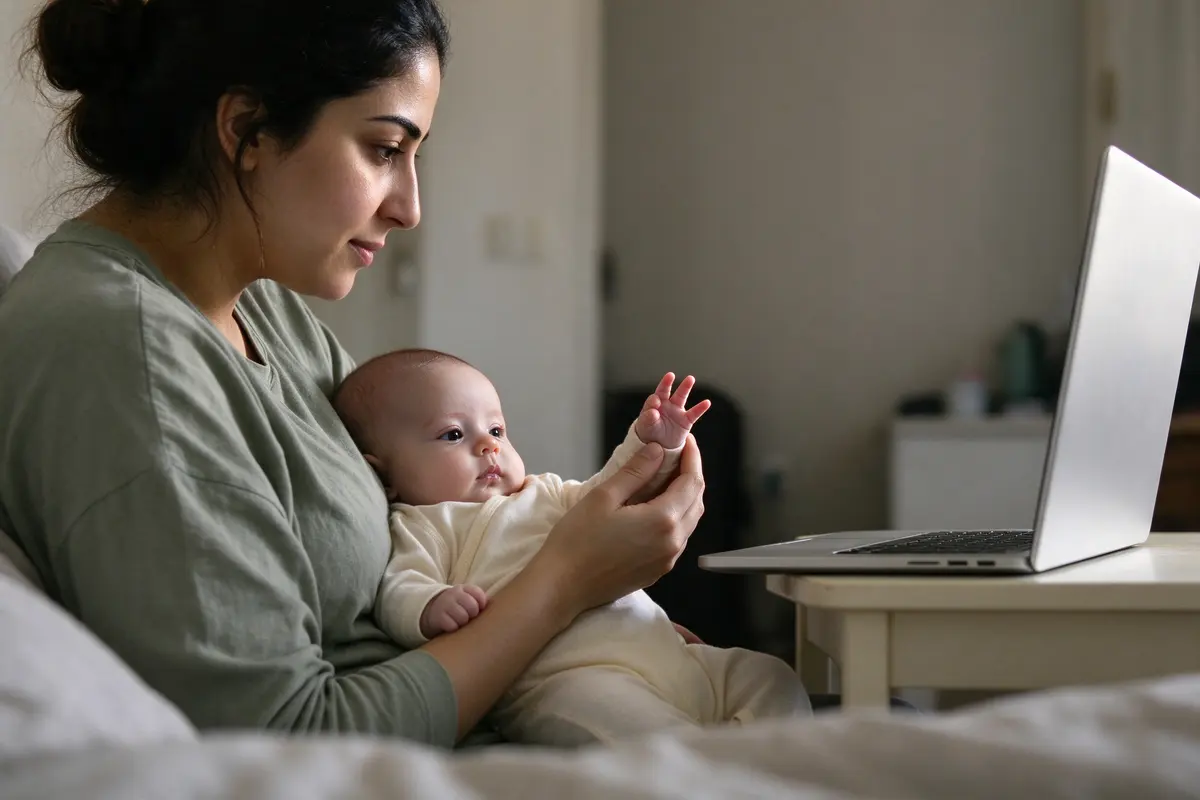
Video chat with family
Time: A few minutes · Video chat with family in the guide
Hold your baby on your lap, close to the screen.
Ask the caller to talk slowly, smile, and pause for your baby's sounds.
Narrate for both sides: "That's Grandpa. He's saying hello."
End before fussing starts.
Make it work:Keep it short, and close the laptop when the call ends. Video chat is the exception; the rest of the day is faces, not screens (Hill, AAP).
Watch for
Normal
a baby who stares at the screen, then loses interest.
Talk with your pediatrician now
if your baby has lost skills they used to have (CDC).
Normal
a sniffly relative asked to visit next week instead.
Call your pediatrician immediately
for a rectal temperature of 100.4°F (38°C) or higher, even if your baby seems fine (AAP).
Normal
dozing off on an aunt's chest. Move your baby to their back on a firm, flat surface as soon as you can (AAP), and
call 911
if your baby has bluish lips or face (AAP).
For you
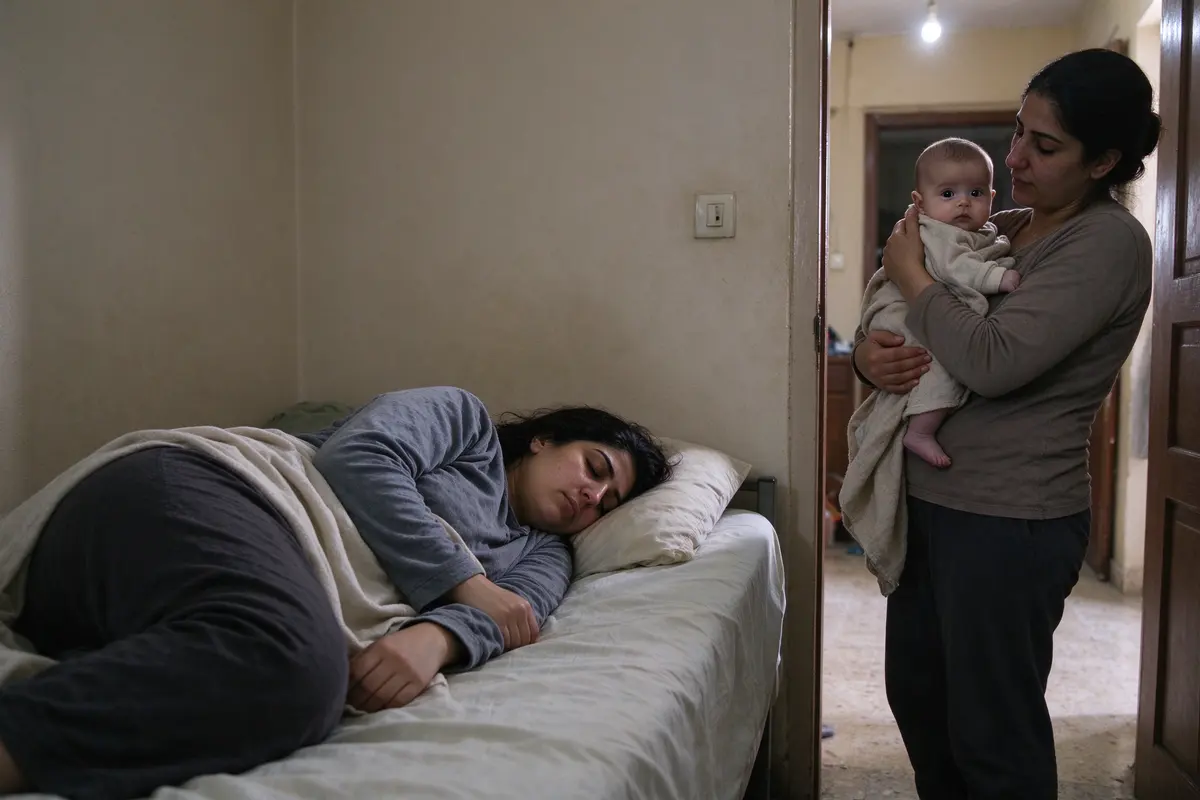
Who else can hold the baby this week? Name three people. Give each one a specific job, because "let me know if you need anything" never turns into anything: a meal, a load of laundry, a stroller walk while you nap. The AAP urges pediatricians to support fathers' involvement, and the same logic applies to grandparents and friends: spread the load on purpose (Yogman & Garfield, 2016).
If you're the partner: you're not on the list of helpers. You're the other parent. Make the list with her, and make the calls.
Sources
- Hill DL. "Why to Avoid TV for Infants & Toddlers." HealthyChildren.org, 2016. https://www.healthychildren.org/English/family-life/Media/Pages/Why-to-Avoid-TV-Before-Age-2.aspx
- Myers LJ, LeWitt RB, Gallo RE, Maselli NM. "Baby FaceTime: can toddlers learn from online video chat?" Developmental Science, 2017. https://pubmed.ncbi.nlm.nih.gov/27417537/
- Munzer T. "Helping Kids Thrive in a Digital World: AAP Policy Explained." HealthyChildren.org, 2026. https://www.healthychildren.org/English/family-life/Media/Pages/helping-kids-thrive-in-a-digital-world-AAP-policy-explained.aspx
- AAP Center of Excellence on Social Media and Youth Mental Health. "Kids & Screen Time: The 5 C's Questions to Ask for Infants." HealthyChildren.org, 2024. https://www.healthychildren.org/English/family-life/Media/Pages/infants-and-screen-time-5-cs-questions-to-ask.aspx
- Nemours KidsHealth. "When Can I Take My Newborn Out in Public?" 2024. https://kidshealth.org/en/parents/newborn-out.html
- American Academy of Pediatrics Section on Infectious Diseases. "How to Cocoon a Newborn: Family & Friends Can Protect Baby From Germs." HealthyChildren.org, 2025. https://www.healthychildren.org/English/safety-prevention/immunizations/Pages/How-to-Cocoon-a-Newborn-Only-an-E-Mail-Away.aspx
- Centers for Disease Control and Prevention. "Milestones by 2 Months." Learn the Signs. Act Early., 2026. https://www.cdc.gov/act-early/milestones/2-months.html
- American Academy of Pediatrics. "Fever and Your Baby." HealthyChildren.org, 2025. https://www.healthychildren.org/English/health-issues/conditions/fever/Pages/Fever-and-Your-Baby.aspx
- Moon RY. "How to Keep Your Sleeping Baby Safe: AAP Policy Explained." HealthyChildren.org, 2026. https://www.healthychildren.org/English/ages-stages/baby/sleep/Pages/a-parents-guide-to-safe-sleep.aspx
- American Academy of Pediatrics. "Breathing Trouble" (symptom checker). HealthyChildren.org, 2026. https://www.healthychildren.org/English/tips-tools/symptom-checker/Pages/symptomviewer.aspx?symptom=Breathing+Trouble
- Yogman M, Garfield CF; AAP Committee on Psychosocial Aspects of Child and Family Health. "Fathers' Roles in the Care and Development of Their Children: The Role of Pediatricians." Pediatrics, 2016. https://pubmed.ncbi.nlm.nih.gov/27296867/
This guide is general education that summarizes published research and guidance from groups like the American Academy of Pediatrics, the CDC, and the WHO. It isn’t medical advice, and every child develops on their own timeline. Your pediatrician knows your child; if something feels wrong, call them. In an emergency, call 911.
Get each day’s note the morning it applies
Add your baby to a free Chorevia household with their date of birth, and every morning for 60 days the day’s note arrives in the app and by email: what’s developing, one thing to try, what to watch for, and a word for you.
Create your household