Day 49 of 60 · Week 7
Seven weeks
Last reviewed · 3 min read · 9 sources · Plain-text version
Calms when picked up, looks at your face, seems happy to see you, smiles back: the social milestones of month two, and a lap-to-lap tour of everyone's smile.
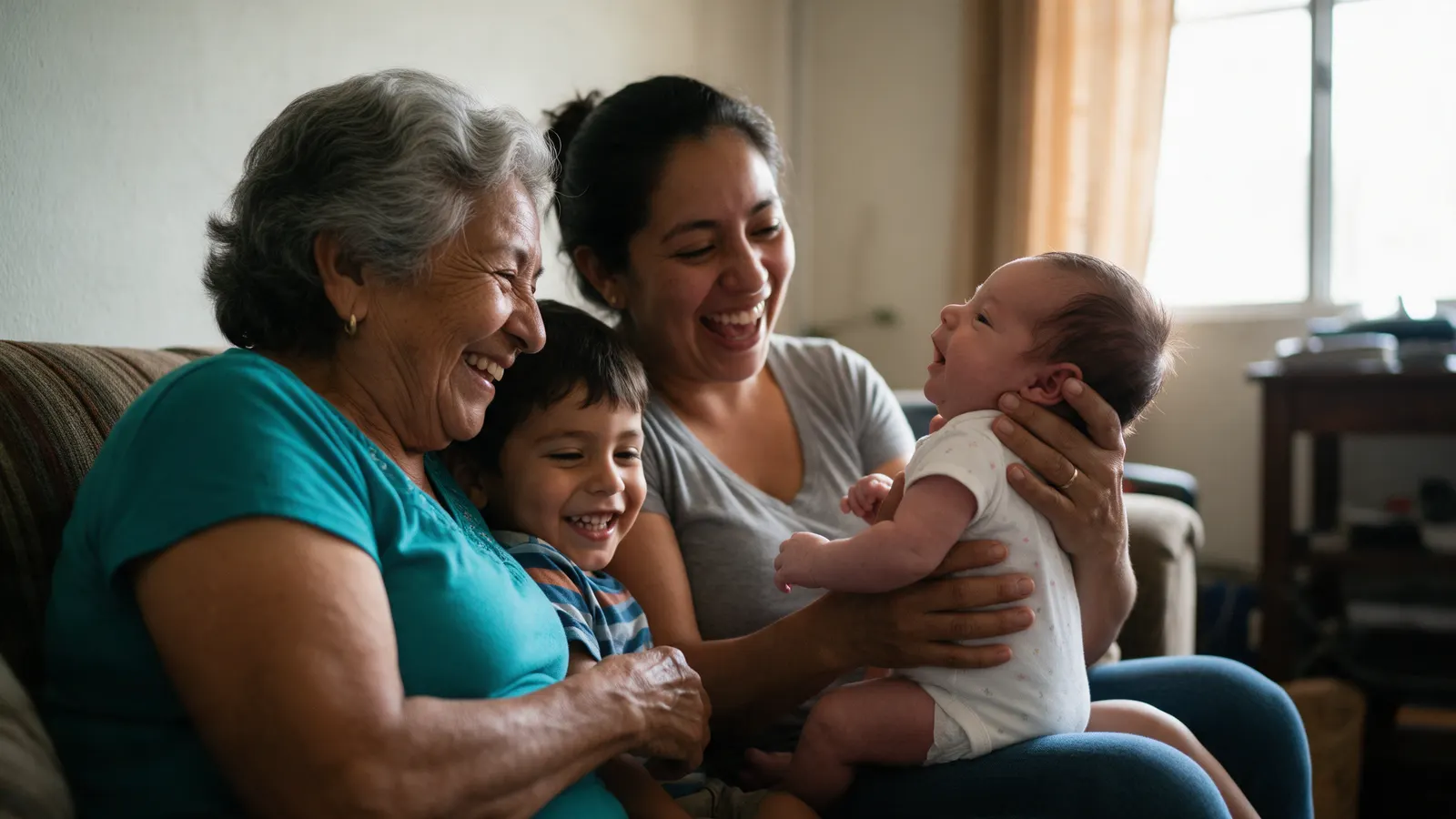
Seven weeks. This is the stretch when many families get the thing they've been waiting for: a smile that is clearly for you.
Heart
By 2 months, most babies calm down when spoken to or picked up, look at your face, seem happy to see you, and smile when you talk to or smile at them (CDC). The AAP says that in the second month, early expressions begin to turn into genuine signals of pleasure and friendliness, and that a smile gives your baby a new way, besides crying, to tell you what they need (AAP).
Head
What to do with a smile: respond quickly and with enthusiasm. The AAP says this tells your baby they're important, they can trust you, and they have some control over their world (AAP). Researchers call that back-and-forth serve and return, and it helps build connections in the brain (Harvard Center on the Developing Child).
"Most babies" has a definition: CDC's lists include skills that at least 75% of babies show by that age (Zubler et al., 2022). Not yet is common. If your baby was born early, count from the due date (AAP). If there's no smile at people by the 2-month checkup, bring it up (CDC).
Body
Smiles travel. A baby who smiles at you can learn to smile at a grandparent, a sibling, a partner, and each new face is a new conversation. Calming when picked up (CDC) is a milestone anyone in the house can collect, including the sibling who gets to feel the baby settle, with your hands underneath.
Try today
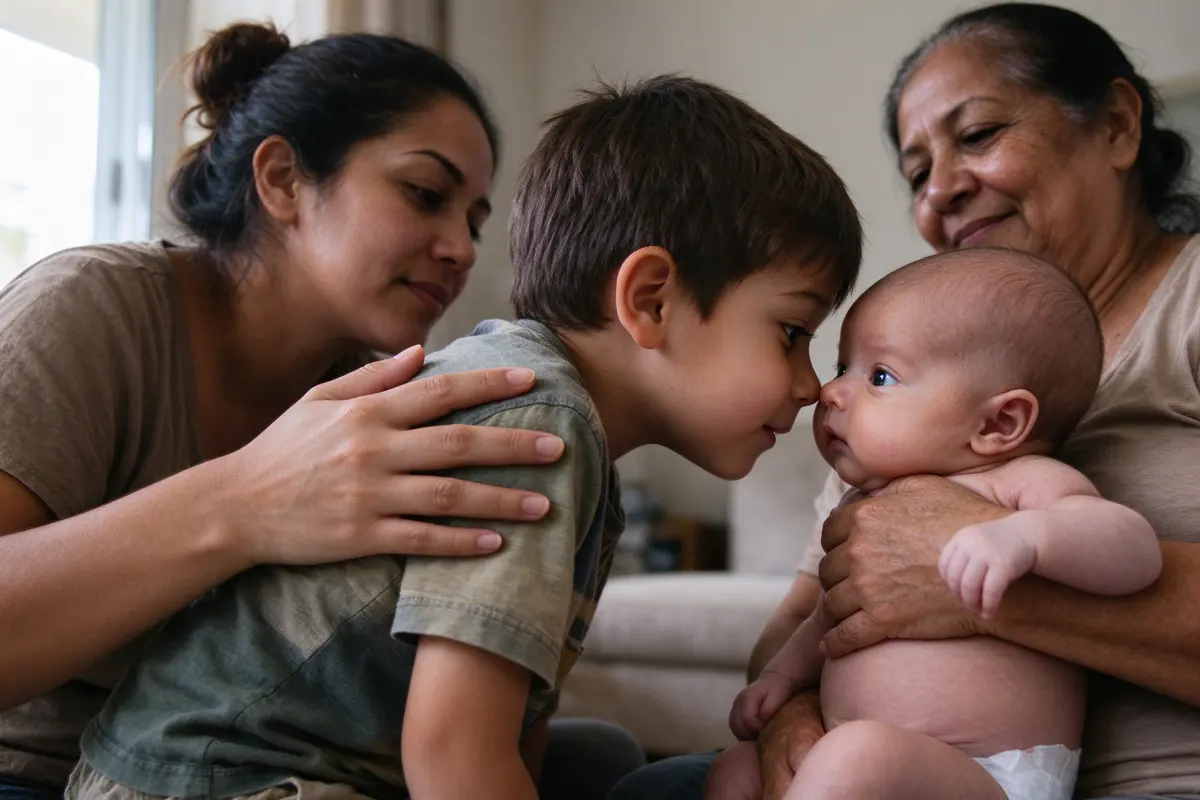
Face tour: everyone smiles
Time: 5 minutes, when your baby is fed and alert · Smile conversations in the guide
Carry your baby to each person in the house, one at a time.
Each one gets close, about 8 to 12 inches (AAP), smiles, raises their eyebrows, and says hello.
Then they wait. Give your baby several seconds.
When the smile comes, that person smiles bigger, says a few words, and pauses again.
For a sibling, sit them on the sofa and hold the baby in front of them, head supported, so the child gets the smile without the lifting.
Make it work:One face at a time, and stop when your baby looks away. No smile for someone today isn't a verdict on that person.
Watch for
Normal
a smile for one person and a blank stare for the next.
Bring it up now rather than waiting
if your baby doesn't smile when you talk to or smile at them by 2 months (CDC).
Normal
a baby who takes a minute to settle in a new lap.
Tell your pediatrician
if your baby doesn't calm down when spoken to or picked up (CDC).
Normal
a quiet baby on a quiet day.
If you have any concern about development,
you can also call your state's early intervention program for a free evaluation; you don't need a doctor's referral or a diagnosis to call (CDC).
For you

Name one thing that got easier. Out loud, to someone. The latch, the car seat buckle, the 2 a.m. change, knowing which cry is which. Seven weeks ago you couldn't do it; now you don't think about it. That's the measure, not the baby book.
If you're the partner: say yours too. And if nothing has gotten easier for you, say that. About 10% of fathers have depression around a birth, with higher rates 3 to 6 months after (Paulson & Bazemore, 2010). The hotline is for you as well: call or text 1-833-TLC-MAMA (1-833-852-6262), or call or text 988 (CDC).
Sources
- Centers for Disease Control and Prevention. "Milestones by 2 Months." Learn the Signs. Act Early., 2026. https://www.cdc.gov/act-early/milestones/2-months.html
- American Academy of Pediatrics. "Emotional & Social Development: Birth Through 3 Months." HealthyChildren.org, 2026. https://www.healthychildren.org/English/ages-stages/baby/Pages/Emotional-and-Social-Development-Birth-to-3-Months.aspx
- Center on the Developing Child at Harvard University. "Serve and Return." https://developingchild.harvard.edu/key-concept/serve-and-return/
- Zubler JM, Wiggins LD, Macias MM, et al. "Evidence-Informed Milestones for Developmental Surveillance Tools." Pediatrics, 2022. https://pubmed.ncbi.nlm.nih.gov/35132439/
- American Academy of Pediatrics. "Corrected Age For Preemies." HealthyChildren.org, 2018. https://www.healthychildren.org/English/ages-stages/baby/preemie/Pages/Corrected-Age-For-Preemies.aspx
- American Academy of Pediatrics. "Infant Vision Development: What Can Babies See?" HealthyChildren.org, 2024. https://www.healthychildren.org/English/ages-stages/baby/Pages/Babys-Vision-Development.aspx
- Centers for Disease Control and Prevention. "Concerned About Your Child's Development?" 2026. https://www.cdc.gov/act-early/families/concerned.html
- Paulson JF, Bazemore SD. "Prenatal and postpartum depression in fathers and its association with maternal depression: a meta-analysis." JAMA, 2010. https://pubmed.ncbi.nlm.nih.gov/20483973/
- Centers for Disease Control and Prevention. "Symptoms of Depression Among Women." 2024. https://www.cdc.gov/reproductive-health/depression/index.html
This guide is general education that summarizes published research and guidance from groups like the American Academy of Pediatrics, the CDC, and the WHO. It isn’t medical advice, and every child develops on their own timeline. Your pediatrician knows your child; if something feels wrong, call them. In an emergency, call 911.
Get each day’s note the morning it applies
Add your baby to a free Chorevia household with their date of birth, and every morning for 60 days the day’s note arrives in the app and by email: what’s developing, one thing to try, what to watch for, and a word for you.
Create your household