Day 35 of 60 · Week 5
Five weeks
Last reviewed · 3 min read · 15 sources · Plain-text version
Five weeks: how fast babies grow now, how much a bottle holds, why the evenings are all feeding, and a gentle leg-and-tummy game for between feeds.
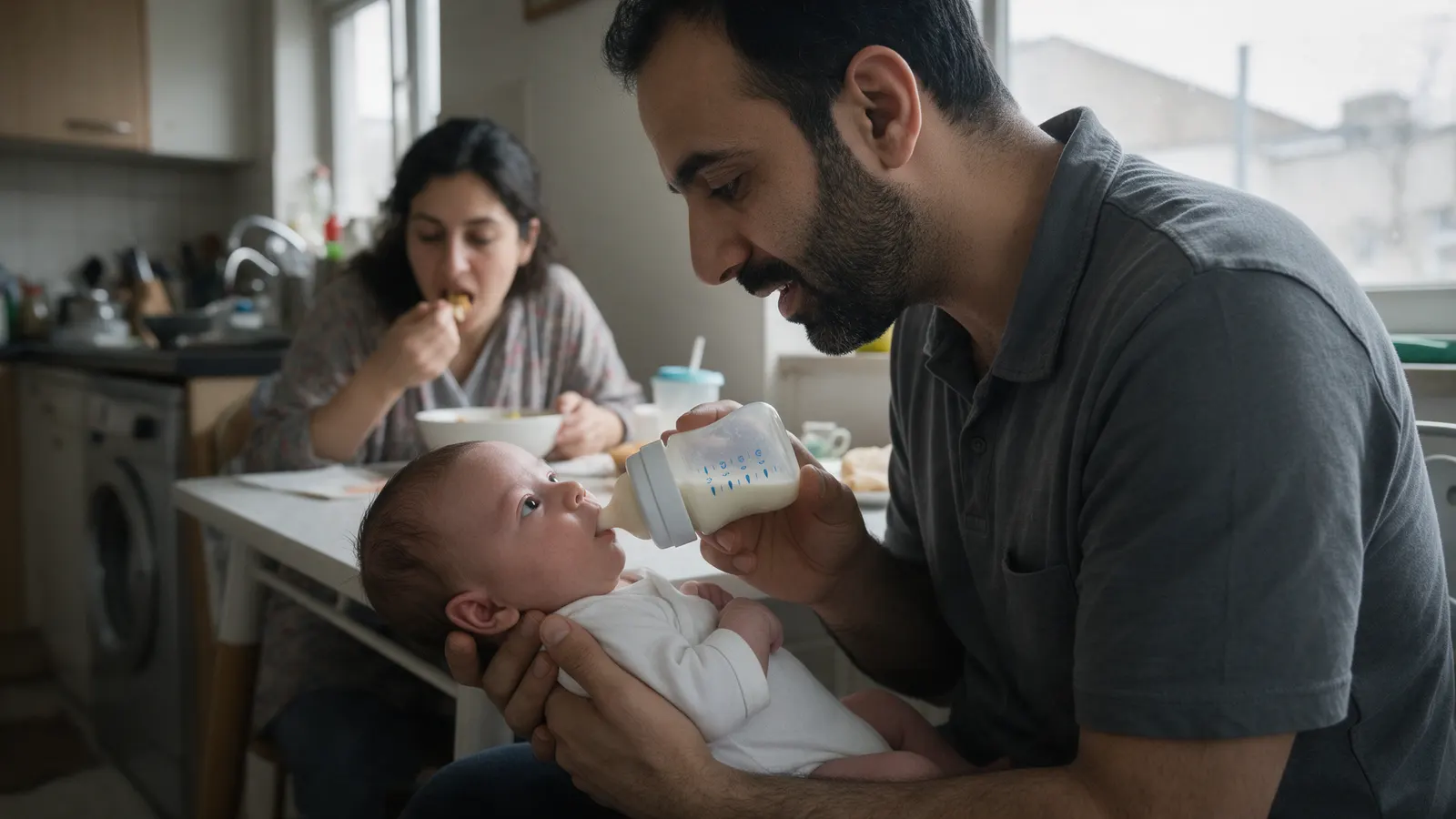
Five weeks today. Your baby is growing faster than they ever will again, and it shows in the feeding: more at each feed, and evenings that feel like one long one.
Heart
Babies typically gain 1.5 to 2 pounds a month now (AAP). That weight is built almost entirely out of the feeds you're doing around the clock. The scale at the 2-month visit will show it.
Head
Formula-fed babies usually take at least 3 to 4 ounces per feed, about every 3 to 4 hours, by the end of the first month; a rough daily guide is 2.5 ounces per pound of body weight, usually topping out around 32 ounces (AAP). Breastfed babies don't have a set amount: feed on cue, watching for early signs like lip smacking and rooting (AAP). On a bottle, watch your baby, not the bottle: stop when they turn away or seem full, even if it isn't empty, and never prop a bottle (CDC). If your baby gets any breast milk, keep giving 400 IU of vitamin D a day (AAP).
Body
Evenings: many breastfed babies bunch feeds together in the evening, sometimes every 30 minutes to an hour, and it doesn't mean your milk supply is low (USDA WIC). Growth spurts get the blame, but a 2024 review found little solid evidence that they happen on a fixed schedule (Davanzo & Baldassarre, 2024).
Diapers: after the first month, some breastfed babies go several days or even a week between bowel movements, and normal grunting and straining are fine (AAP). Gas, though, is real, and today's game is for it.
Try today
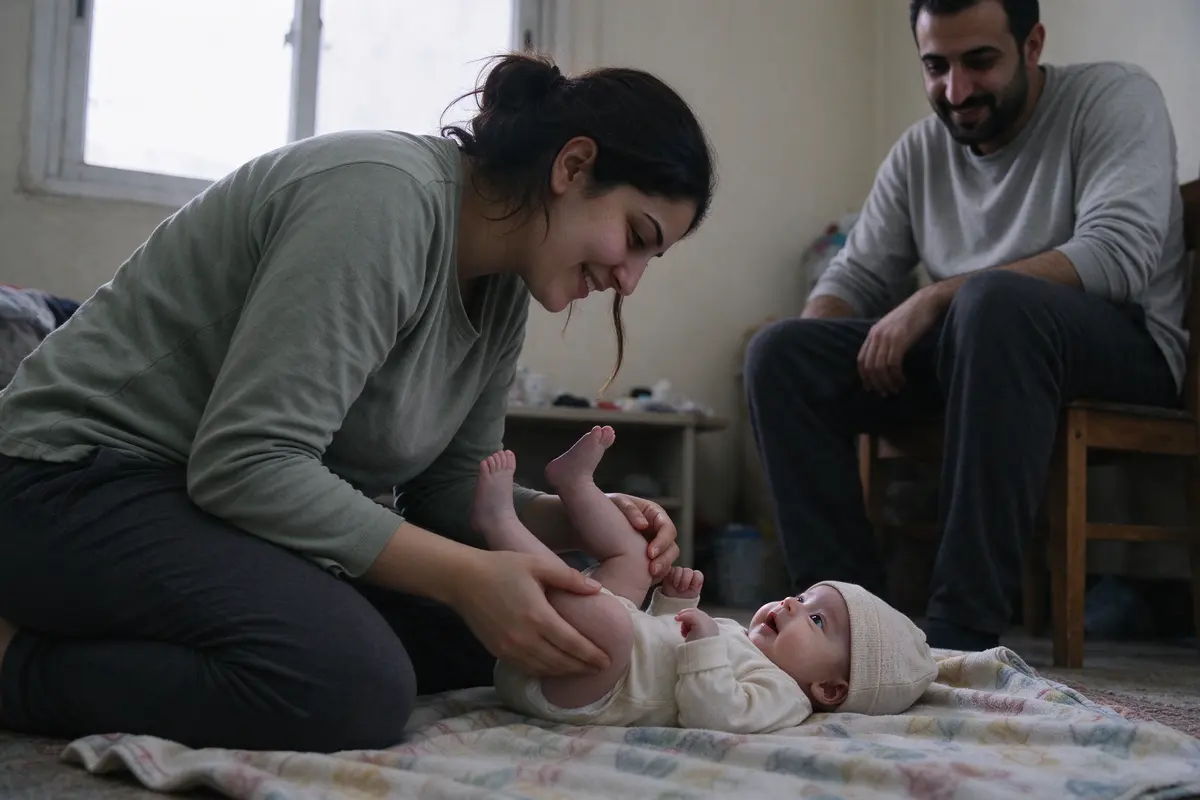
Bicycle legs and tummy rub
Time: 1 to 3 minutes, between feeds · Bicycle legs and tummy rub in the guide
Lay your baby on their back and gently move their legs in a slow pedaling motion.
With warm hands, rub their tummy in slow circles.
Talk as you go, and watch their face.
Make it work:Stop if your baby fusses or turns away. Honest evidence: an AAP article suggests bicycling your baby's legs, a form of baby massage, to help move gas (Jana & Shu, AAP), but a Cochrane review of 34 studies found mostly poor-quality evidence and didn't support routine massage for healthy babies under 6 months (Bennett et al., 2013). Think of it as a way to connect that may help a gassy belly.
Watch for
Normal
evening cluster feeding, with a baby who settles between feeds the rest of the day.
Call your pediatrician within a day
if your baby isn't gaining weight or always seems hungry (AAP).
Normal
days between poops in a breastfed baby who is feeding well.
Normal
easy spit-up after a big feed.
Call your pediatrician right away
if your baby vomits 2 or more times, not just spit-up (AAP).
For you
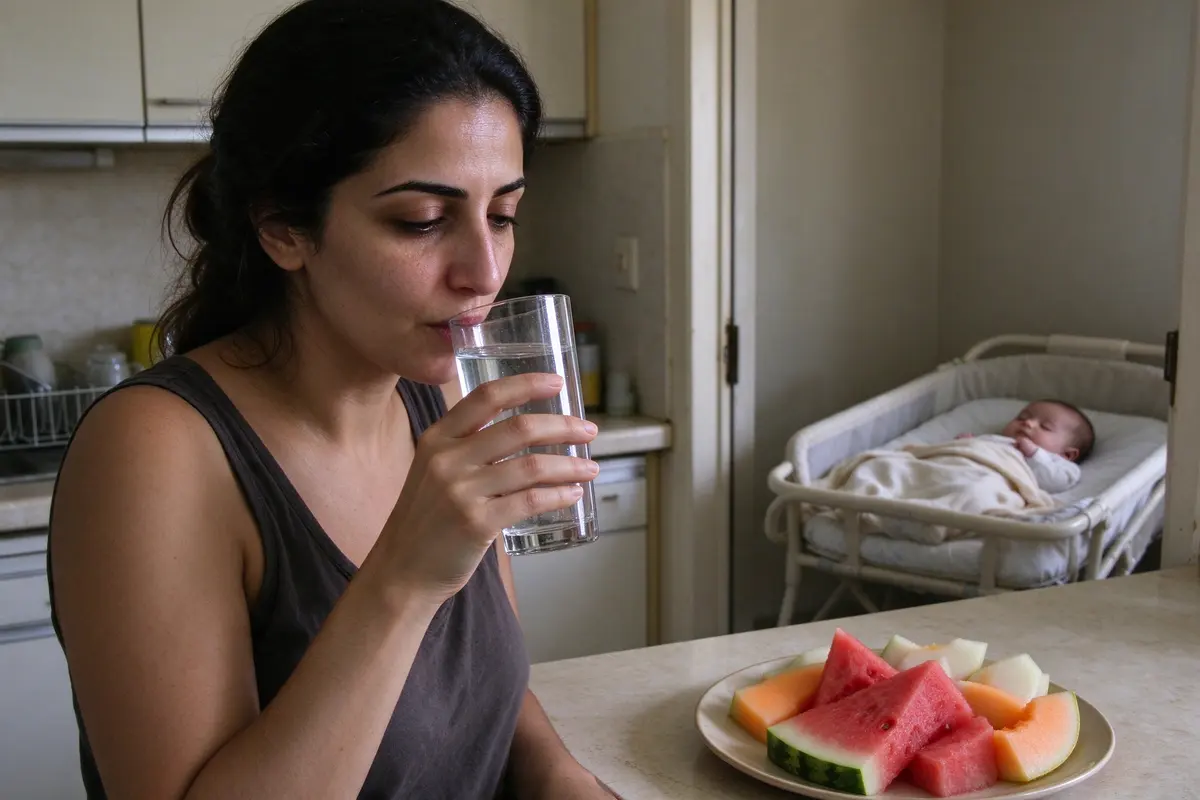
Feeding a baby who's gaining 1.5 to 2 pounds a month takes food. Eat sitting down at least once a day, and keep a glass of water wherever you feed. For constipation, the Office on Women's Health suggests plenty of water and fresh fruits and vegetables (OWH). If you're feeding from the breast, a tender, red, warm area on one breast is a reason to call (MedlinePlus).
If you're the partner: dinner is the witching hour and the cluster-feeding hour at once. Cook, plate, and hand her a fork while she feeds.
Sources
- American Academy of Pediatrics. "Your Baby's Growth & Physical Development: 1 to 4 Months Old." HealthyChildren.org, updated 2026. https://www.healthychildren.org/English/ages-stages/baby/Pages/Physical-Appearance-and-Growth-1-To-3-Months.aspx
- American Academy of Pediatrics. "Amount and Schedule of Baby Formula Feedings." HealthyChildren.org, updated 2022. https://www.healthychildren.org/English/ages-stages/baby/formula-feeding/Pages/amount-and-schedule-of-formula-feedings.aspx
- American Academy of Pediatrics. "How Often to Breastfeed." HealthyChildren.org, updated 2015. https://www.healthychildren.org/English/ages-stages/baby/breastfeeding/Pages/How-Often-to-Breastfeed.aspx
- Centers for Disease Control and Prevention. "About Feeding From a Bottle." 2026. https://www.cdc.gov/infant-toddler-nutrition/bottle-feeding/index.html
- American Academy of Pediatrics Section on Gastroenterology, Hepatology and Nutrition. "Vitamin D for Babies, Children & Adolescents." HealthyChildren.org, updated 2022. https://www.healthychildren.org/English/healthy-living/nutrition/Pages/vitamin-d-on-the-double.aspx
- US Department of Agriculture WIC Breastfeeding Support. "Cluster Feeding and Growth Spurts." Accessed 2026. https://wicbreastfeeding.fna.usda.gov/cluster-feeding-and-growth-spurts
- Davanzo R, Baldassarre ME. "Infant Growth Spurts in the Context of Perceived Insufficient Milk Supply." Nutrients, 2024. https://pmc.ncbi.nlm.nih.gov/articles/PMC11547328/
- American Academy of Pediatrics. "How Can I Tell If My Baby is Constipated?" HealthyChildren.org, updated 2022. https://www.healthychildren.org/English/ages-stages/baby/diapers-clothing/Pages/Infant-Constipation.aspx
- Jana LA, Shu J. "Gas Relief for Babies." HealthyChildren.org, updated 2025. https://www.healthychildren.org/English/ages-stages/baby/diapers-clothing/Pages/Breaking-Up-Gas.aspx
- Bennett C, Underdown A, Barlow J. "Massage for promoting mental and physical health in typically developing infants under the age of six months." Cochrane Database of Systematic Reviews, 2013. https://pubmed.ncbi.nlm.nih.gov/23633323/
- American Academy of Pediatrics. "Crying Baby - Before 3 Months Old" (symptom checker). HealthyChildren.org, accessed 2026. https://www.healthychildren.org/English/tips-tools/symptom-checker/Pages/symptomviewer.aspx?symptom=Crying+Baby+-+Before+3+Months+Old
- American Academy of Pediatrics. "Stools - Blood In" (symptom checker). HealthyChildren.org, accessed 2026. https://www.healthychildren.org/English/tips-tools/symptom-checker/Pages/symptomviewer.aspx?symptom=Stools+-+Blood+In
- American Academy of Pediatrics. "Vomiting Without Diarrhea" (symptom checker). HealthyChildren.org, accessed 2026. https://www.healthychildren.org/English/tips-tools/symptom-checker/Pages/symptomviewer.aspx?symptom=Vomiting+Without+Diarrhea
- Office on Women's Health, US Department of Health and Human Services. "Recovering from birth." https://womenshealth.gov/pregnancy/childbirth-and-beyond/recovering-birth
- MedlinePlus. "Going home after a C-section." National Library of Medicine. https://medlineplus.gov/ency/patientinstructions/000624.htm
This guide is general education that summarizes published research and guidance from groups like the American Academy of Pediatrics, the CDC, and the WHO. It isn’t medical advice, and every child develops on their own timeline. Your pediatrician knows your child; if something feels wrong, call them. In an emergency, call 911.
Get each day’s note the morning it applies
Add your baby to a free Chorevia household with their date of birth, and every morning for 60 days the day’s note arrives in the app and by email: what’s developing, one thing to try, what to watch for, and a word for you.
Create your household