Day 307 of 365 · Week 41
Forty-one weeks: pat-a-cake and games with you
Last reviewed · 4 min read · 8 sources · Plain-text version
Playing games with you, like pat-a-cake, is on the 12-month list, and copying gestures comes toward the end of the first year. Today, wait for the game they start and play it their way.

Forty-one weeks. Somewhere this month the games stop being yours and start being theirs: the hands come up before you've said "pat-a-cake," the blanket goes over the face before you've said "where's the baby." Today is games with you, and the one rule that makes them teach.
Heart
By 1 year, most babies play games with you, like pat-a-cake (CDC). By 9 months, most already smile or laugh at peekaboo (CDC); the 12-month version is the baby doing a part of the game, not just enjoying it. Toward the end of the first year, babies copy the gestures they see you use (AAP), and your baby is 10 months old, so what you may see this month is a clap that arrives at the right moment, a hand over the eyes, a wrist flick that's most of a wave. Playing the games is also how a baby learns that they go in turns, which is the shape of every conversation they'll ever have.
Head
CDC suggests teaching gestures like waving and shaking your head for "no" (CDC), and the guide rates the pat-a-cake activity's evidence as emerging: whether practice speeds the gestures up hasn't been tested (CDC). What has been studied is attention. In 24 babies followed monthly from 9 to 15 months, time spent sharing attention with their mothers, and mothers' talk about what the baby was already looking at, predicted the earliest gestures and words (Carpenter et al., 1998). A link, not a cause, and a small study. But it points at the rule for today: the game that teaches most is the one the baby was already playing.
Body
The guide's activity is Bye-bye and pat-a-cake, which you've been doing since month nine: wave whenever someone leaves, clap and sing with their hands guided at first, raise your arms for "So big!" and wait for the copy. Today reverses it. Instead of starting the game, you wait for them to start one, however roughly, and then you play it exactly as offered. Repeat their sounds, add simple words, and describe what they see (CDC) applies to games too: repeat their move, add one of yours, pause.
Try today

The game they start
Time: Whenever it happens, a few minutes each time · Bye-bye and pat-a-cake in the guide
Sit on the floor facing your baby and do nothing for a full minute. Watch for a move aimed at you: a clap, a hand over the eyes, a block held out, a raspberry.
Copy the move exactly, once, and wait. If it comes again, you have a game (AAP).
Play it their way: their speed, their ending. If the game is "I cover my eyes and you say boo," don't turn it into pat-a-cake.
Add one thing, a word for the move ("Clap!") or a bigger face, then go back to their version (CDC).
When they stop, stop. The game is over when the baby says so.
Make it work:The clap that comes at the wrong moment still counts. Copy it anyway; the timing is what the next hundred rounds are for.
Watch for
Normal
a clap at the start of pat-a-cake and a blank stare at the end; games with you are a 12-month skill (CDC).
Talk with your pediatrician
if your baby seems not to see or hear well (AAP).
Normal
a baby who plays peekaboo with you and hides from the grandfather; wariness of strangers is often one of the first emotional milestones (AAP).
Mention it at the 12-month visit
if your baby's fear is very intense across the board (Brooker et al., 2013).
Normal
a game that ends in a wail because it ended.
Go to the ER now
if your baby had a seizure with a fever, has a stiff neck, or has a bulging soft spot (AAP).
For you
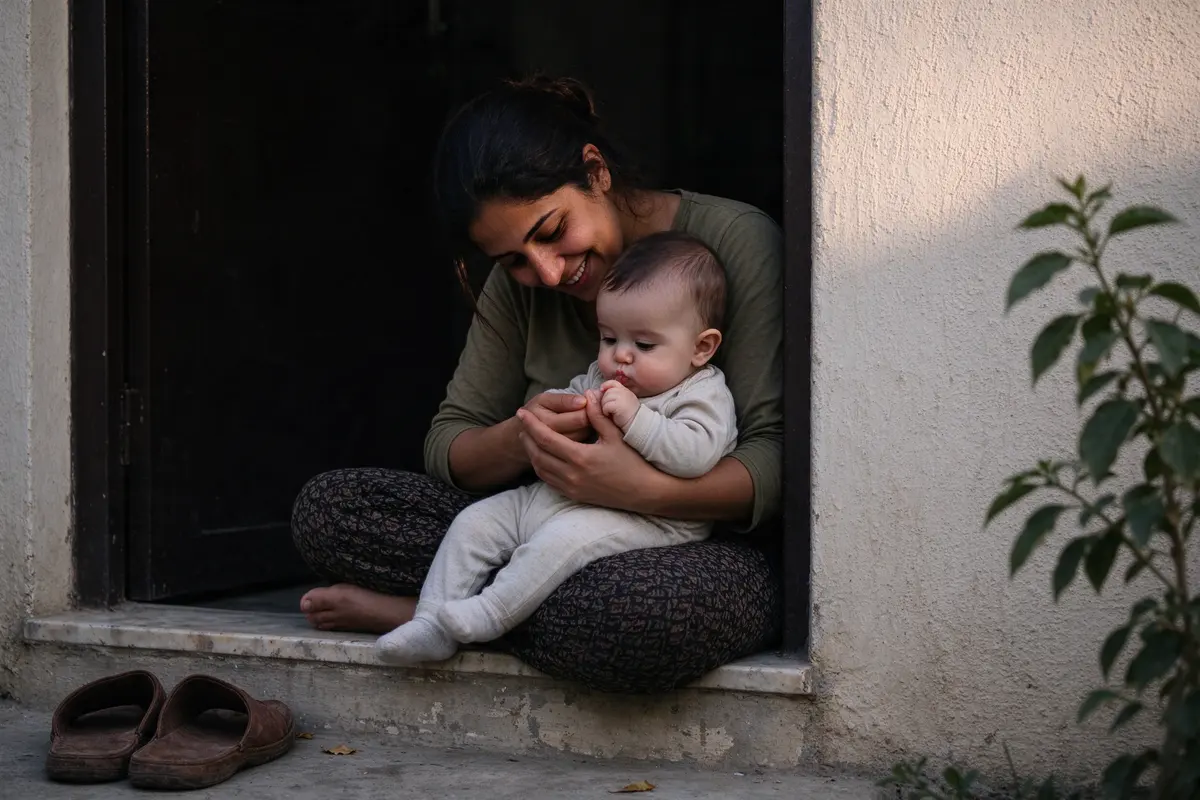
Let them lead once a day. It's harder than it sounds, because you have a hundred better games and twenty minutes before the nap. But the talk that predicted the earliest gestures and words in the study was talk about what the baby was already looking at (Carpenter et al., 1998), and the same goes for play: the game that teaches is the one they chose. One round a day on their terms is the whole assignment. The rest of the day can be your games, with your songs, at your speed, and that's fine too.
If you're the partner: the grandfather's game, the one with the slippers or the nose, is the game the baby starts with him. Don't fix it or improve it. Film it instead.
Sources
- Centers for Disease Control and Prevention. "Milestones by 1 Year." Learn the Signs. Act Early. program, updated 2026. https://www.cdc.gov/act-early/milestones/1-year.html
- Centers for Disease Control and Prevention. "Milestones by 9 Months." Learn the Signs. Act Early. program, updated 2026. https://www.cdc.gov/act-early/milestones/9-months.html
- American Academy of Pediatrics. "Language Development: 8 to 12 Months." HealthyChildren.org, updated 2009. https://www.healthychildren.org/English/ages-stages/baby/Pages/Language-Development-8-to-12-Months.aspx
- Carpenter M, Nagell K, Tomasello M. "Social cognition, joint attention, and communicative competence from 9 to 15 months of age." Monographs of the Society for Research in Child Development, 1998. https://pubmed.ncbi.nlm.nih.gov/9835078/
- American Academy of Pediatrics. "Checkup Checklist: 9 Months Old." HealthyChildren.org, updated 2021. https://www.healthychildren.org/English/ages-stages/Your-Childs-Checkups/Pages/Your-Checkup-Checklist-9-Months-Old.aspx
- American Academy of Pediatrics. "Emotional and Social Development: 8 to 12 Months." HealthyChildren.org, updated 2009. https://www.healthychildren.org/English/ages-stages/baby/Pages/Emotional-and-Social-Development-8-12-Months.aspx
- Brooker RJ, Buss KA, Lemery-Chalfant K, et al. "The development of stranger fear in infancy and toddlerhood: normative development, individual differences, antecedents, and outcomes." Developmental Science, 2013. https://pubmed.ncbi.nlm.nih.gov/24118713/
- American Academy of Pediatrics. "Fever" (symptom checker). HealthyChildren.org, accessed 2026. https://www.healthychildren.org/English/tips-tools/symptom-checker/Pages/symptomviewer.aspx?symptom=Fever
This guide is general education that summarizes published research and guidance from groups like the American Academy of Pediatrics, the CDC, and the WHO. It isn’t medical advice, and every child develops on their own timeline. Your pediatrician knows your child; if something feels wrong, call them. In an emergency, call 911.
Get each day’s note the morning it applies
Add your baby to a free Chorevia household with their date of birth, and every morning for 365 days the day’s note arrives in the app and by email: what’s developing, one thing to try, what to watch for, and a word for you.
Create your household