Day 323 of 365 · Week 44
Tip-overs, standing baby
Last reviewed · 4 min read · 8 sources · Plain-text version
Dressers, bookcases, and TV stands are what a standing baby pulls up on. CPSC's numbers, the STURDY Act, and why anchoring still matters. The pull-up test: push every piece, anchor what moves.
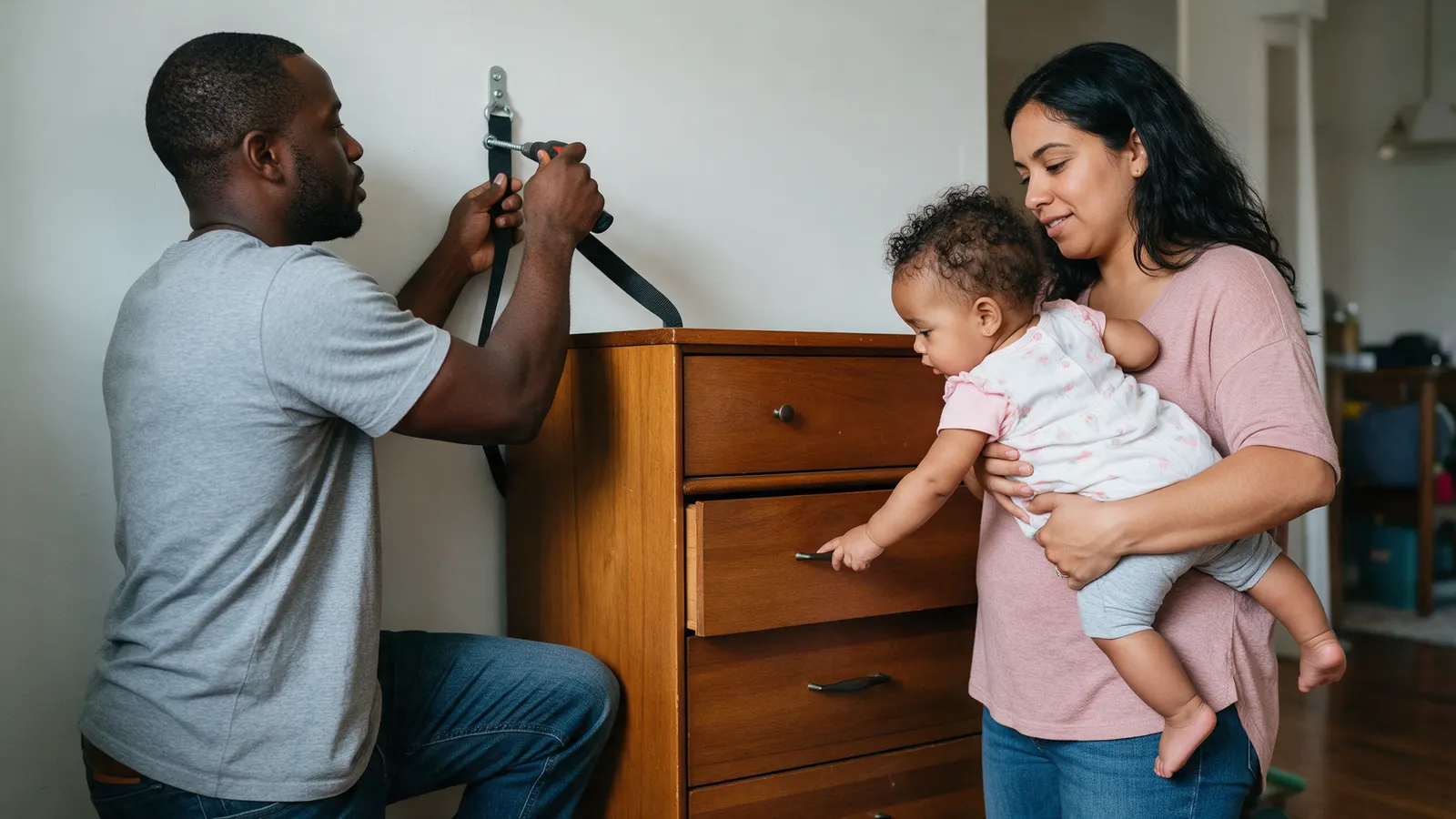
The furniture a baby pulls up on this month is the furniture that can come down on them. Today is the tip-over, the one home hazard that got a federal law, and a test you do with your own two hands.
Heart
By 1 year, most babies pull up to stand (CDC), and the things they pull up on are rarely the sturdy sofa. They're the dresser with the drawer pulls at hand height, the bookcase with the toy on the second shelf, the TV stand. The AAP's rule is one line: anchor bookcases, dressers, and TV stands to the wall (AAP). CPSC counted 234 deaths from dresser and other clothing-storage tip-overs from 2000 to April 2022, 199 of them children (CPSC). A child is treated in an emergency department for a tip-over injury about every 53 minutes, and more than half of reported tip-over deaths from 2013 to 2023 were children ages 1 to 3 (CPSC, 2024). Your baby is a few weeks from that age group.
Head
Under the STURDY Act, dressers made since September 2023 must pass tougher stability tests, but CPSC still advises anchoring them (CPSC). Two reasons that matters for a house with a standing baby: the dresser you own was probably made before the standard, and the standard covers clothing storage, not the bookcase or the TV stand. The guide's section is Furniture and TV tip-overs. Nothing on the AAP's list says "if it seems sturdy." It says anchor it (AAP).
Body
A pull-up isn't a gentle lean. Your baby grabs the highest edge they can reach, loads their whole weight onto it, and comes down the same way, often before they know how to get back down on their own (AAP). That's a sideways tug at the top of the piece, repeated many times a day. The test today copies the tug, with your hands instead of theirs, so the furniture tells you what it would do before the baby finds out.
Try today
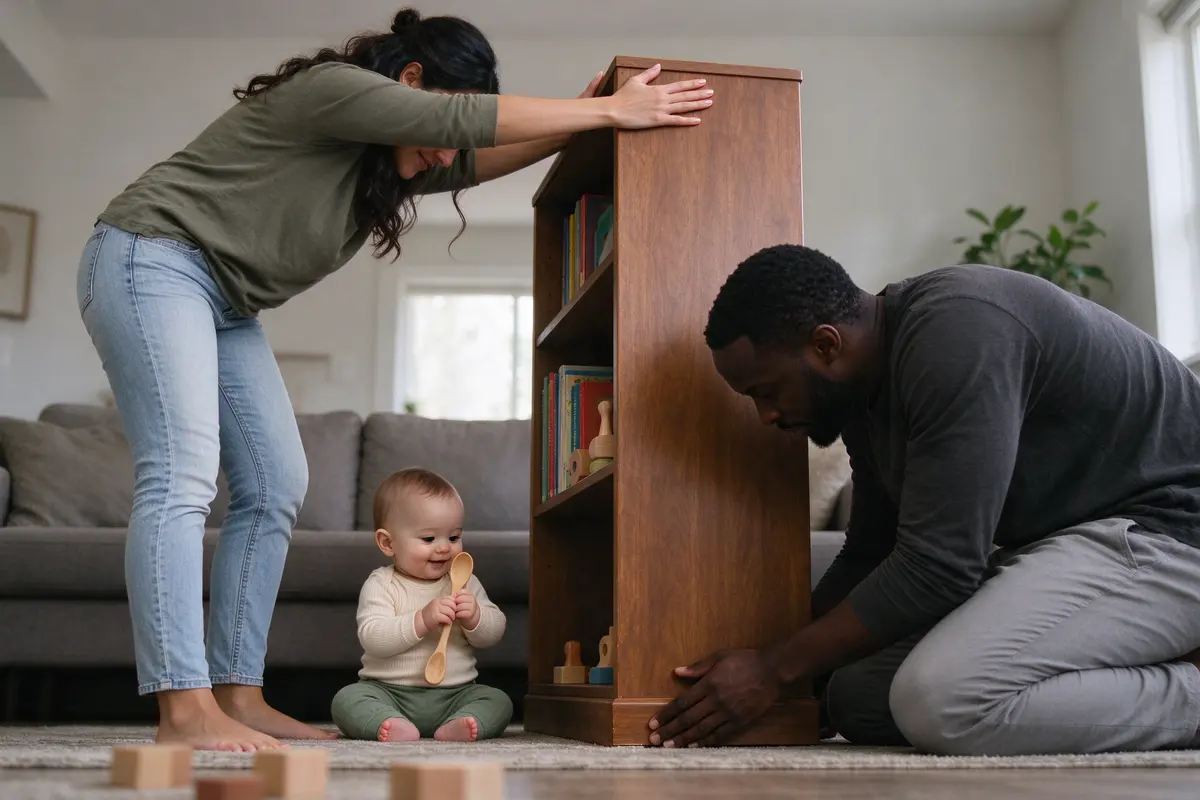
The pull-up test
Time: 15 minutes, every room with furniture · Furniture and TV tip-overs in the guide
Put the baby on the floor with someone, or in the crib. Go to every piece they could pull up on: dressers, bookcases, the TV stand, the changing table, the nightstand.
Put both hands at the height your baby's hands reach and pull toward you, then sideways, with a firm tug. Open the top drawer and pull again.
Anything that rocks, lifts a foot, or shifts gets an anchor strap into a wall stud today; CPSC's advice is to anchor even a dresser that passed the new tests (CPSC).
The TV itself gets anchored to the wall too, not only the stand under it (CPSC, 2024; AAP).
Take the toy off the second shelf and the remote off the top, so there's less reason to climb.
Make it work:Anchor before you load. A higher shelf on an unanchored piece is a heavier thing to pull over.
Watch for
Normal
a baby who stands at the dresser pulling the bottom drawer open and shut forty times, and who would climb into it if it opened far enough; dropping and banging are experiments in how things work (AAP).
Call your pediatrician now
for any head injury in a baby under 1 year, even if your baby seems fine (AAP).
Normal
pulling up on anything at hand height and coming down with a thump, since getting down comes after getting up (AAP).
Call 911
if your baby is not moving, is very weak, or can't be woken (AAP).
Normal
a pinched finger in a drawer, a cry, and a cuddle.
Call your pediatrician right away
if your baby cries when touched or moved, or won't move an arm or leg normally (AAP).
For you
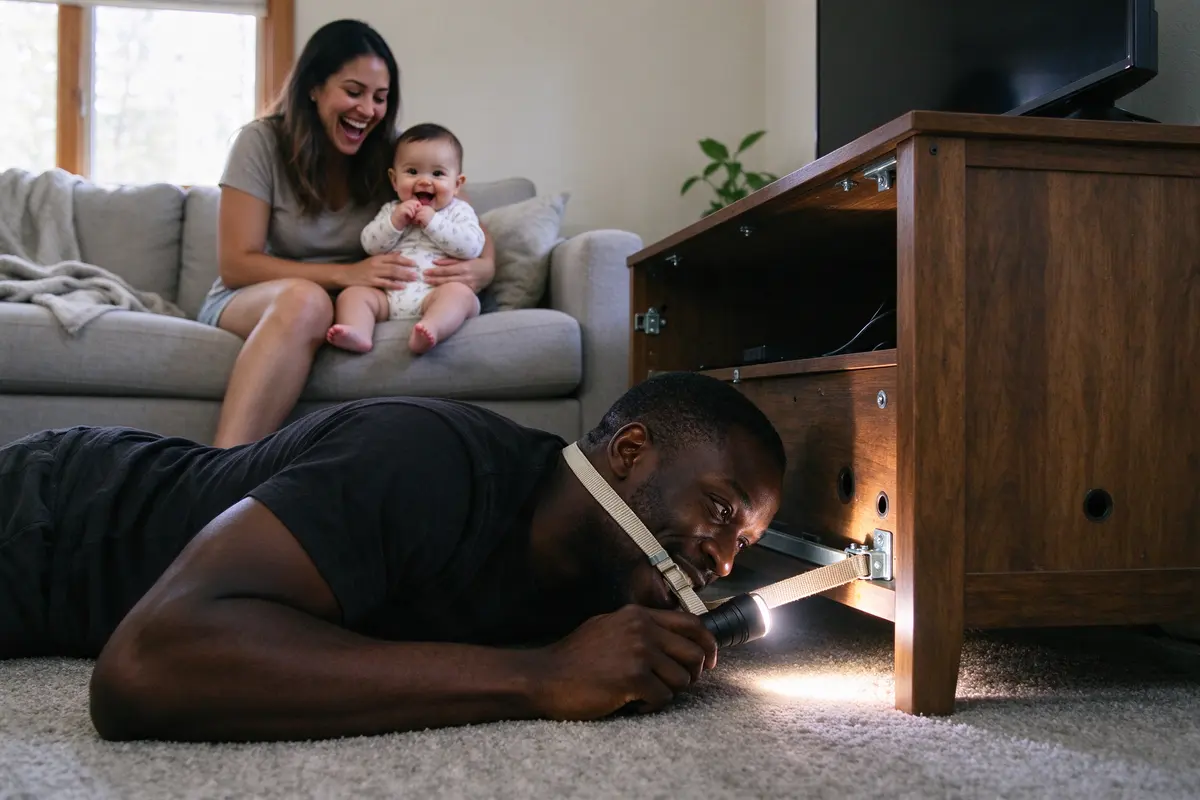
The TV stand too. It's the piece that gets skipped, because the TV is heavy and the stand looks solid and nobody wants to move the cables. Anchor bookcases, dressers, and TV stands to the wall: the AAP lists all three, and the TV stand isn't last by accident (AAP). If the straps are still in the drawer from the crawling-height sweep, the drawer they're in is probably one of the ones that needs them. A rented place can be anchored too; the holes are small, and it's worth asking the landlord today rather than wondering.
If you're the partner: the flashlight-on-the-floor job behind the TV is yours tonight. Find the studs, strap the stand, strap the TV. Then tell her it's done, because she's been thinking about it.
Sources
- Centers for Disease Control and Prevention. "Milestones by 1 Year." Learn the Signs. Act Early. program, updated 2026. https://www.cdc.gov/act-early/milestones/1-year.html
- American Academy of Pediatrics. "Home Safety: Tips for Families With Young Children." HealthyChildren.org, updated 2022. https://www.healthychildren.org/English/safety-prevention/at-home/Pages/Home-Safety-Heres-How.aspx
- US Consumer Product Safety Commission. "CPSC Adopts Final Consumer Product Safety Standard to Prevent Tip-overs of Dressers and Other Clothing Storage Units." 2023. https://www.cpsc.gov/Newsroom/News-Releases/2023/CPSC-Adopts-Final-Consumer-Product-Safety-Standard-to-Prevent-Tip-overs-of-Dressers-and-Other-Clothing-Storage-Units
- US Consumer Product Safety Commission. "Ahead of Sunday's Game, CPSC Reminds Families to Tackle the Deadly Hazard of TV and Furniture Tip-Overs." 2024. https://www.cpsc.gov/Newsroom/News-Releases/2024/Ahead-of-Sundays-Game-CPSC-Reminds-Families-to-Tackle-the-Deadly-Hazard-of-TV-and-Furniture-Tip-Overs
- American Academy of Pediatrics. "Movement Milestones in Babies 8 to 12 Months Old." HealthyChildren.org, updated 2021. https://www.healthychildren.org/English/ages-stages/baby/Pages/Movement-8-to-12-Months.aspx
- American Academy of Pediatrics. "Cognitive Development in Infants: 8 to 12 Months." HealthyChildren.org, updated 2023. https://www.healthychildren.org/English/ages-stages/baby/Pages/Cognitive-Development-8-to-12-Months.aspx
- American Academy of Pediatrics. "Head Injury" (symptom checker). HealthyChildren.org, accessed 2026. https://www.healthychildren.org/English/tips-tools/symptom-checker/Pages/symptomviewer.aspx?symptom=Head+Injury
- American Academy of Pediatrics. "Fever" (symptom checker). HealthyChildren.org, accessed 2026. https://www.healthychildren.org/English/tips-tools/symptom-checker/Pages/symptomviewer.aspx?symptom=Fever
This guide is general education that summarizes published research and guidance from groups like the American Academy of Pediatrics, the CDC, and the WHO. It isn’t medical advice, and every child develops on their own timeline. Your pediatrician knows your child; if something feels wrong, call them. In an emergency, call 911.
Get each day’s note the morning it applies
Add your baby to a free Chorevia household with their date of birth, and every morning for 365 days the day’s note arrives in the app and by email: what’s developing, one thing to try, what to watch for, and a word for you.
Create your household