Day 319 of 365 · Week 43
New fears
Last reviewed · 4 min read · 8 sources · Plain-text version
The dark, thunder, the vacuum: new fears are common now and arrive with separation anxiety. Name the feeling, stay close, don't force the thing. The vacuum from your arms, from across the room.
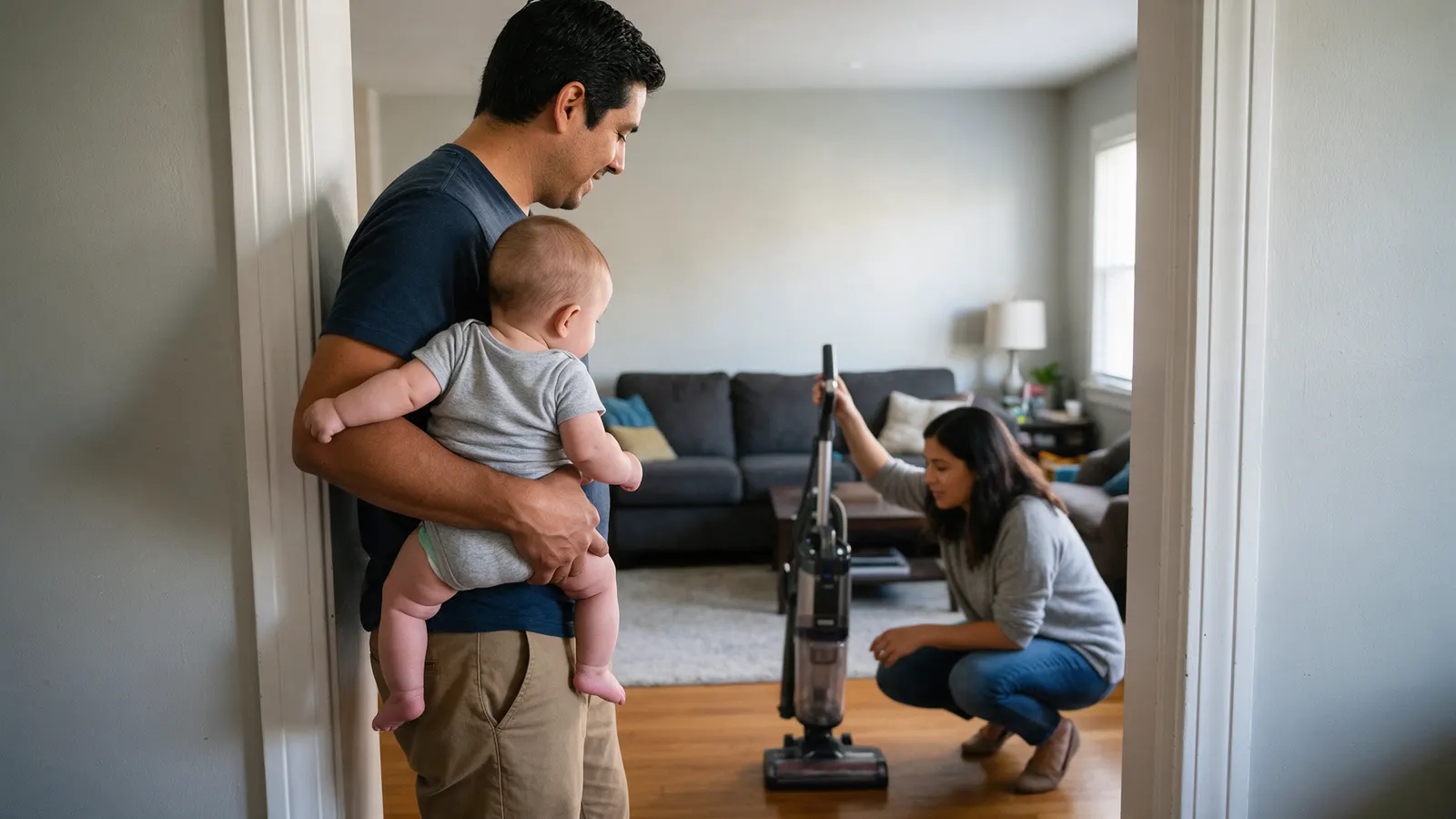
A baby who sat through the vacuum for nine months may now scream at it. Today is why the fears show up at the same time as the goodbyes, and a way to introduce the loud thing that doesn't make it worse.
Heart
The AAP lists new fears of the dark, thunder, or the vacuum as common in these months, right alongside separation anxiety, which peaks between 10 and 18 months (AAP). Your baby can now tell familiar from unfamiliar (AAP), remembers that things exist when they're out of sight (AAP), and has no way yet to know that a loud thing will stop. A fear at ten months is memory working.
Head
The research on fear: in 1,285 twins followed from 6 to 36 months, the most common patterns started with little fear at 6 months that rose over time, and children whose fear was high and steady from the start, or rose sharply, were more inhibited at age 3 (Brooker et al., 2013). The study was about strangers; the takeaway carries over: some wariness is expected, and very intense fear is worth mentioning at checkups (Brooker et al., 2013). A baby who hates the vacuum is in the common pattern. One frightened of most things, most days, is a sentence for the 12-month visit.
Body
The AAP's advice for new people is the right shape for new noises too: go slowly, and let your baby watch from your arms first (AAP). The CDC's tip is to name feelings out loud (CDC), which gives the fear a word before your baby has one. Stay close, name it, don't force the thing. The vacuum will be there next week; the lesson worth teaching today is that you were there and it ended. The guide's section is Stranger and separation anxiety.
Try today
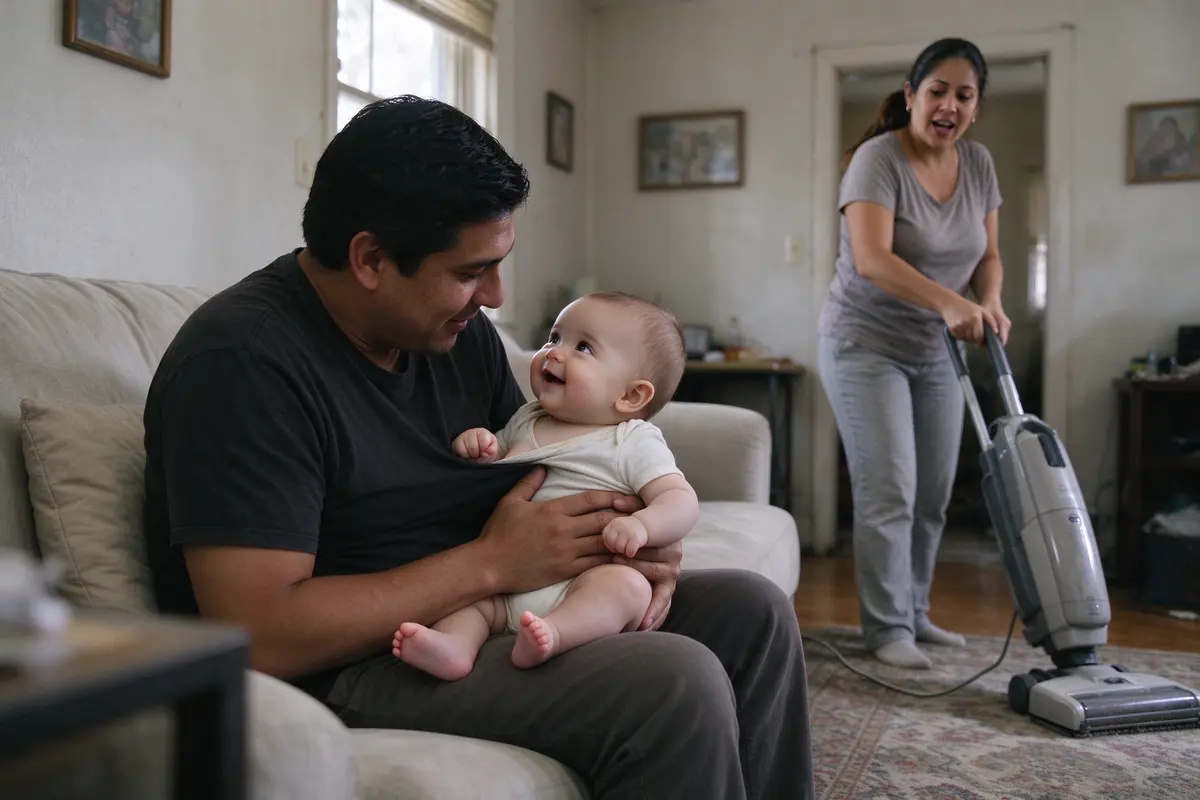
The vacuum from your arms
Time: 2 to 3 minutes, once today
Pick the loud thing your baby fears, parked and switched off, across the room. Sit with your baby on your lap and look at it together: "That's the vacuum. It's loud. It's off."
Have the other adult switch it on for ten seconds at the far end of the room while you hold your baby and name what happens: "Loud! You're scared. I've got you." (CDC)
Off. "All done. It stopped." Wait, and let your baby look at it again from your arms (AAP).
Stop there. If ten seconds was too much, tomorrow is five, or just the looking.
Make it work:The baby in your arms, never on the floor beside it. The point is a loud thing that ends, not a brave baby.
Watch for
Normal
a sudden terror of the vacuum, the blender, or the dark hallway in a baby who never minded them (AAP).
Mention it at the 12-month visit
if your baby's fear is very intense across the board; fear that was high and steady, or rose sharply, went with more inhibition at age 3 (Brooker et al., 2013).
Normal
a wail at a clap of thunder and a laugh a minute later at the same sky.
Call your pediatrician right away
if your baby screams and can't be consoled, or has cried nonstop for more than 2 hours (AAP).
Normal
a startle and a cling at the blender, over by the time the smoothie is poured.
Bring it up
if your baby doesn't react to loud sounds at all, or seems not to hear well (AAP).
For you
Your own fears count too. Most of them this year have been about the baby, and the vacuum is a fair mirror: the scary thing is real, and the way through was never to pretend it wasn't there. Some of what you fear has a checklist you've carried since the first week: the urgent warning signs run a full year after birth, and the rule is care now, not later, telling whoever sees you that you were pregnant within the last year (CDC). The fear that doesn't attach to anything and doesn't lift has a number: call or text 1-833-TLC-MAMA (1-833-852-6262), or 988 (CDC). Name it, stay close to someone, don't force yourself through it alone.
If you're the partner: you run the vacuum today, and you watch her face as much as the baby's. Ask what the loud thing is for her this month, and don't fix it; be the other adult in the room when it switches on.
Sources
- American Academy of Pediatrics. "Emotional and Social Development: 8 to 12 Months." HealthyChildren.org, updated 2009. https://www.healthychildren.org/English/ages-stages/baby/Pages/Emotional-and-Social-Development-8-12-Months.aspx
- American Academy of Pediatrics. "Cognitive Development in Infants: 8 to 12 Months." HealthyChildren.org, updated 2023. https://www.healthychildren.org/English/ages-stages/baby/Pages/Cognitive-Development-8-to-12-Months.aspx
- Brooker RJ, Buss KA, Lemery-Chalfant K, et al. "The development of stranger fear in infancy and toddlerhood: normative development, individual differences, antecedents, and outcomes." Developmental Science, 2013. https://pubmed.ncbi.nlm.nih.gov/24118713/
- Centers for Disease Control and Prevention. "Milestones by 9 Months." Learn the Signs. Act Early. program, updated 2026. https://www.cdc.gov/act-early/milestones/9-months.html
- American Academy of Pediatrics. "Crying Child - 3 Months and Older" (symptom checker). HealthyChildren.org, accessed 2026. https://www.healthychildren.org/English/tips-tools/symptom-checker/Pages/symptomviewer.aspx?symptom=Crying+Child+-+3+Months+and+Older
- American Academy of Pediatrics. "Checkup Checklist: 9 Months Old." HealthyChildren.org, updated 2021. https://www.healthychildren.org/English/ages-stages/Your-Childs-Checkups/Pages/Your-Checkup-Checklist-9-Months-Old.aspx
- Centers for Disease Control and Prevention. "Urgent Maternal Warning Signs and Symptoms." HEAR HER campaign, accessed 2026. https://www.cdc.gov/hearher/maternal-warning-signs/index.html
- Centers for Disease Control and Prevention. "Symptoms of Depression Among Women." 2024. https://www.cdc.gov/reproductive-health/depression/index.html
This guide is general education that summarizes published research and guidance from groups like the American Academy of Pediatrics, the CDC, and the WHO. It isn’t medical advice, and every child develops on their own timeline. Your pediatrician knows your child; if something feels wrong, call them. In an emergency, call 911.
Get each day’s note the morning it applies
Add your baby to a free Chorevia household with their date of birth, and every morning for 365 days the day’s note arrives in the app and by email: what’s developing, one thing to try, what to watch for, and a word for you.
Create your household