Day 324 of 365 · Week 44
Car seat, month eleven
Last reviewed · 4 min read · 4 sources · Plain-text version
Rear-facing until the seat's top weight or height. Infant seats fit up to 22 to 35 pounds and 26 to 35 inches depending on the model; a convertible seat comes next, rear-facing. The outgrown check.

The infant seat that came home from the hospital has a top line on its label, and a baby near eleven months is closer to it than you think. Today is the car seat at this age, the seat that comes next, and ten minutes with a scale and a tape measure.
Heart
The rule hasn't moved: keep your baby rear-facing until they reach the top weight or height their seat allows. When they outgrow an infant-only seat, switch to a convertible or all-in-one seat installed rear-facing (AAP). Rear-facing-only infant seats typically fit babies up to 22 to 35 pounds and 26 to 35 inches, depending on the model (AAP), and that range is wide enough that the only number that matters is the one on your seat. The guide's section is Car seats; the fuller one is in the 6-month guide.
Head
Outgrowing is about the label, not the legs. Bent legs are fine: children are flexible, and leg injuries in rear-facing seats are very rare (AAP). A baby whose feet press the back seat is still rear-facing on purpose, and will be well past the first birthday; the AAP says to keep toddlers rear-facing as long as possible, and most convertible seats allow it until 2 or later (AAP). What does end the infant seat is the weight or the height limit on its label, and a 10-month-old who was long at birth can be near it now.
Body
The fit inside the seat is the other half. Keep the harness snug, the chest clip at armpit level, and bulky coats off under the straps (AAP). A baby who can pull up and cruise has shoulders and a chest that have grown since the last time anyone checked the strap height, and a coat season may have arrived since the pinch test was last done. Never put a rear-facing seat in front of an active airbag (AAP); the back seat is where it lives.
Try today
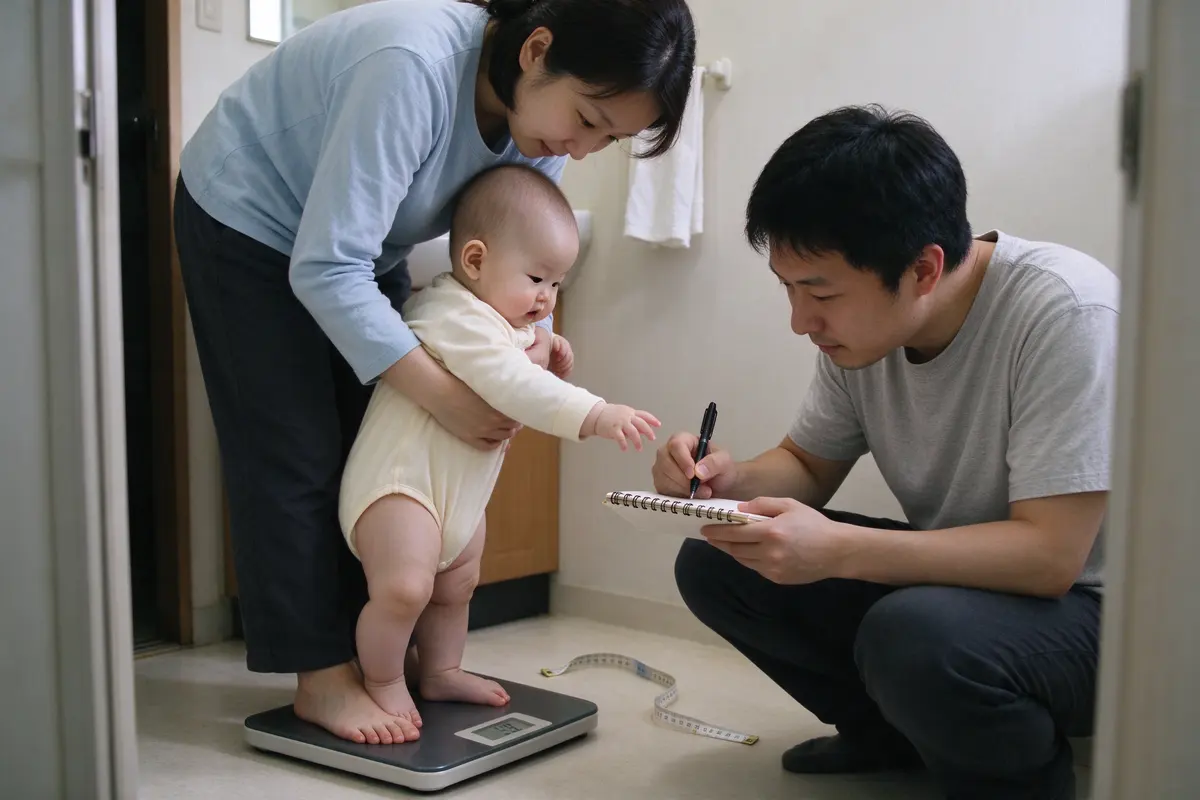
The outgrown check
Time: 10 minutes · Car seats in the guide
Find the label on the side of the infant seat and write down its top weight and top height; those two numbers, not your baby's age, are what end the seat (AAP).
Weigh your baby at home: you on the scale, then you holding them, and subtract. Measure them lying flat, heel to head, on the floor.
Compare. If either number is within a couple of pounds or an inch of the limit, the next seat gets bought this week, and installed rear-facing (AAP).
While the baby is in the seat, redo the fit: harness snug, chest clip at armpit level, no coat under the straps (AAP).
Make it work:The 12-month visit will give you an exact weight and length; today's numbers only need to tell you whether to shop before then.
Watch for
Normal
a baby who arches and howls at being buckled now that they'd rather be standing; the seat is still for every ride (AAP).
Call your pediatrician right away
if your baby cries nonstop, or cries when touched or moved (AAP).
Normal
feet pressed flat against the back seat and knees bent; bent legs are fine, and leg injuries in rear-facing seats are very rare (AAP).
Talk with your pediatrician
if your baby uses one arm or leg much more than the other (AAP).
Normal
a nap that starts in the car and ends, as always, flat on their back in a bare crib once you're home (AAP).
Go to the ER now
if your baby is hard to wake, isn't alert when awake, or seems confused (AAP).
For you

The next seat is bought before it's needed. The day the infant seat is outgrown is not a day you want to discover at the curb, with a baby over the limit and an errand to run; the AAP's switch to a convertible seat is a plan, and a plan has a date (AAP). It's also the one purchase this year with a clear instruction: rear-facing, as long as the seat allows. Everything else about it, the color, the cup holder, the price, is yours to not care about.
If you're the partner: you read the manual tonight, the whole thing, and install the seat on a weekend morning with the baby asleep, not in the dark the night before a trip. Then she checks it. Two sets of hands on the straps is the rule from here on.
Sources
- American Academy of Pediatrics. "Car Seats: Information for Families." HealthyChildren.org, updated 2026. https://www.healthychildren.org/English/safety-prevention/on-the-go/Pages/Car-Safety-Seats-Information-for-Families.aspx
- American Academy of Pediatrics. "Fever" (symptom checker). HealthyChildren.org, accessed 2026. https://www.healthychildren.org/English/tips-tools/symptom-checker/Pages/symptomviewer.aspx?symptom=Fever
- American Academy of Pediatrics. "Movement Milestones in Babies 8 to 12 Months Old." HealthyChildren.org, updated 2021. https://www.healthychildren.org/English/ages-stages/baby/Pages/Movement-8-to-12-Months.aspx
- American Academy of Pediatrics. "Getting Your Baby to Sleep." HealthyChildren.org, updated 2024. https://www.healthychildren.org/English/ages-stages/baby/sleep/Pages/getting-your-baby-to-sleep.aspx
This guide is general education that summarizes published research and guidance from groups like the American Academy of Pediatrics, the CDC, and the WHO. It isn’t medical advice, and every child develops on their own timeline. Your pediatrician knows your child; if something feels wrong, call them. In an emergency, call 911.
Get each day’s note the morning it applies
Add your baby to a free Chorevia household with their date of birth, and every morning for 365 days the day’s note arrives in the app and by email: what’s developing, one thing to try, what to watch for, and a word for you.
Create your household