Day 305 of 365 · Week 41
First helping games
Last reviewed · 4 min read · 12 sources · Plain-text version
The urge to help shows up before the first birthday. Hand me a sock, drop the block in the bin, thank you. Family jobs come at a year; this is the seed. The block in the bin.
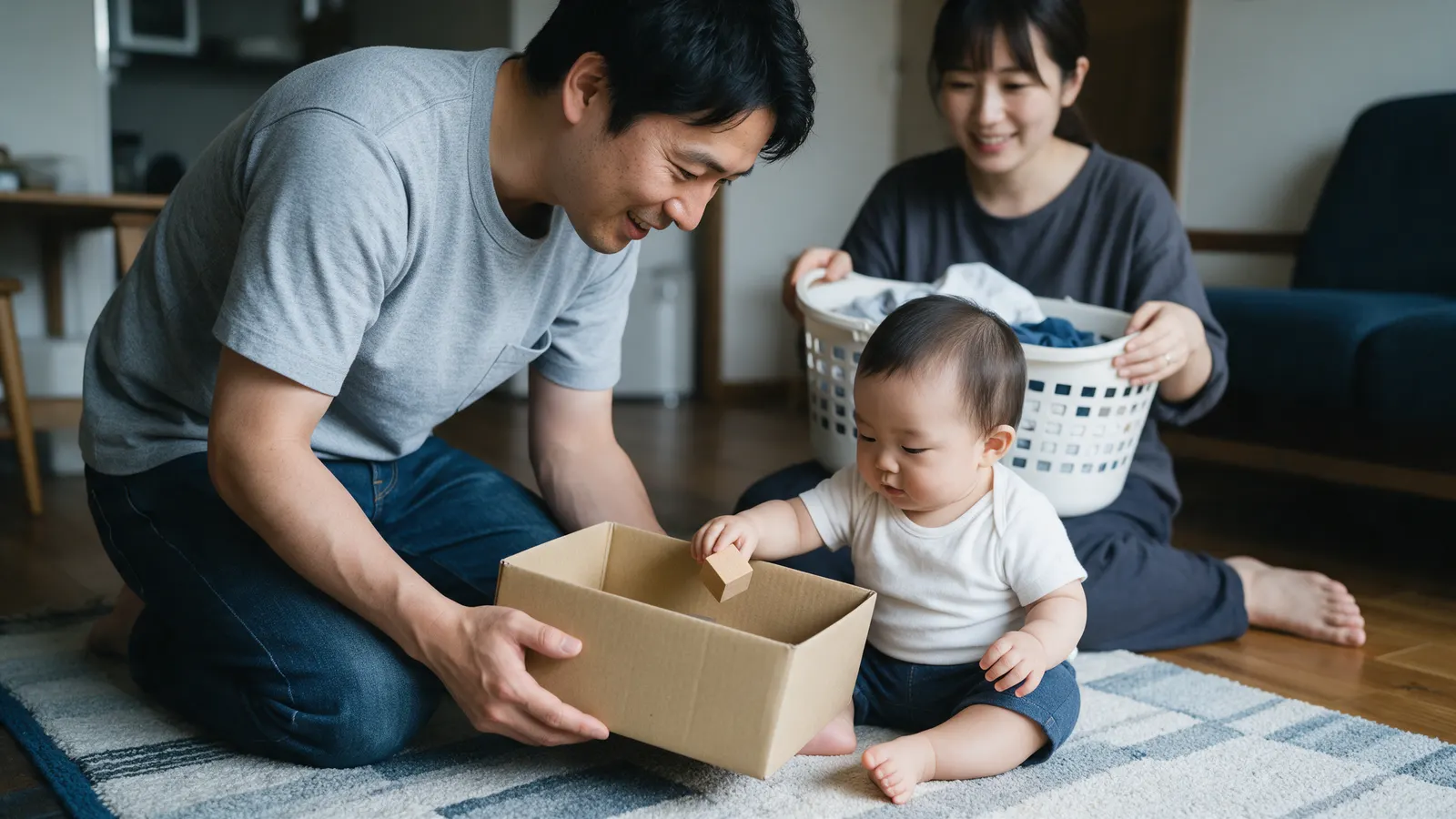
It's too early for chores, and the guide says so. But the thing chores are built on, the wish to be useful to the people you love, is already in the room. Today is what the research found, and a game that gives it somewhere to go.
Heart
In experiments, 12-month-olds pointed to show an adult where a lost object was, more often when the adult hadn't seen where it went (Liszkowski et al., 2008). By 18 months, toddlers readily help adults reach their goals, with nothing in it for them (Warneken & Tomasello, 2006), and even 14-month-olds handed over objects an adult was reaching for (Warneken & Tomasello, 2007). At home, most children start helping around their first birthday (Dahl, 2015). Your baby is 10 months old, a few weeks short of the youngest babies in those studies. The urge is being assembled now, out of handing you the spoon and watching your face.
Head
The guide's instruction: give that urge somewhere to go. Pass a toy back and forth (CDC), ask your baby to hand you a sock or drop a block in the bin, and say a warm thank-you. The first real family jobs come next year, in Family jobs for helpers in diapers: CDC suggests including a child in everyday tasks like fetching shoes or carrying napkins to the table (CDC), and the AAP's advice is to make it a game and not to discourage the urge to help, even when it takes longer (AAP). Expect it to be unhelpful: in a survey of more than 500 families, most parents of 1- to 4-year-olds said their child's help was sometimes unhelpful (Hammond & Brownell, 2018).
Body
The block in the bin is also, as it happens, a milestone: by 1 year, most babies put something in a container, like a block in a cup (CDC). Letting go on purpose is the hand skill underneath it, the same one that makes dropping and throwing favorite games (AAP). So a bin on the floor is practice for two things at once. The guide's section is First helping games.
Try today

The block in the bin
Time: 5 minutes, at tidy-up time · Family jobs for helpers in diapers in the guide
Put a low, open bin on the floor and four blocks beside it. Drop one in yourself, slowly, and say "In!"
Hand your baby a block and hold the bin close. Wait. When it goes in, by drop, throw, or accident, say "Thank you!" like it was the thing you needed most (CDC).
Tip the bin out together, and go again. Dumping is half the game and most of the fun.
Later, the sock version: hold out the laundry basket and ask for the sock in their hand. Twelve-month-olds in the lab pointed to help an adult find something (Liszkowski et al., 2008); a sock in a basket is the household edition.
Make it work:Blocks too big to fit entirely in the mouth (AAP). The thank-you is the whole reward; no treat, no sticker.
Watch for
Normal
a block handed over and instantly screamed for; letting go on purpose is new (AAP).
Call 911
if your baby has purple or blood-colored spots or dots on the skin (AAP).
Normal
the bin ignored and the basket climbed into.
Bring it up
if by 12 months your baby doesn't pull up to stand, wave bye-bye, or look for a toy they saw you hide (CDC).
Normal
a sock pulled off and chewed instead of delivered.
Call your pediatrician right away
if your baby won't move an arm or leg normally, or cries when touched or moved (AAP).
For you
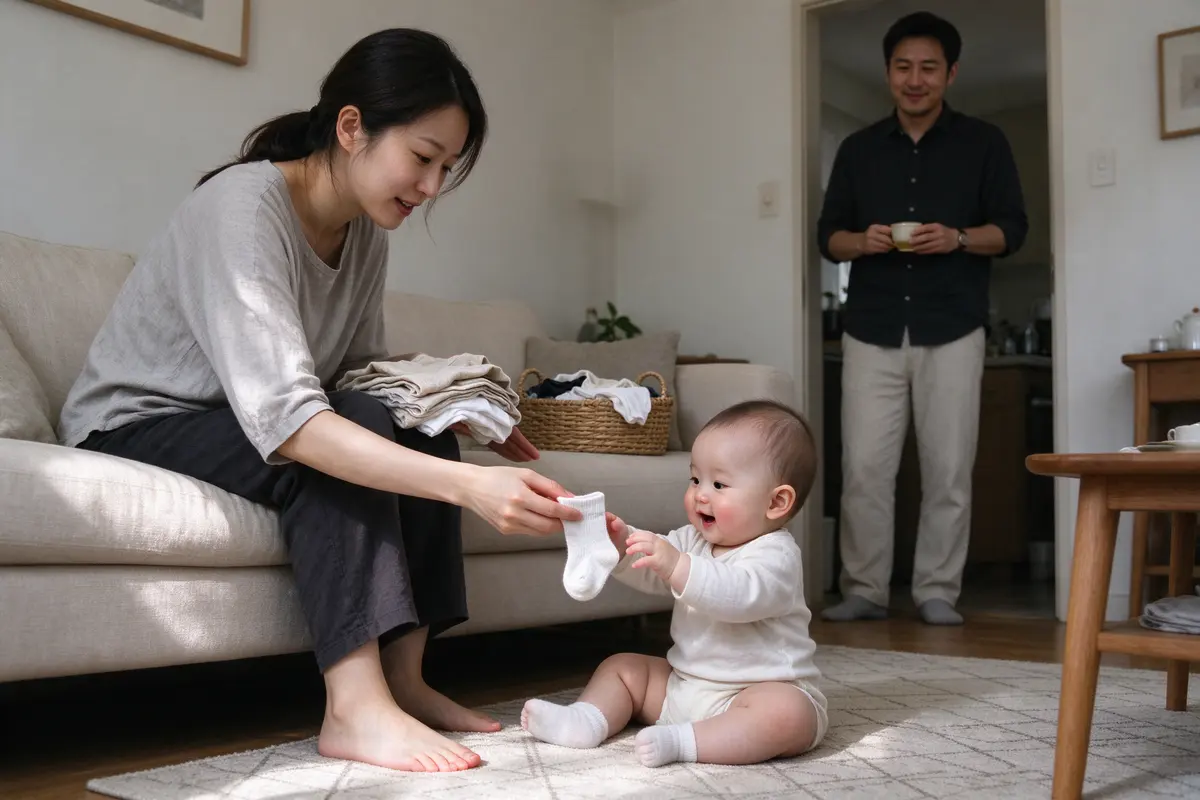
Chorevia's first family jobs are a few weeks away, and this is the seed. Everything the app will ever do with chores rests on what the lab found about toddlers: they help with nothing in it for them (Warneken & Tomasello, 2006), and most start at home around the first birthday (Dahl, 2015). Family jobs stay unpaid and stay a game; the AAP's line is don't discourage the urge, even when it costs you time (AAP). Today it costs you a tipped-over bin. That's the price of a helper, and it's cheap.
If you're the partner: hold the basket tonight. Your thank-you is being studied as closely as hers, and the sock that lands on the floor beside the basket still gets it.
Sources
- Liszkowski U, Carpenter M, Tomasello M. "Twelve-month-olds communicate helpfully and appropriately for knowledgeable and ignorant partners." Cognition, 2008. https://pubmed.ncbi.nlm.nih.gov/18721918/
- Warneken F, Tomasello M. "Altruistic helping in human infants and young chimpanzees." Science, 2006. https://pubmed.ncbi.nlm.nih.gov/16513986/
- Warneken F, Tomasello M. "Helping and Cooperation at 14 Months of Age." Infancy, 2007. https://pubmed.ncbi.nlm.nih.gov/33412734/
- Dahl A. "The Developing Social Context of Infant Helping in Two U.S. Samples." Child Development, 2015. https://pubmed.ncbi.nlm.nih.gov/25800068/
- Centers for Disease Control and Prevention. "Milestones by 9 Months." Learn the Signs. Act Early. program, updated 2026. https://www.cdc.gov/act-early/milestones/9-months.html
- Centers for Disease Control and Prevention. "Milestones by 15 Months." Learn the Signs. Act Early. program, accessed 2026. https://www.cdc.gov/act-early/milestones/15-months.html
- American Academy of Pediatrics. "Social Development: 1 Year Olds." HealthyChildren.org, updated 2009. https://www.healthychildren.org/English/ages-stages/toddler/Pages/Social-Development-1-Year-Olds.aspx
- Hammond SI, Brownell CA. "Happily Unhelpful: Infants' Everyday Helping and its Connections to Early Prosocial Development." Frontiers in Psychology, 2018. https://pubmed.ncbi.nlm.nih.gov/30298039/
- Centers for Disease Control and Prevention. "Milestones by 1 Year." Learn the Signs. Act Early. program, updated 2026. https://www.cdc.gov/act-early/milestones/1-year.html
- American Academy of Pediatrics. "Hand and Finger Skills." HealthyChildren.org, updated 2009. https://www.healthychildren.org/English/ages-stages/baby/Pages/Hand-and-Finger-Skills.aspx
- Bradin S. "Choking Prevention for Babies & Children: What Every Parent Needs to Know." HealthyChildren.org, updated 2026. https://www.healthychildren.org/English/health-issues/injuries-emergencies/Pages/Choking-Prevention.aspx
- American Academy of Pediatrics. "Fever" (symptom checker). HealthyChildren.org, accessed 2026. https://www.healthychildren.org/English/tips-tools/symptom-checker/Pages/symptomviewer.aspx?symptom=Fever
This guide is general education that summarizes published research and guidance from groups like the American Academy of Pediatrics, the CDC, and the WHO. It isn’t medical advice, and every child develops on their own timeline. Your pediatrician knows your child; if something feels wrong, call them. In an emergency, call 911.
Get each day’s note the morning it applies
Add your baby to a free Chorevia household with their date of birth, and every morning for 365 days the day’s note arrives in the app and by email: what’s developing, one thing to try, what to watch for, and a word for you.
Create your household