Day 322 of 365 · Week 44
Windows, gates, cords
Last reviewed · 4 min read · 9 sources · Plain-text version
A screen won't stop a fall: window guards or windows opened from the top. Wall-mounted gates, no accordion style. Cordless coverings, and cords 3 feet from the crib. The window check.
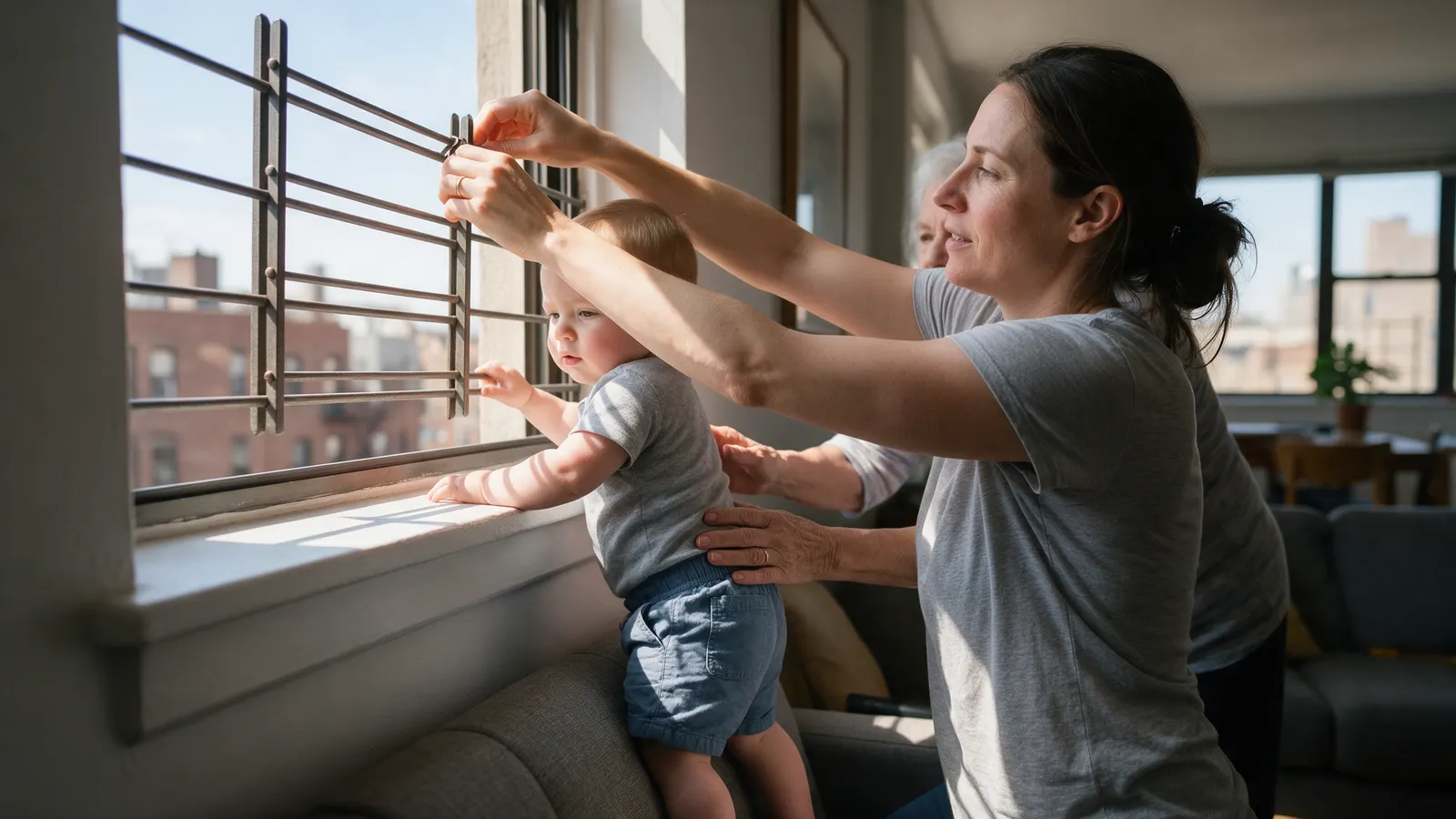
Forty-four weeks. Three things in a home don't care how careful you are: a window with a screen, a gate that can trap an arm, and a cord within reach of a crib. Today is the AAP's short list for each, and a walk to every window your baby could reach from a piece of furniture.
Heart
Windows first, because a standing baby at a sofa under a sill is a new fact this month. The AAP's rule: open windows from the top or install window guards, and remember that a screen won't stop a fall (AAP). Window stops should keep a window from opening more than 4 inches, and about 5,600 children 12 and under were treated in emergency departments for window falls in 2024 (CPSC, 2026). By 1 year, most babies pull up to stand and cruise along furniture (CDC); a sofa, a bed, or a toy chest under a window is a step up to it.
Head
Gates go at the top and bottom of stairs, mounted firmly to the wall studs; skip accordion-style gates, which can trap an arm or neck (AAP). Cords are the quiet one. Cordless window coverings are the only way to remove the strangulation risk from blind cords (CPSC); about nine children 5 and under die each year from window-cord strangulation, which can happen in under a minute, so choose cordless coverings and move cribs and furniture away from windows (CPSC, 2021). Keep baby monitor, lamp, and night-light cords at least 3 feet from the crib (CPSC, 2019).
Body
The guide's section is Childproof at crawling height, and the crawling-height version of this walk was done weeks ago. What changed is the furniture: the mattress at its lowest position before standing, cords well away from the crib (AAP), and now every piece a baby can pull up on becomes a platform. Today's walk measures each window against the nearest thing a standing baby can climb from, not against the floor.
Try today
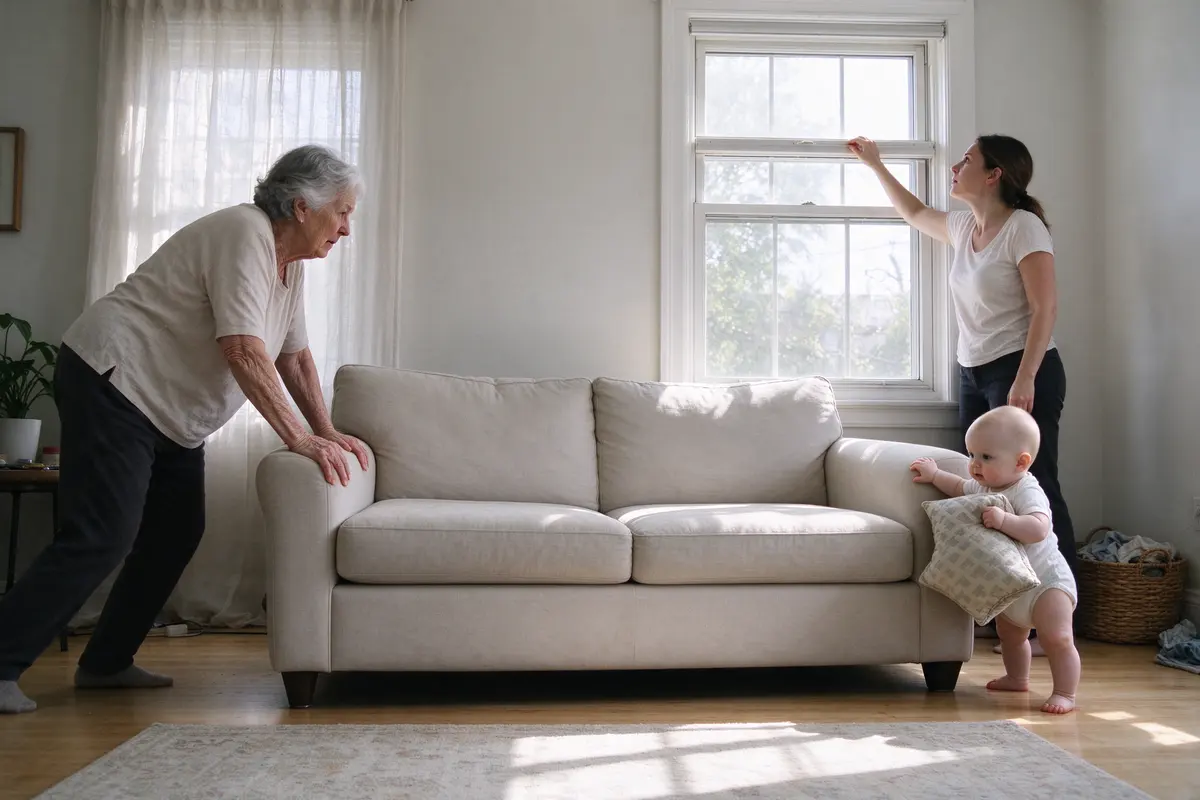
The window check
Time: 15 minutes · Childproof at crawling height in the guide
Go to every window your baby could reach from furniture: a sofa, a bed, a chair, a crib, a toy chest. Count them; the number is usually higher than you'd guess.
For each one, either it opens only from the top, or it has a guard or a stop, or it stays locked. A screen doesn't count (AAP).
Move the furniture away from the window where you can, the crib first (CPSC, 2021).
Any blind or shade with a cord goes on the replace list; in the meantime, the cord is tied up out of reach, not just tucked (CPSC).
Finish at the crib: monitor, lamp, and night-light cords measured at 3 feet or more from it (CPSC, 2019).
Make it work:Do the top floor and the stairs' gates in the same trip: top and bottom, screwed to the studs, no accordion gate anywhere (AAP).
Watch for
Normal
a baby who stands at the sofa arm and slaps the window for the dog outside; cruising along furniture is a 12-month milestone (CDC).
Call 911
if your baby has a seizure, or was knocked out for more than a minute, after any fall (AAP).
Normal
the stair gate rattled, mouthed, and used as a pull-up bar.
Go to the ER now
if, after a head injury, your baby vomits 2 or more times, cries and won't stop, or is awake but not alert (AAP).
Normal
a fascination with the tied-up blind cord's tassel, which is why it's going.
Call 911
if your baby is struggling for each breath or can barely cry (AAP).
For you
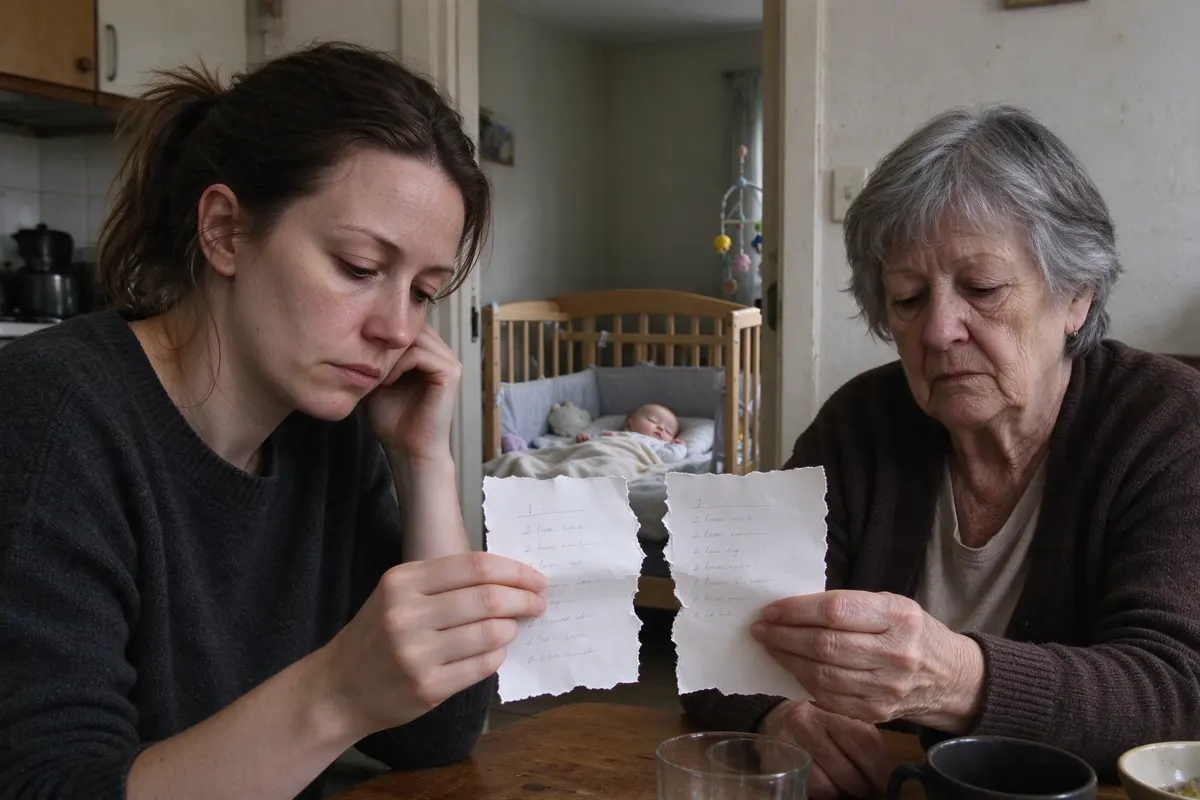
The partner takes half. Not "helps": takes half the windows, half the gates, and the whole list of cords, written down and crossed off. The AAP's home-safety list is long enough that one person doing it alone drops something (AAP), and the something is usually in the room they're least in. If there isn't a partner, the half goes to whoever is in the house most after you: the grandmother, the friend with the drill, the neighbor who already has guards on hers and knows which ones fit.
If you're the partner: the windows in the rooms you're in, the gate at the top of the stairs you use, and the cords behind the furniture you'd never think to look behind. Do it today, and say which ones you did.
Sources
- American Academy of Pediatrics. "Home Safety: Tips for Families With Young Children." HealthyChildren.org, updated 2022. https://www.healthychildren.org/English/safety-prevention/at-home/Pages/Home-Safety-Heres-How.aspx
- US Consumer Product Safety Commission. "CPSC Urges Families to Protect Children During National Window Safety Week." 2026. https://www.cpsc.gov/Newsroom/News-Releases/2026/CPSC-Urges-Families-to-Protect-Children-During-National-Window-Safety-Week
- Centers for Disease Control and Prevention. "Milestones by 1 Year." Learn the Signs. Act Early. program, updated 2026. https://www.cdc.gov/act-early/milestones/1-year.html
- US Consumer Product Safety Commission. "Window Covering Cords." Accessed 2026. https://www.cpsc.gov/gocordless
- US Consumer Product Safety Commission. "CPSC to Consumers: The Safest Window Coverings When Young Children Are Present Are Cordless." 2021. https://www.cpsc.gov/Newsroom/News-Releases/2022/CPSC-to-Consumers-The-Safest-Window-Coverings-When-Young-Children-Are-Present-Are-Cordless
- US Consumer Product Safety Commission. "CPSC Issues Call to Action: Check Your Homes for Recalled Products; Babies' Lives Depend on It!" OnSafety, 2019. https://onsafety.cpsc.gov/blog/2019/09/11/cpsc-issues-call-to-action-check-your-homes-for-recalled-products-babies-lives-depend-on-it
- American Academy of Pediatrics. "Make Baby's Room Safe: Parent Checklist." HealthyChildren.org, updated 2020. https://www.healthychildren.org/English/safety-prevention/at-home/Pages/Make-Babys-Room-Safe.aspx
- American Academy of Pediatrics. "Head Injury" (symptom checker). HealthyChildren.org, accessed 2026. https://www.healthychildren.org/English/tips-tools/symptom-checker/Pages/symptomviewer.aspx?symptom=Head+Injury
- American Academy of Pediatrics. "Fever" (symptom checker). HealthyChildren.org, accessed 2026. https://www.healthychildren.org/English/tips-tools/symptom-checker/Pages/symptomviewer.aspx?symptom=Fever
This guide is general education that summarizes published research and guidance from groups like the American Academy of Pediatrics, the CDC, and the WHO. It isn’t medical advice, and every child develops on their own timeline. Your pediatrician knows your child; if something feels wrong, call them. In an emergency, call 911.
Get each day’s note the morning it applies
Add your baby to a free Chorevia household with their date of birth, and every morning for 365 days the day’s note arrives in the app and by email: what’s developing, one thing to try, what to watch for, and a word for you.
Create your household