Day 310 of 365 · Week 42
Shoes, when it's time
Last reviewed · 4 min read · 9 sources · Plain-text version
No shoes until your baby walks outside. Then closed-toe, flexible, nonskid, with room to grow; no wedges or special arches; a pair lasts 2 to 3 months, so check the fit monthly. The shoe fit check.
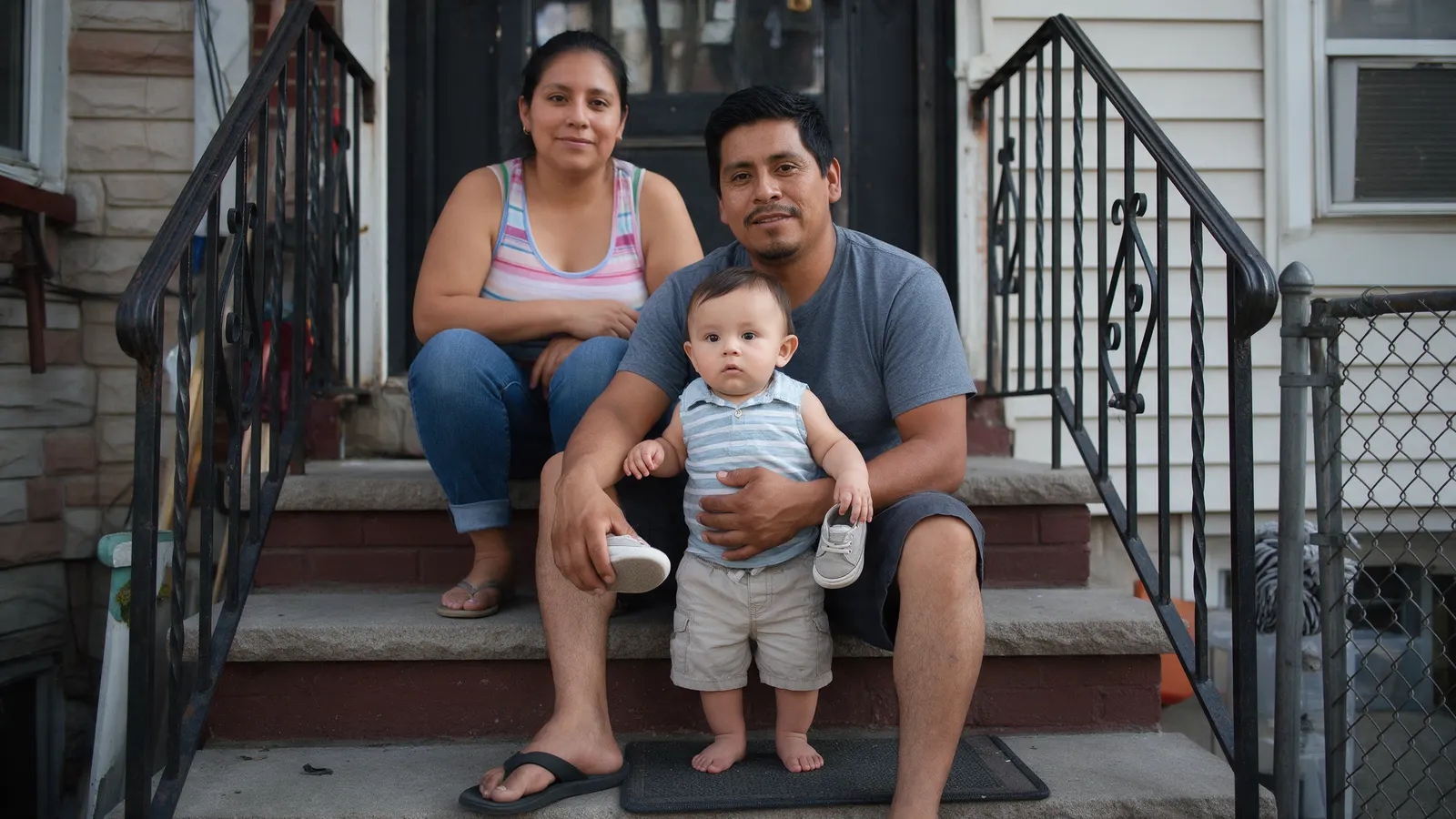
The box of tiny shoes has probably arrived already, from someone who loves you. Today is when shoes are for, what the AAP says to look for when it's time, and a fit check that takes a thumb and a minute.
Heart
Your baby doesn't need shoes until they start walking outside, and special "supportive" shoes have no proven benefit (AAP). Your baby is 10 months old; walking alone starts anywhere from 8.2 to 17.6 months (WHO Multicentre Growth Reference Study Group, 2006), and a few steps alone is a 15-month milestone (CDC). So for most babies, shoes are weeks or months away, and indoors the answer stays bare feet or socks with grips. The shoes in the box can wait in the box.
Head
When it is time: choose closed-toe, comfortable, flexible shoes with nonskid soles and room to grow; sneakers are a great choice. Skip wedges, inserts, high backs, and special arches: they have no proven benefit for most children and may make walking harder. A first pair usually lasts 2 to 3 months, so check the fit monthly (AAP). That's the whole list. The expensive pair with the molded sole isn't on it; the cheap flexible sneaker is. The guide's question is Does my baby need shoes to learn to walk?.
Body
Until then, the floor. Cruising and the first steps are learned by practice, thousands of steps and dozens of falls an hour once walking starts (Adolph et al., 2012), and bare feet feel the floor in a way a sole can't. Keep the practice space the kind where a fall is a thump on a diaper: gates at the top and bottom of stairs, mounted firmly to the wall studs (AAP). Walkers stay out of the house (AAP).
Try today
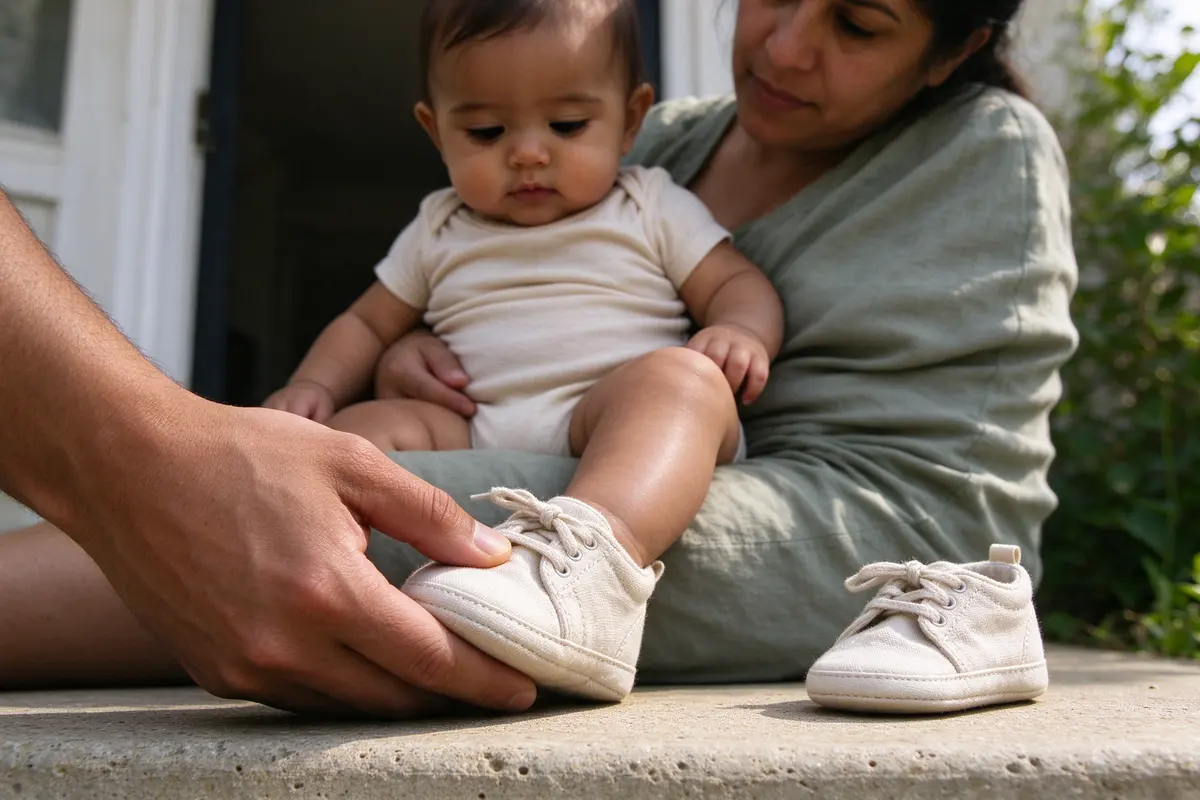
The shoe fit check
Time: 1 minute, if shoes have started; otherwise none · Does my baby need shoes to learn to walk? in the guide
If your baby isn't walking outside yet, today's check is the box: close it, write the date on the lid, and leave it. Bare feet indoors (AAP).
If shoes have started, put one on with the baby standing on your lap or the floor, and press the toe end: you want room to grow, about a thumb's width between the longest toe and the end.
Bend the sole in your hand. It should fold easily at the ball of the foot; a stiff sole, a wedge, or a built-up arch goes back in the box (AAP).
Write today's date inside the tongue. A first pair usually lasts 2 to 3 months; check again in a month (AAP).
Make it work:Socks with grips on a slippery floor indoors; shoes are for outside.
Watch for
Normal
feet that turn out or in, and toes that curl on a cold floor.
Talk with your pediatrician
if your baby uses one arm or leg much more than the other (AAP).
Normal
a shoe pulled off and chewed within a minute of going on.
Call 911
if your baby is struggling for each breath or can barely cry (AAP).
Normal
a drooly, off-their-food day with a new tooth.
Call your pediatrician right away
for signs of dehydration: no urine in more than 8 hours, dark urine, a very dry mouth, and no tears (AAP).
Normal
knowing which thump means tears and which means nothing, from the next room.
Call anyway
if your baby just doesn't seem right to you. Trust your instincts; three hundred and ten days have built them (Lurie Children's).
For you
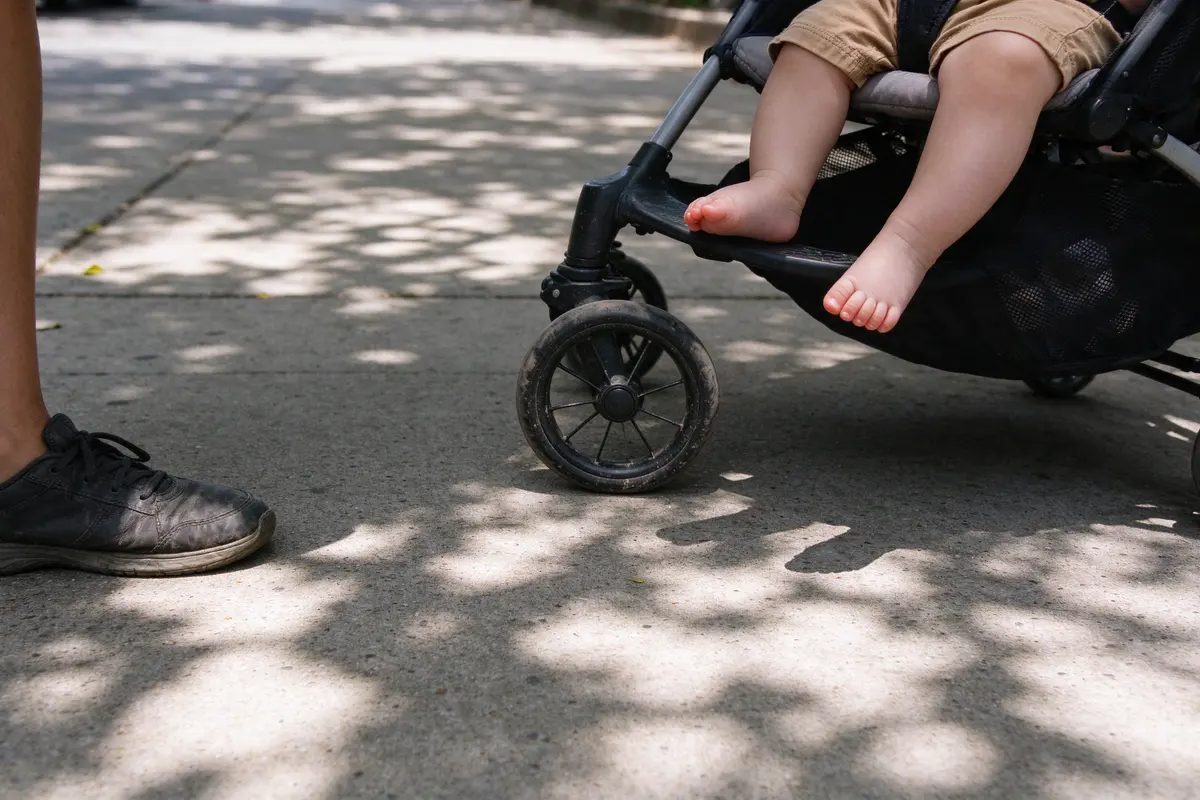
Your own shoes. You've carried a baby who now weighs what a small suitcase weighs, up and down stairs, for ten months, in whatever was by the door. The AAP's list for the baby is a decent list for you too: comfortable, flexible, nonskid, room to move (AAP). And one line that isn't about shoes: severe swelling, redness, or pain of a leg or arm is on the CDC's list of urgent maternal warning signs for the full year after birth, so a leg that hurts or swells isn't a shoe problem, it's a call, and the person you call needs to know you were pregnant within the last year (CDC).
If you're the partner: the box of tiny shoes is the gift. Thank the giver, write the date on the lid, and buy her a pair of the flat, comfortable, nonskid kind instead, this week, in her size.
Sources
- American Academy of Pediatrics. "Movement Milestones in Babies 8 to 12 Months Old." HealthyChildren.org, updated 2021. https://www.healthychildren.org/English/ages-stages/baby/Pages/Movement-8-to-12-Months.aspx
- WHO Multicentre Growth Reference Study Group. "WHO Motor Development Study: windows of achievement for six gross motor development milestones." Acta Paediatrica Supplement, 2006. https://pubmed.ncbi.nlm.nih.gov/16817682/
- Centers for Disease Control and Prevention. "Milestones by 15 Months." Learn the Signs. Act Early. program, accessed 2026. https://www.cdc.gov/act-early/milestones/15-months.html
- Adolph KE, Cole WG, Komati M, et al. "How do you learn to walk? Thousands of steps and dozens of falls per day." Psychological Science, 2012. https://pubmed.ncbi.nlm.nih.gov/23085640/
- American Academy of Pediatrics. "Home Safety: Tips for Families With Young Children." HealthyChildren.org, updated 2022. https://www.healthychildren.org/English/safety-prevention/at-home/Pages/Home-Safety-Heres-How.aspx
- American Academy of Pediatrics. "Baby Walkers: A Dangerous Choice." HealthyChildren.org, updated 2022. https://www.healthychildren.org/English/safety-prevention/at-home/Pages/Baby-Walkers-A-Dangerous-Choice.aspx
- American Academy of Pediatrics. "Fever" (symptom checker). HealthyChildren.org, accessed 2026. https://www.healthychildren.org/English/tips-tools/symptom-checker/Pages/symptomviewer.aspx?symptom=Fever
- Latimer T. "When to Call the Pediatrician for Your Newborn." Lurie Children's Hospital of Chicago, 2022. https://www.luriechildrens.org/en/blog/when-to-call-the-pediatrician-for-your-newborn/
- Centers for Disease Control and Prevention. "Urgent Maternal Warning Signs and Symptoms." HEAR HER, 2024. https://www.cdc.gov/hearher/maternal-warning-signs/index.html
This guide is general education that summarizes published research and guidance from groups like the American Academy of Pediatrics, the CDC, and the WHO. It isn’t medical advice, and every child develops on their own timeline. Your pediatrician knows your child; if something feels wrong, call them. In an emergency, call 911.
Get each day’s note the morning it applies
Add your baby to a free Chorevia household with their date of birth, and every morning for 365 days the day’s note arrives in the app and by email: what’s developing, one thing to try, what to watch for, and a word for you.
Create your household