Day 314 of 365 · Week 42
Forty-two weeks: the bottle wind-down begins
Last reviewed · 4 min read · 8 sources · Plain-text version
Bottles end between 12 and 18 months, so the first one goes now: keep the mealtime bottles, drop a nap or bedtime one, add cuddles and a story. Never a bottle in bed. The first bottle to go.
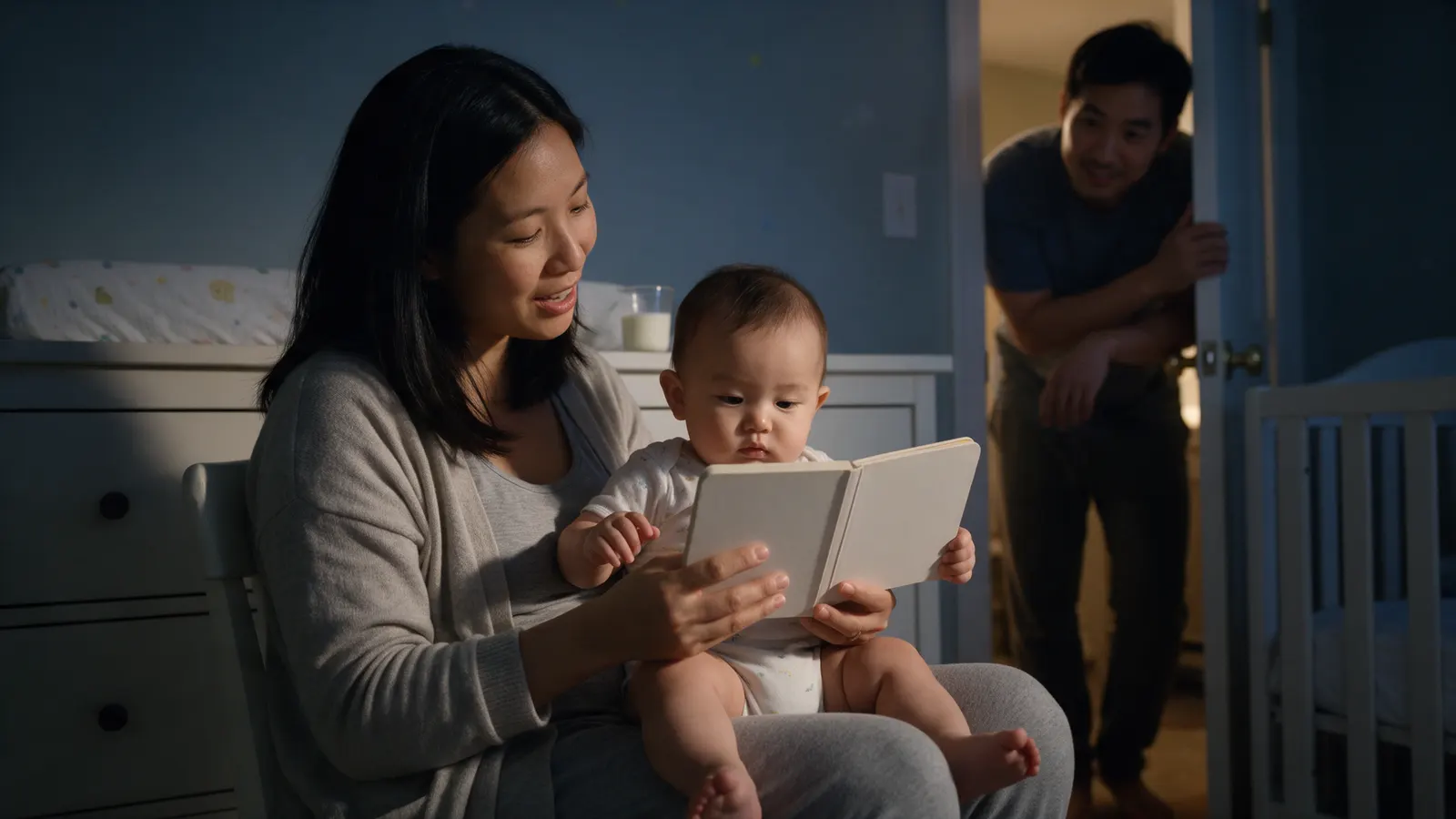
Forty-two weeks. Three weeks ago you drew the bottle map. Today one bottle comes off it, and the thing that replaces it isn't a cup. It's you.
Heart
The AAP suggests offering a cup around 6 months and finishing the move off bottles sometime between 12 and 18 months (Shu, AAP). The window opens in about two months, so this is the time to start. The order is the AAP's: cut bottles gradually, keep the ones at meals at first, drop the ones at naps and bedtime, and offer extra cuddles and stories instead (Shu, AAP). The milk doesn't go anywhere; breast milk or formula is still the main drink until the birthday (Muth, AAP). What changes is the one bottle that was really about sleep.
Head
Bottles that go on longer are linked to cavities, skipped meals, and more resistance later (Shu, AAP). A bottle in bed is its own problem at any age: sugary residue left in the mouth overnight promotes tooth decay (AAP), and if teeth are in, the brushing comes after the last drink or food of the day, not before the bottle (AAP). None of it is urgent this week; all of it is easier at ten months than at eighteen.
Body
The replacement is a routine, and the AAP's version is Brush, Book, Bed at a regular bedtime (AAP); in a survey of mothers of 10,085 young children, more consistent routines went with better sleep, though a survey can't prove cause (Mindell et al., 2015). The guide's shape is a bath, then stories or songs, then down drowsy but awake (Nemours KidsHealth). If the bedtime bottle was the last step, the story becomes the last step, and the milk moves earlier, to the table. The guide's section is Cups in, bottles out.
Try today
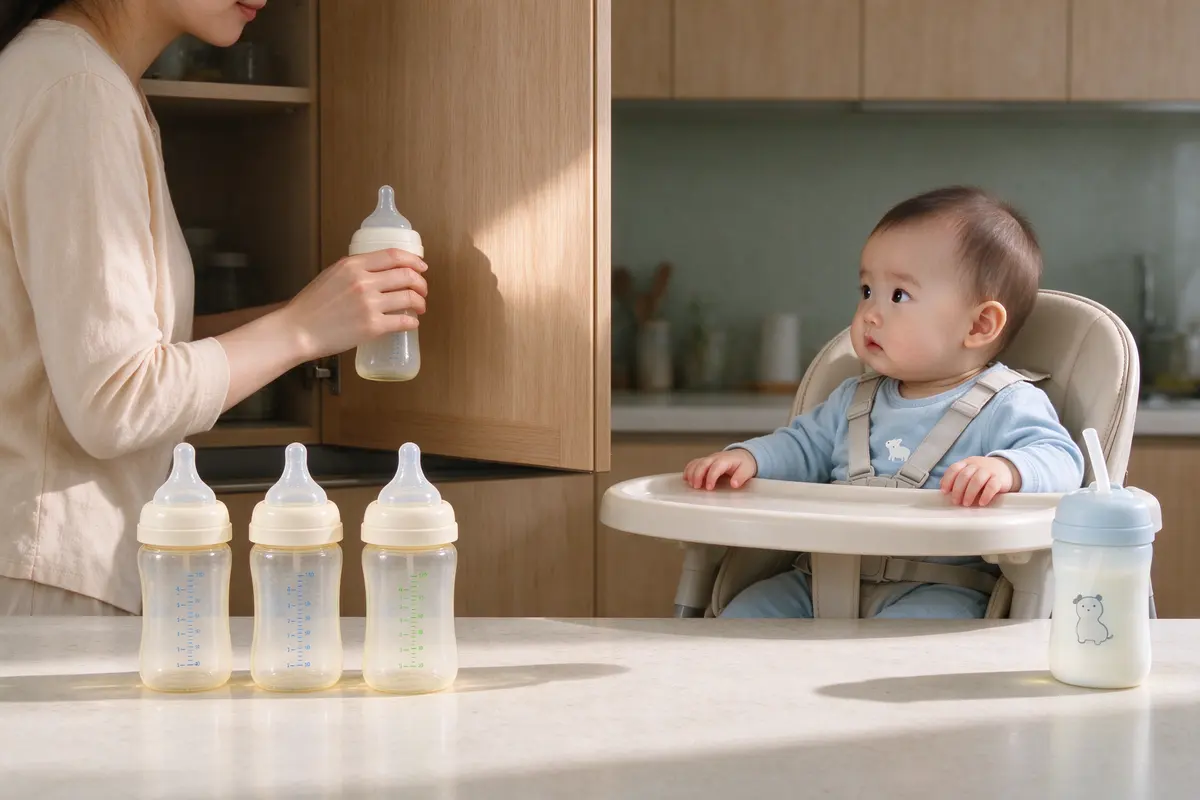
The first bottle to go
Time: One decision today, then a week · Cups in, bottles out in the guide
Look at the bottle map, or make one now: every bottle of the day and when it happens. Circle the nap bottles and the bedtime one; the mealtime ones stay for now (Shu, AAP).
Pick one circled bottle, the easiest, and write the date next to it. That's the one that goes this week.
Move its milk to the meal before it, in the bottle or a cup; the amount stays the same (Muth, AAP).
In its old slot, put a longer cuddle and one more book, the same book each time (Shu, AAP).
Seven days, same slot, same book. Then look at the map again and circle the next one.
Make it work:Every caregiver gets the map. The bottle that comes back on the sitter's day is the one that never leaves.
Watch for
Normal
a loud week in the slot where the nap bottle used to be, and a baby who sleeps anyway.
Talk with your pediatrician
before cutting feeds if your baby isn't growing and gaining weight steadily (AAP).
Normal
a baby who bites the cup rim with new teeth; plan the first dental visit after the first tooth and by the first birthday (AAP).
Call your pediatrician right away
for a fever over 104°F (40°C) (AAP).
Normal
a rough first night when the story replaces the bottle, better by the third.
Go to the ER now
if your baby is hard to wake, isn't alert when awake, or seems confused (AAP).
For you

A plan, not a fight. The AAP's window, 12 to 18 months (Shu, AAP), means nothing has to be finished this month, and the first bottle to go is allowed to be the one nobody will miss. If you're breastfeeding, none of this is about you: the AAP supports continuing as long as you both want, to 2 years or beyond (Muth, AAP), and the bottle wind-down is for the bottles, whatever is in them. The cuddle and the story that replace a bottle are ten minutes at the end of the day with a warm, heavy baby and a book. Take them as yours.
If you're the partner: the bottle that goes first is the one you'll be in the room for. The book is in your voice this week, so the swap is tied to you and not to the missing bottle.
Sources
- Shu J. "From Bottle to Cup: Helping Your Child Make a Healthy Transition." HealthyChildren.org, updated 2023. https://www.healthychildren.org/English/ages-stages/baby/feeding-nutrition/Pages/Discontinuing-the-Bottle.aspx
- Muth ND. "Recommended Drinks for Children Age 5 & Younger." HealthyChildren.org, updated 2023. https://www.healthychildren.org/English/healthy-living/nutrition/Pages/Recommended-Drinks-for-Young-Children-Ages-0-5.aspx
- American Academy of Pediatrics. "Sleeping Through the Night." HealthyChildren.org, updated 2013. https://www.healthychildren.org/English/ages-stages/baby/sleep/Pages/Sleeping-Through-the-Night.aspx
- American Academy of Pediatrics. "Brush, Book, Bed: How to Structure Your Child's Nighttime Routine." HealthyChildren.org, updated 2024. https://www.healthychildren.org/English/healthy-living/oral-health/Pages/Brush-Book-Bed.aspx
- Mindell JA, Li AM, Sadeh A, et al. "Bedtime routines for young children: a dose-dependent association with sleep outcomes." Sleep, 2015. https://pubmed.ncbi.nlm.nih.gov/25325483/
- Nemours KidsHealth. "Baby Sleep: 8- to 12-Month-Olds." Reviewed 2025. https://kidshealth.org/en/parents/sleep812m.html
- American Academy of Pediatrics. "Baby's First Tooth: 7 Facts Parents Should Know." HealthyChildren.org, accessed 2026. https://www.healthychildren.org/English/ages-stages/baby/teething-tooth-care/Pages/Babys-First-Tooth-Facts-Parents-Should-Know.aspx
- American Academy of Pediatrics. "Fever" (symptom checker). HealthyChildren.org, accessed 2026. https://www.healthychildren.org/English/tips-tools/symptom-checker/Pages/symptomviewer.aspx?symptom=Fever
This guide is general education that summarizes published research and guidance from groups like the American Academy of Pediatrics, the CDC, and the WHO. It isn’t medical advice, and every child develops on their own timeline. Your pediatrician knows your child; if something feels wrong, call them. In an emergency, call 911.
Get each day’s note the morning it applies
Add your baby to a free Chorevia household with their date of birth, and every morning for 365 days the day’s note arrives in the app and by email: what’s developing, one thing to try, what to watch for, and a word for you.
Create your household