Day 329 of 365 · Eleven months
What eleven months changed
Last reviewed · 4 min read · 17 sources · Plain-text version
Standing, maybe a step with a hand held, pinching, pointing, a sound that means something, and a pause at "no": eleven months in one look, with the birthday ahead. Eleven-month photo and letter.

Tomorrow is eleven months. Today is the look back at what the eleventh month did, the plans that wait for the birthday, and the photo in the spot where the first one was taken.
Heart
By 1 year, most babies pull up to stand, walk while holding on to furniture, pick up small bits of food between thumb and pointer finger, wave bye-bye, call a parent "mama," "dada," or another special name, and understand "no," pausing briefly or stopping when you say it (CDC). Some of that arrived this month and some of it is still on its way, and both are fine: the checklists hold skills at least 75% of babies show by each age, so a missed one is a reason to check in, not to wait and see (Zubler et al., 2022). Born early? Use your baby's corrected age for milestones during the first 2 years (AAP).
Head
What the month added that no list measures: a sound used the same way each time, which to a baby is a word (AAP); a cup, spoon, or hairbrush used for what it's for, with you as the audience (AAP); and the first helping, a sock handed over or a block dropped in the bin, with a warm thank-you as the whole reward (CDC). The 12-month-olds in Liszkowski's experiments pointed to show an adult where a lost object was (Liszkowski et al., 2008); your baby is weeks from that age, and the urge is already visible. The 1-year guide picks up first family jobs from here.
Body
The plans that wait for the birthday stay plans today. Around 12 months, most babies can switch to whole cow's milk; before that, the AAP says babies shouldn't drink cow's milk or other milk substitutes (AAP). Bottles finish between 12 and 18 months, meal bottles kept first, naps and bedtime dropped first (Shu, AAP). Walking has the widest window of all: 8.2 to 17.6 months for walking alone, 6.9 to 16.9 for standing alone (WHO Multicentre Growth Reference Study Group, 2006), and a few steps alone is a 15-month milestone (CDC). The 12-month visit is in the guide; the next series starts after the birthday.
Try today
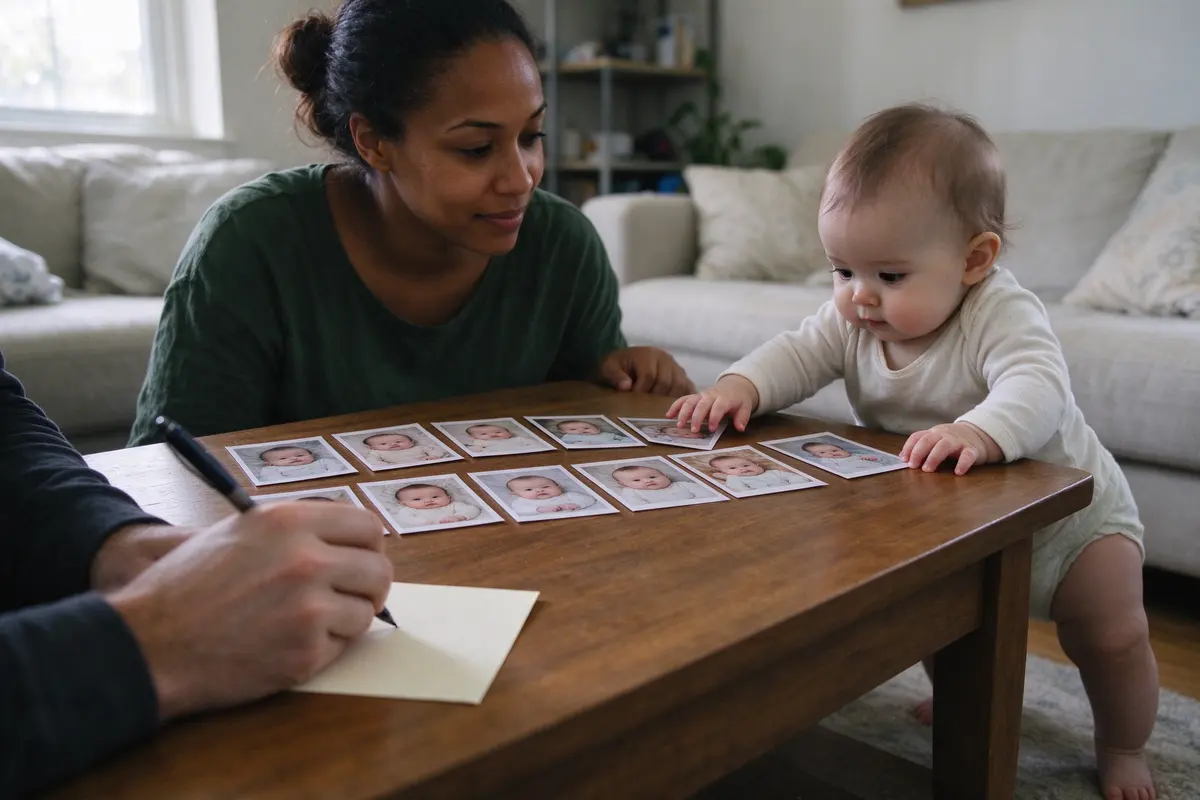
Eleven-month photo and letter
Time: 15 minutes
Take the photo in the day-one spot: your baby standing with one of your fingers in each hand, or sitting, or on your hip. Whatever they do today is the pose.
Write the letter: what they do now that they didn't at ten months, in plain words, with "should" left out and "no" written down as the word it's become.
Add the sound you'd call a word, and what you think it means, as a record for later (AAP).
Date it, put the photo with it, and file it with the other ten.
Make it work:If your baby was born early, write both ages at the top; corrected age is the one that counts for milestones (AAP).
Watch for
Normal
a baby who stands at the sofa, lets go for a second, and grabs it again; standing alone ran from 6.9 to 16.9 months in the WHO's study (WHO Multicentre Growth Reference Study Group, 2006).
Ask about a developmental screening
if your baby isn't pulling to stand by 12 months (CDC).
Normal
a pause at "no" that lasts exactly as long as it takes to reach for the thing again (CDC).
Talk with your pediatrician
if your baby uses one arm or leg much more than the other (AAP).
Normal
a hairbrush dragged across their own head backward, then yours (AAP).
Bring it up
if your baby seems not to see or hear well (AAP).
Normal
a cold with a cough and a low fever that eases in a couple of days.
Call your pediatrician right away
for trouble breathing that isn't severe, and call 911 if your baby is struggling for each breath (AAP).
For you
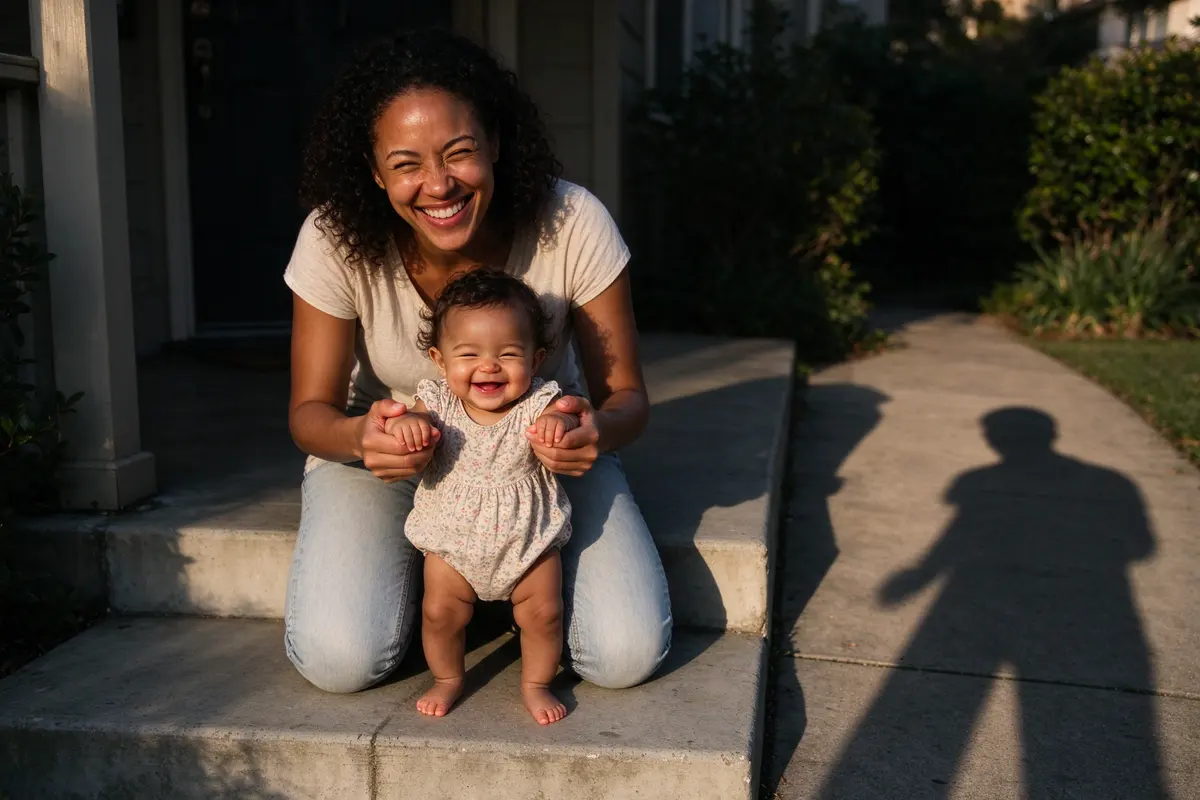
The photo of you, on the front step this time, with the baby standing between your knees holding your thumbs, because that's where eleven months has put you both: out the door, upright, and holding on. Take it before you fix your hair. Then the quiet check that no visit makes for you now: if sadness has lasted more than two weeks, go to your own doctor without waiting (Office on Women's Health), and if something just doesn't feel right, or you aren't sure if it's serious, talk to your health care provider (CDC).
If you're the partner: you take hers, then hand over the phone and take the step yourself, baby and all. Look at your own photo as honestly as you'd look at hers; about 10% of fathers have depression around a birth (Paulson & Bazemore, 2010).
Sources
- Centers for Disease Control and Prevention. "Milestones by 1 Year." Learn the Signs. Act Early. program, updated 2026. https://www.cdc.gov/act-early/milestones/1-year.html
- Zubler JM, Wiggins LD, Macias MM, et al. "Evidence-Informed Milestones for Developmental Surveillance Tools." Pediatrics, 2022. https://pubmed.ncbi.nlm.nih.gov/35132439/
- American Academy of Pediatrics. "Corrected Age For Preemies." HealthyChildren.org, updated 2018. https://www.healthychildren.org/English/ages-stages/baby/preemie/Pages/Corrected-Age-For-Preemies.aspx
- American Academy of Pediatrics. "Language Development: 8 to 12 Months." HealthyChildren.org, updated 2009. https://www.healthychildren.org/English/ages-stages/baby/Pages/Language-Development-8-to-12-Months.aspx
- American Academy of Pediatrics. "Cognitive Development in Infants: 8 to 12 Months." HealthyChildren.org, updated 2023. https://www.healthychildren.org/English/ages-stages/baby/Pages/Cognitive-Development-8-to-12-Months.aspx
- Centers for Disease Control and Prevention. "Milestones by 9 Months." Learn the Signs. Act Early. program, updated 2026. https://www.cdc.gov/act-early/milestones/9-months.html
- Liszkowski U, Carpenter M, Tomasello M. "Twelve-month-olds communicate helpfully and appropriately for knowledgeable and ignorant partners." Cognition, 2008. https://pubmed.ncbi.nlm.nih.gov/18721918/
- American Academy of Pediatrics. "Why Do Infants Need Baby Formula Instead of Cow's Milk?" HealthyChildren.org, updated 2024. https://www.healthychildren.org/English/ages-stages/baby/formula-feeding/Pages/Why-Formula-Instead-of-Cows-Milk.aspx
- Shu J. "From Bottle to Cup: Helping Your Child Make a Healthy Transition." HealthyChildren.org, updated 2023. https://www.healthychildren.org/English/ages-stages/baby/feeding-nutrition/Pages/Discontinuing-the-Bottle.aspx
- WHO Multicentre Growth Reference Study Group. "WHO Motor Development Study: windows of achievement for six gross motor development milestones." Acta Paediatrica Supplement, 2006. https://pubmed.ncbi.nlm.nih.gov/16817682/
- Centers for Disease Control and Prevention. "Milestones by 15 Months." Learn the Signs. Act Early. program, accessed 2026. https://www.cdc.gov/act-early/milestones/15-months.html
- American Academy of Pediatrics. "Movement Milestones in Babies 8 to 12 Months Old." HealthyChildren.org, updated 2021. https://www.healthychildren.org/English/ages-stages/baby/Pages/Movement-8-to-12-Months.aspx
- American Academy of Pediatrics. "Checkup Checklist: 9 Months Old." HealthyChildren.org, updated 2021. https://www.healthychildren.org/English/ages-stages/Your-Childs-Checkups/Pages/Your-Checkup-Checklist-9-Months-Old.aspx
- American Academy of Pediatrics. "Fever" (symptom checker). HealthyChildren.org, accessed 2026. https://www.healthychildren.org/English/tips-tools/symptom-checker/Pages/symptomviewer.aspx?symptom=Fever
- Office on Women's Health. "Recovering from birth." US Department of Health and Human Services, 2021. https://womenshealth.gov/pregnancy/childbirth-and-beyond/recovering-birth
- Centers for Disease Control and Prevention. "Urgent Maternal Warning Signs and Symptoms." HEAR HER, 2024. https://www.cdc.gov/hearher/maternal-warning-signs/index.html
- Paulson JF, Bazemore SD. "Prenatal and postpartum depression in fathers and its association with maternal depression: a meta-analysis." JAMA, 2010. https://pubmed.ncbi.nlm.nih.gov/20483973/
This guide is general education that summarizes published research and guidance from groups like the American Academy of Pediatrics, the CDC, and the WHO. It isn’t medical advice, and every child develops on their own timeline. Your pediatrician knows your child; if something feels wrong, call them. In an emergency, call 911.
Get each day’s note the morning it applies
Add your baby to a free Chorevia household with their date of birth, and every morning for 365 days the day’s note arrives in the app and by email: what’s developing, one thing to try, what to watch for, and a word for you.
Create your household