Day 311 of 365 · Week 42
Favoring one side
Last reviewed · 4 min read · 8 sources · Plain-text version
Scooting, slithering, and crawling all count, as long as each arm and leg gets used. A side that's always favored is a note for the pediatrician, and early intervention is free. The both-sides watch.

Your baby has a way of getting across the floor by now, and it's probably not tidy. Today is the one thing the AAP asks you to watch in all that movement, and a five-minute game that shows you.
Heart
How a baby moves matters less than you'd think. Crawling isn't on any CDC checklist (Kretch et al., 2022); in the WHO's study of 816 healthy children, 4.3% never crawled on hands and knees at all (WHO Multicentre Growth Reference Study Group, 2006). The AAP says a few babies scoot on their bottoms or slither on their bellies instead, and that's no cause for concern as long as they use each arm and leg equally (AAP). That last clause is today.
Head
The AAP's line is plain: talk with your pediatrician if your baby favors one side or doesn't seem to be moving normally (AAP), and the guide's own takeaway from the crawling research is the same: mention it if your baby favors one side (Kretch et al., 2022). Using one arm or leg much more than the other is on the guide's don't-wait list, next to losing skills they used to have (AAP; CDC). None of that is a diagnosis; it's a sentence for the visit, or the phone before it.
Body
What "favoring" looks like at ten months: one hand that does all the reaching while the other stays tucked; a crawl that drags one leg every time, not just on tired afternoons; a pull-up that always uses the same arm. What it doesn't look like: a left-handed breakfast and a right-handed lunch. By the end of this stage most babies pinch with thumb and finger and practice on anything small (AAP). If you're worried, ask your pediatrician about developmental screening, or call your state's early intervention program for a free evaluation; you don't need a referral (CDC). The guide's section is Don't wait on development worries.
Try today

The both-sides watch
Time: 5 minutes, at two different times of day
Sit your baby on the floor and hold a toy out to their left, at shoulder height, just past reach. Note which hand comes up.
Do the same on the right. Then straight ahead. Then once more each side with a different toy.
Put the toy on the floor a crawl away, to the left, then the right, and watch both legs and both arms as they go (AAP).
Write two columns, left and right, and a tick in each for what you saw. Do it again after a nap.
If one column is nearly empty both times, that's your sentence for the pediatrician. If both have ticks, you've looked, and you're done.
Make it work:A baby holding a toy in one hand will reach with the other; start each round with empty hands.
Watch for
Normal
a crawl that's lopsided for a day, one knee up and one down, then even again.
Talk with your pediatrician
if your baby uses one arm or leg much more than the other, over days, not hours (AAP).
Normal
a baby who scoots on their bottom and shows no interest in hands and knees; 4.3% of healthy children never crawled that way (WHO Multicentre Growth Reference Study Group, 2006).
Bring it up
if your baby has lost skills they used to have (CDC).
Normal
a toy reached for with the near hand every time, whichever side you hold it on.
Call your pediatrician right away
if your baby won't move an arm or leg normally, or cries when touched or moved (AAP).
For you
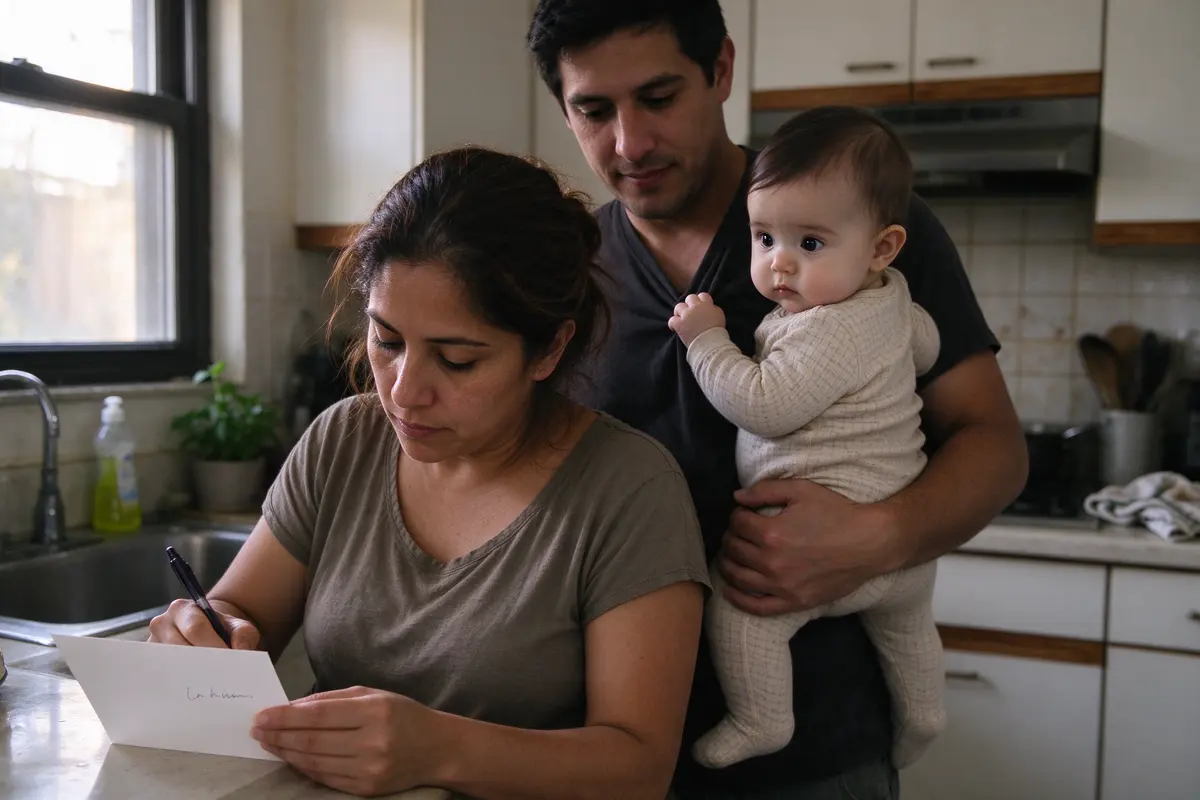
A note to the pediatrician costs nothing. The evaluation, if it comes to that, costs nothing either, and needs no referral (CDC). What costs something is the month of watching and wondering before you say it, so say it on the day you notice, in one sentence, and let the person whose job it is decide whether it's anything. The same rule has been true for your own body all year: if you feel like something just isn't right, or you aren't sure if it's serious, talk to your health care provider (CDC). Apply it today, to both of you.
If you're the partner: do the watch yourself tomorrow without looking at her columns, and compare. Two sets of eyes make a better note than one worried pair.
Sources
- Kretch KS, Willett SL, Hsu LY, et al. "'Learn the Signs. Act Early.': Updates and Implications for Physical Therapists." Pediatric Physical Therapy, 2022. https://pubmed.ncbi.nlm.nih.gov/35876833/
- WHO Multicentre Growth Reference Study Group. "WHO Motor Development Study: windows of achievement for six gross motor development milestones." Acta Paediatrica Supplement, 2006. https://pubmed.ncbi.nlm.nih.gov/16817682/
- American Academy of Pediatrics. "Movement Milestones in Babies 8 to 12 Months Old." HealthyChildren.org, updated 2021. https://www.healthychildren.org/English/ages-stages/baby/Pages/Movement-8-to-12-Months.aspx
- Centers for Disease Control and Prevention. "Milestones by 9 Months." Learn the Signs. Act Early. program, updated 2026. https://www.cdc.gov/act-early/milestones/9-months.html
- American Academy of Pediatrics. "Hand and Finger Skills." HealthyChildren.org, updated 2009. https://www.healthychildren.org/English/ages-stages/baby/Pages/Hand-and-Finger-Skills.aspx
- Centers for Disease Control and Prevention. "Concerned About Your Child's Development?" Updated 2026. https://www.cdc.gov/act-early/families/concerned.html
- American Academy of Pediatrics. "Fever" (symptom checker). HealthyChildren.org, accessed 2026. https://www.healthychildren.org/English/tips-tools/symptom-checker/Pages/symptomviewer.aspx?symptom=Fever
- Centers for Disease Control and Prevention. "Urgent Maternal Warning Signs and Symptoms." HEAR HER campaign, accessed 2026. https://www.cdc.gov/hearher/maternal-warning-signs/index.html
This guide is general education that summarizes published research and guidance from groups like the American Academy of Pediatrics, the CDC, and the WHO. It isn’t medical advice, and every child develops on their own timeline. Your pediatrician knows your child; if something feels wrong, call them. In an emergency, call 911.
Get each day’s note the morning it applies
Add your baby to a free Chorevia household with their date of birth, and every morning for 365 days the day’s note arrives in the app and by email: what’s developing, one thing to try, what to watch for, and a word for you.
Create your household