Day 330 of 365 · Eleven months
Eleven months
Last reviewed · 4 min read · 13 sources · Plain-text version
The 12-month list as most babies, around now or soon. The 7-to-12-month guide for this stretch, the 1-year guide as the next home, and the first-word video, whatever the word is. Eleven months, done.
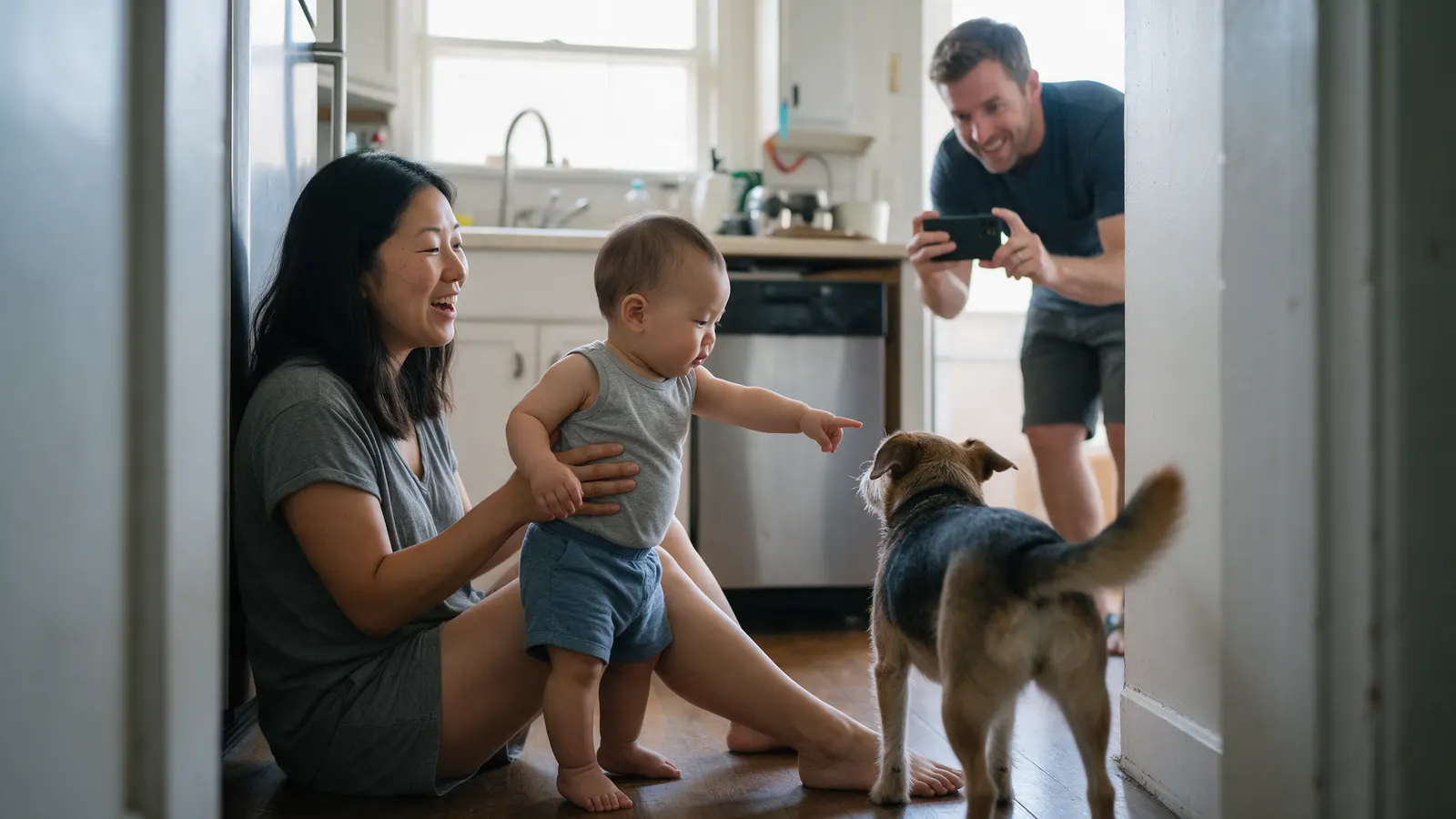
Eleven months. One more month of the 7-to-12-month guide, then a birthday, a new guide, and a baby who is officially a toddler whether or not they walk. Today is the list once more, the two guides, and a video of the word.
Heart
By 1 year, most babies play games with you like pat-a-cake, wave bye-bye, call a parent "mama," "dada," or another special name, understand "no," put something in a container, look for things they saw you hide, pull up to stand, cruise, drink from a cup without a lid as you hold it, and pick up small bits of food between thumb and pointer finger (CDC). Around now or soon, for most: the checklists hold skills at least 75% of babies show by each age (Zubler et al., 2022), and a missed one at the birthday is a reason to ask, not to worry alone.
Head
The 7-to-12-month guide has been this stretch's home: crawling or not, pulling up, the pincer, pointing, goodbyes, cups in and bottles out. The 1-year guide is the next one, and its list is the one you'll read next: by 15 months, most toddlers take a few steps on their own, try to say one or two words besides "mama" or "dada," and point to ask for something or get help (CDC). It also carries the first family jobs for helpers in diapers, which is where this month's hand-me-the-sock was heading (Liszkowski et al., 2008).
Body
The word. Most babies call a parent "mama" or "dada" or another special name by 12 months, but having few or no other clear words at the first birthday is normal (CDC). The AAP says some babies have 2 or 3 words by their first birthday, but most 12-month speech is babble with the ups and downs of real talk, and any sound your baby uses consistently for the same thing counts as a word (AAP). Bring it up if your baby isn't babbling lots of different sounds by 9 months or doesn't look when you call their name (CDC). So the video is of whatever the word is, or of the babble.
Try today
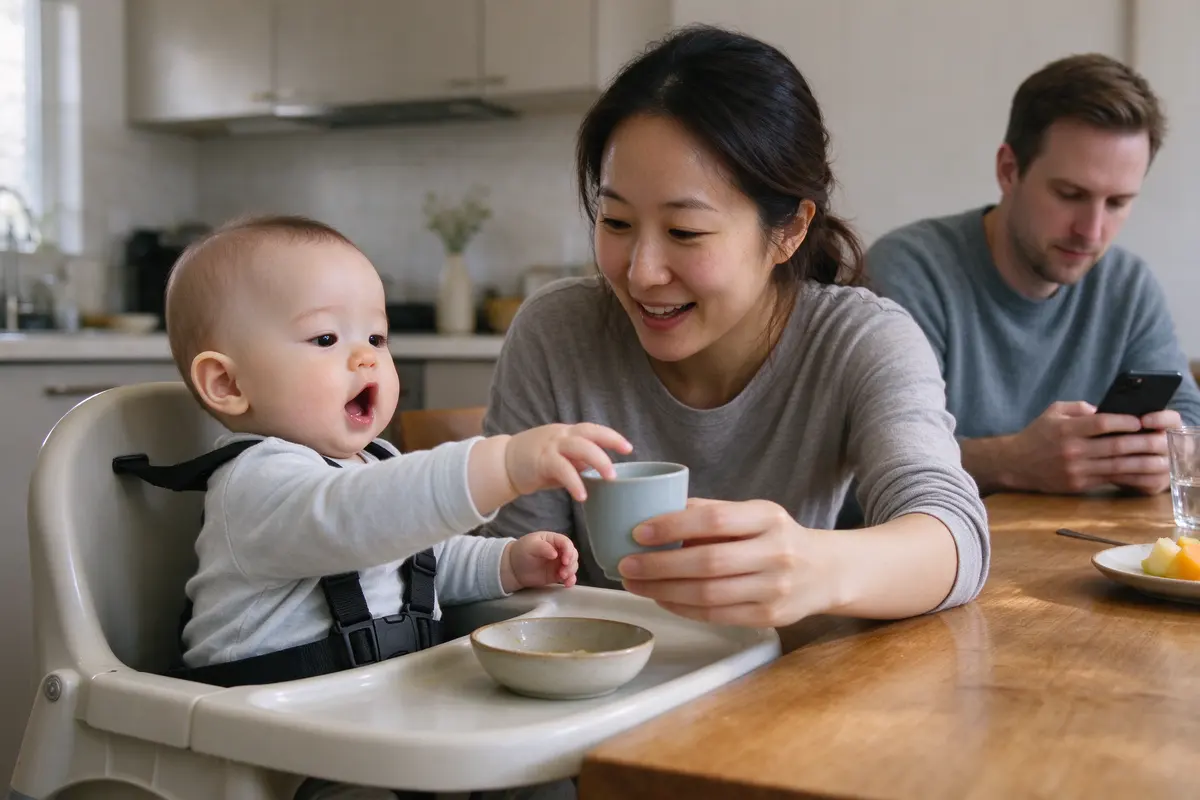
The first-word video
Time: 5 minutes, when the word is likely
Pick the moment the sound usually comes: the cup, the dog, the door. Set the phone where it can see the baby's face and the thing.
Do the thing. Hold up the cup, let the dog in, open the door, and wait without saying the word yourself.
Record whatever comes, the word or the babble, and say back what you heard: "Mog? Milk! Here's your milk" (AAP).
Name the file with the date and what you think it meant. There's nothing to prove.
Make it work:If no word comes today, record the babble; that's the recording you'll want later too.
Watch for
Normal
"mama" aimed at the dog, the spoon, and the ceiling; the target comes after the sound.
Bring it up
if your baby doesn't look when you call their name (CDC).
Normal
a baby who cruises the whole sofa and has never let go of it; walking alone ran from 8.2 to 17.6 months in the WHO's study (WHO Multicentre Growth Reference Study Group, 2006).
Ask about a developmental screening
if by 12 months your baby doesn't pull up to stand, wave bye-bye, or look for a toy they saw you hide (CDC).
Normal
a clingy, tearful week at goodbyes; separation anxiety peaks between 10 and 18 months and is a sign of attachment (AAP).
Call your pediatrician right away
for a fever over 104°F (40°C), or if your baby looks or acts very sick (AAP).
Normal
knowing this baby better than anyone alive, and better than any list.
Call anyway
if your baby just doesn't seem right to you. Trust your instincts; three hundred and thirty days have built them (Lurie Children's).
For you

Eleven months of you. Once more, lightly: the National Maternal Mental Health Hotline is 1-833-TLC-MAMA (1-833-852-6262), call or text; 988 is for anyone; in an emergency, 911 (CDC). The 6-month visit was the last at which the AAP recommends screening the birthing parent for depression (Earls et al., 2019), so the question tonight is yours to ask each other on the step, and "not great" is an allowed answer. Partners count too: about 10% of fathers have depression around a birth, with higher rates reported at 3 to 6 months after (Paulson & Bazemore, 2010).
If you're the partner: play her the video, then say the thing from this month you'll still remember in ten years, out loud. Then keep going together: the 7-to-12-month guide covers the last stretch to the first birthday, the 1-year guide is the next home, and the notes continue tomorrow at your twelfth month.
Sources
- Centers for Disease Control and Prevention. "Milestones by 1 Year." Learn the Signs. Act Early. program, updated 2026. https://www.cdc.gov/act-early/milestones/1-year.html
- Zubler JM, Wiggins LD, Macias MM, et al. "Evidence-Informed Milestones for Developmental Surveillance Tools." Pediatrics, 2022. https://pubmed.ncbi.nlm.nih.gov/35132439/
- Centers for Disease Control and Prevention. "Milestones by 15 Months." Learn the Signs. Act Early. program, accessed 2026. https://www.cdc.gov/act-early/milestones/15-months.html
- Liszkowski U, Carpenter M, Tomasello M. "Twelve-month-olds communicate helpfully and appropriately for knowledgeable and ignorant partners." Cognition, 2008. https://pubmed.ncbi.nlm.nih.gov/18721918/
- American Academy of Pediatrics. "Language Development: 8 to 12 Months." HealthyChildren.org, updated 2009. https://www.healthychildren.org/English/ages-stages/baby/Pages/Language-Development-8-to-12-Months.aspx
- Centers for Disease Control and Prevention. "Milestones by 9 Months." Learn the Signs. Act Early. program, updated 2026. https://www.cdc.gov/act-early/milestones/9-months.html
- WHO Multicentre Growth Reference Study Group. "WHO Motor Development Study: windows of achievement for six gross motor development milestones." Acta Paediatrica Supplement, 2006. https://pubmed.ncbi.nlm.nih.gov/16817682/
- American Academy of Pediatrics. "Emotional and Social Development: 8 to 12 Months." HealthyChildren.org, updated 2009. https://www.healthychildren.org/English/ages-stages/baby/Pages/Emotional-and-Social-Development-8-12-Months.aspx
- American Academy of Pediatrics. "Fever" (symptom checker). HealthyChildren.org, accessed 2026. https://www.healthychildren.org/English/tips-tools/symptom-checker/Pages/symptomviewer.aspx?symptom=Fever
- Latimer T. "When to Call the Pediatrician for Your Newborn." Lurie Children's Hospital of Chicago, 2022. https://www.luriechildrens.org/en/blog/when-to-call-the-pediatrician-for-your-newborn/
- Centers for Disease Control and Prevention. "Symptoms of Depression Among Women." 2024. https://www.cdc.gov/reproductive-health/depression/index.html
- Earls MF, Yogman MW, Mattson G, Rafferty J; AAP Committee on Psychosocial Aspects of Child and Family Health. "Incorporating Recognition and Management of Perinatal Depression Into Pediatric Practice." Pediatrics, 2019. https://pubmed.ncbi.nlm.nih.gov/30559120/
- Paulson JF, Bazemore SD. "Prenatal and postpartum depression in fathers and its association with maternal depression: a meta-analysis." JAMA, 2010. https://pubmed.ncbi.nlm.nih.gov/20483973/
This guide is general education that summarizes published research and guidance from groups like the American Academy of Pediatrics, the CDC, and the WHO. It isn’t medical advice, and every child develops on their own timeline. Your pediatrician knows your child; if something feels wrong, call them. In an emergency, call 911.
Get each day’s note the morning it applies
Add your baby to a free Chorevia household with their date of birth, and every morning for 365 days the day’s note arrives in the app and by email: what’s developing, one thing to try, what to watch for, and a word for you.
Create your household