Day 331 of 365 · Week 45
Month twelve
Last reviewed · 5 min read · 15 sources · Plain-text version
Eleven months old today. The 12-month list as what most babies do by a year, the 15-month list as the look ahead, corrected age, and the first birthday five weeks off.

Eleven months old today. Last month's notes are at your eleventh month. This is the last month of the first year: five weeks to a birthday, a visit, and a new guide, and for the first time the list you've been reading is the list for the age your baby is about to be.
Heart
By 1 year, most babies play games with you, like pat-a-cake; wave "bye-bye"; call a parent "mama," "dada," or another special name; understand "no"; put something in a container, like a block in a cup; look for things they saw you hide; pull up to stand; walk while holding on to furniture; drink from a cup without a lid as you hold it; and pick up small bits of food between thumb and pointer finger (CDC). "Most" is at least 75% of babies by that age, so a missed one is a reason to check in, not to wait and see (Zubler et al., 2022). The list has five weeks left to come true, and a baby still working on part of it is a normal 11-month-old. Born early? Use corrected age for milestones during the first 2 years (AAP).
Head
The look ahead is the 15-month list. In the months after the birthday, most toddlers copy other children during play, show you an object they like, clap when excited, hug a stuffed toy, and show you affection; try to say one or two words besides "mama" or "dada," look at a familiar object when you name it, follow directions given with both a gesture and words, and point to ask for something or get help; try to use things the right way, like a phone, cup, or book, and stack at least two small objects; and take a few steps on their own and feed themselves some food with their fingers (CDC). Steps alone and pointing to ask live on that list, not this one. Crawling isn't on any CDC checklist at all (Kretch et al., 2022).
Body
The birthday brings the 12-month visit, with an anemia check and, depending on risk, lead; near 12 months, growth slows and appetite often levels off (AAP). It also brings two changes that start from the birthday, not before it: around 12 months, most babies can switch from formula to whole cow's milk (AAP), and the move off bottles finishes sometime between 12 and 18 months (Shu, AAP). The 1-year guide becomes home after the birthday; until then the 7-to-12-month guide still is.
Try today

The last-month list
Time: 10 minutes, both adults if you can · Milestones by 12 and 15 months in the guide
Read the 1-year list aloud and mark what you've seen. Next to anything you haven't, write the date five weeks from today, because that's when it's due (Zubler et al., 2022).
Read the 15-month list aloud once, and put it away. Its job this month is to settle arguments with relatives.
Keep the 1-year list on the fridge until the visit. It's a record, not a score.
Make it work:If you were told to use corrected age, the five weeks run from the due date, not the birthday (AAP).
Watch for
Normal
a 1-year list with two lines still blank at eleven months (Zubler et al., 2022).
Talk with your pediatrician
if your baby has lost skills they used to have (CDC).
Normal
a smaller appetite with the same energy (AAP).
Call within 24 hours
if your baby has a fever with no other symptoms for more than 2 days, any fever that lasts more than 3 days, or a fever that comes back after a day without one (AAP).
Normal
a baby who cruises the whole room and has never let go; standing alone ran from 6.9 to 16.9 months in the WHO's study (WHO Multicentre Growth Reference Study Group, 2006).
Call 911
if your baby is struggling for each breath or can barely cry (AAP).
For you
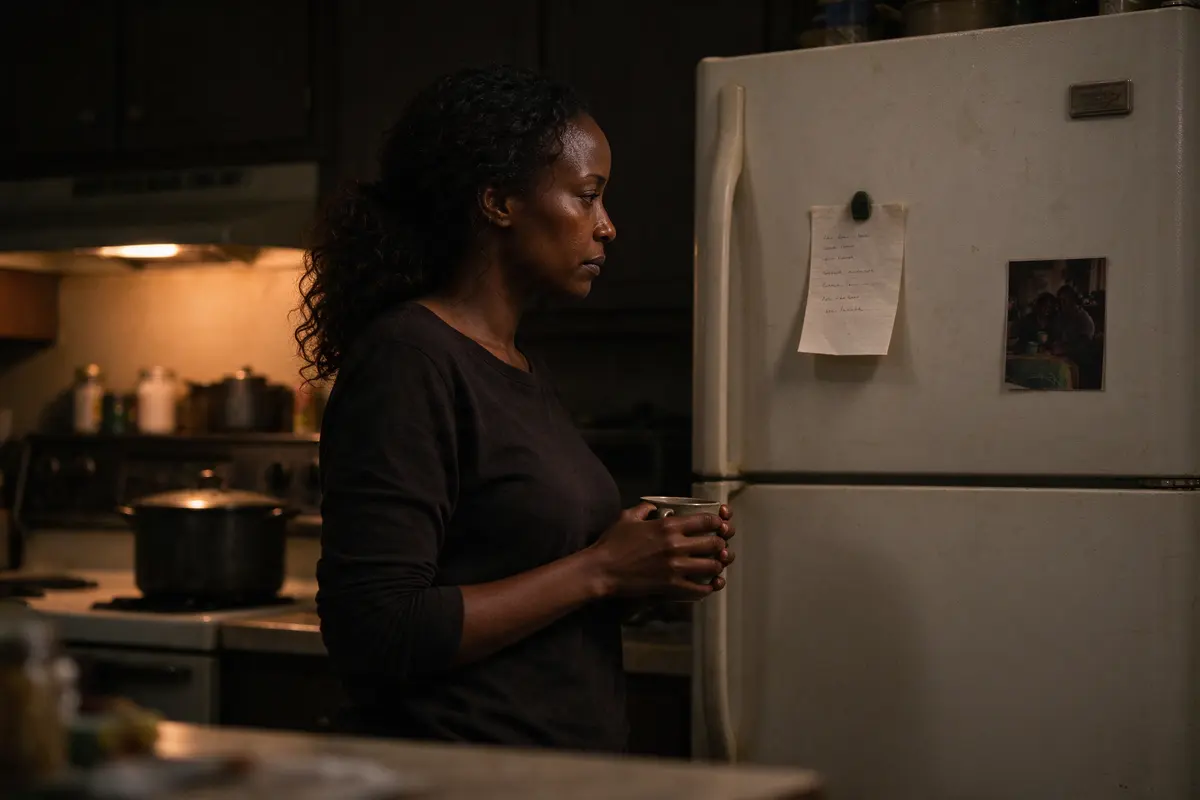
A new month, the last of the year, and the same short list for you, which runs for a full year after birth. Get care now for a headache that won't go away or gets worse, dizziness or fainting, changes in vision, a fever of 100.4°F or higher, extreme swelling of the hands or face, trouble breathing, chest pain or a fast-beating heart, severe belly pain that doesn't go away, heavy bleeding, overwhelming tiredness, or thoughts about harming yourself or your baby, and tell whoever sees you that you were pregnant within the last year (CDC). One thing is different now. The 6-month visit was the last at which the AAP recommends screening the birthing parent for depression (Earls et al., 2019), so the watching is yours, and your partner's. The rule hasn't changed: if sadness has lasted more than two weeks, go to your own doctor without waiting for any visit (Office on Women's Health).
If you're the partner: the birthday planning starts this week. Before the cake, ask the two-week question, and answer it for yourself; about 10% of fathers have depression around a birth, with higher rates reported at 3 to 6 months after (Paulson & Bazemore, 2010).
Sources
- Centers for Disease Control and Prevention. "Milestones by 1 Year." Learn the Signs. Act Early. program, updated 2026. https://www.cdc.gov/act-early/milestones/1-year.html
- Zubler JM, Wiggins LD, Macias MM, et al. "Evidence-Informed Milestones for Developmental Surveillance Tools." Pediatrics, 2022. https://pubmed.ncbi.nlm.nih.gov/35132439/
- American Academy of Pediatrics. "Corrected Age For Preemies." HealthyChildren.org, updated 2018. https://www.healthychildren.org/English/ages-stages/baby/preemie/Pages/Corrected-Age-For-Preemies.aspx
- Centers for Disease Control and Prevention. "Milestones by 15 Months." Learn the Signs. Act Early. program, accessed 2026. https://www.cdc.gov/act-early/milestones/15-months.html
- Kretch KS, Willett SL, Hsu LY, et al. "'Learn the Signs. Act Early.': Updates and Implications for Physical Therapists." Pediatric Physical Therapy, 2022. https://pubmed.ncbi.nlm.nih.gov/35876833/
- American Academy of Pediatrics. "Checkup Checklist: First Birthday (12 Months Old)." HealthyChildren.org, updated 2021. https://www.healthychildren.org/English/ages-stages/Your-Childs-Checkups/Pages/Your-Checkup-Checklist-12-Months-Old.aspx
- American Academy of Pediatrics. "Why Do Infants Need Baby Formula Instead of Cow's Milk?" HealthyChildren.org, updated 2024. https://www.healthychildren.org/English/ages-stages/baby/formula-feeding/Pages/Why-Formula-Instead-of-Cows-Milk.aspx
- Shu J. "From Bottle to Cup: Helping Your Child Make a Healthy Transition." HealthyChildren.org, updated 2023. https://www.healthychildren.org/English/ages-stages/baby/feeding-nutrition/Pages/Discontinuing-the-Bottle.aspx
- Centers for Disease Control and Prevention. "Milestones by 9 Months." Learn the Signs. Act Early. program, updated 2026. https://www.cdc.gov/act-early/milestones/9-months.html
- American Academy of Pediatrics. "Fever" (symptom checker). HealthyChildren.org, accessed 2026. https://www.healthychildren.org/English/tips-tools/symptom-checker/Pages/symptomviewer.aspx?symptom=Fever
- WHO Multicentre Growth Reference Study Group. "WHO Motor Development Study: windows of achievement for six gross motor development milestones." Acta Paediatrica Supplement, 2006. https://pubmed.ncbi.nlm.nih.gov/16817682/
- Centers for Disease Control and Prevention. "Urgent Maternal Warning Signs and Symptoms." HEAR HER campaign, accessed 2026. https://www.cdc.gov/hearher/maternal-warning-signs/index.html
- Earls MF, Yogman MW, Mattson G, Rafferty J; AAP Committee on Psychosocial Aspects of Child and Family Health. "Incorporating Recognition and Management of Perinatal Depression Into Pediatric Practice." Pediatrics, 2019. https://pubmed.ncbi.nlm.nih.gov/30559120/
- Office on Women's Health. "Recovering from birth." US Department of Health and Human Services, 2021. https://womenshealth.gov/pregnancy/childbirth-and-beyond/recovering-birth
- Paulson JF, Bazemore SD. "Prenatal and postpartum depression in fathers and its association with maternal depression: a meta-analysis." JAMA, 2010. https://pubmed.ncbi.nlm.nih.gov/20483973/
This guide is general education that summarizes published research and guidance from groups like the American Academy of Pediatrics, the CDC, and the WHO. It isn’t medical advice, and every child develops on their own timeline. Your pediatrician knows your child; if something feels wrong, call them. In an emergency, call 911.
Get each day’s note the morning it applies
Add your baby to a free Chorevia household with their date of birth, and every morning for 365 days the day’s note arrives in the app and by email: what’s developing, one thing to try, what to watch for, and a word for you.
Create your household