Day 347 of 365 · Week 47
Iron and the anemia check
Last reviewed · 4 min read · 16 sources · Plain-text version
The 12-month visit checks for anemia. Why iron runs low, which foods carry it, and why milk stops at 24 ounces after the birthday. The iron plate: one iron-rich food at each meal today.
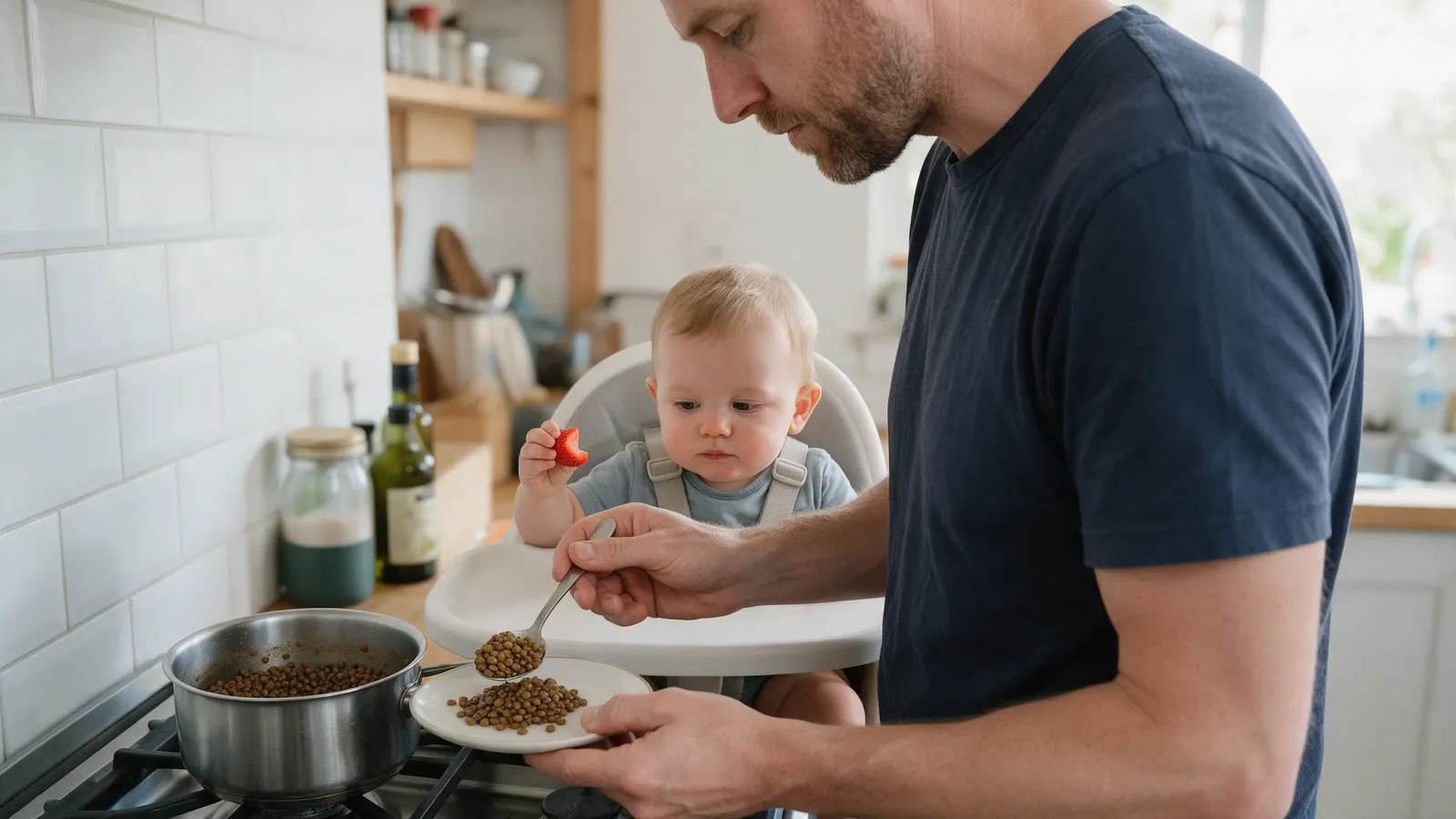
Eighteen days from the birthday, and the visit at the end of the road has a blood test in it. Today is what that test looks for, and the plate that helps the number come back fine.
Heart
At 12 months, your baby will be checked for anemia and, depending on risk, lead (AAP); the AAP's schedule lists the anemia check at this visit, with lead screening based on risk or local rules, and iron screening timing also depends on diet (AAP, 2025; AAP). The reason is the one you heard at six months: the iron babies are born with runs low (AAP). The AAP's 2026 guidance called for iron supplements for exclusively breastfed babies by 6 months (AAP, 2026), and iron-fortified formula covers iron for formula-fed babies (CDC). If your baby takes drops, the visit is where you ask whether they continue.
Head
Food is the other half. Meat and iron-fortified cereal are the AAP's early iron choices (AAP); eggs, fish, beans, lentils, and tofu also supply iron, and vitamin C foods like tomatoes or berries help babies absorb iron from plants (CDC). For the year ahead, the AAP's list reads beef, eggs, lentils, tofu, and iron-fortified cereal (AAP). In the New Zealand BLISS trial, self-feeding babies had normal iron levels at age 1 when parents were coached to offer a high-iron food at each meal (Daniels et al., 2018). That's the whole method: one iron food, every meal.
Body
The milk ceiling is an iron rule too. After the first birthday, more than 24 ounces of milk a day is linked to iron deficiency (AAP), because milk is low in iron and fills toddlers up so they eat fewer iron-rich foods (AAP). Cow's milk before the birthday is off for the same reason, among others (AAP). The guide's section is Growth, appetite, and teeth.
Try today
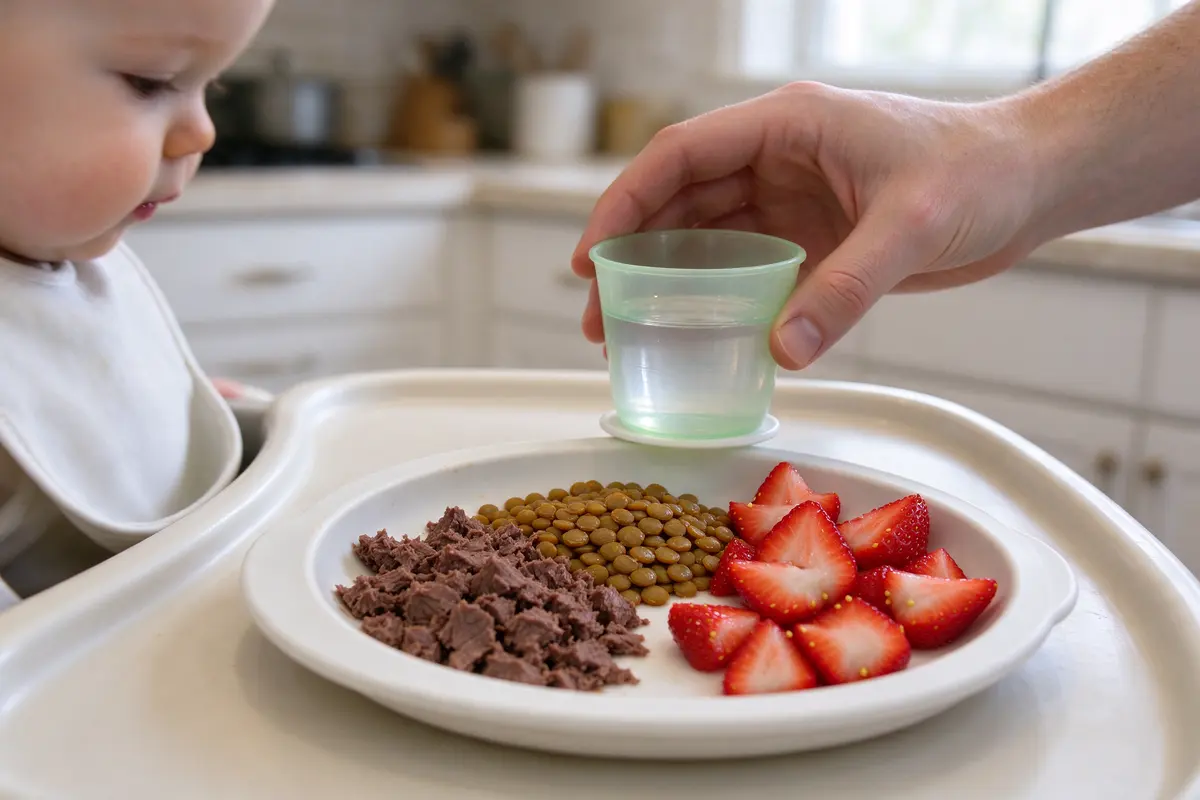
The iron plate
Time: Three meals, no extra time · Mealtimes without battles in the guide
Breakfast: iron-fortified oat or multigrain cereal, mashed with breast milk or formula, with a few small pieces of a vitamin C fruit beside it (CDC).
Lunch: lentils or well-cooked beans, soft, with chopped tomato (CDC).
Count how many of the three the baby actually ate. One is a win; the trial's coaching was one high-iron food per meal, not one per bite (Daniels et al., 2018).
Make it work:The refused lentils come back tomorrow, next to something they like.
Watch for
Normal
lentils flung on Monday and eaten on Thursday; the review's number was 8 to 10 or more days of tastes (Spill et al., 2019).
Talk with your pediatrician
if your baby isn't growing and gaining weight steadily (AAP).
Normal
Call your pediatrician right away
if your baby looks or acts very sick, or you think they need to be seen urgently (AAP).
Normal
egg eaten a second and third time in the same week; the AAP's advice is to keep egg and other allergens in the diet once they're in (AAP).
Call 911
for trouble breathing, swelling of the lips, face, or tongue, widespread hives, or sudden floppiness after a food (AAP).
For you
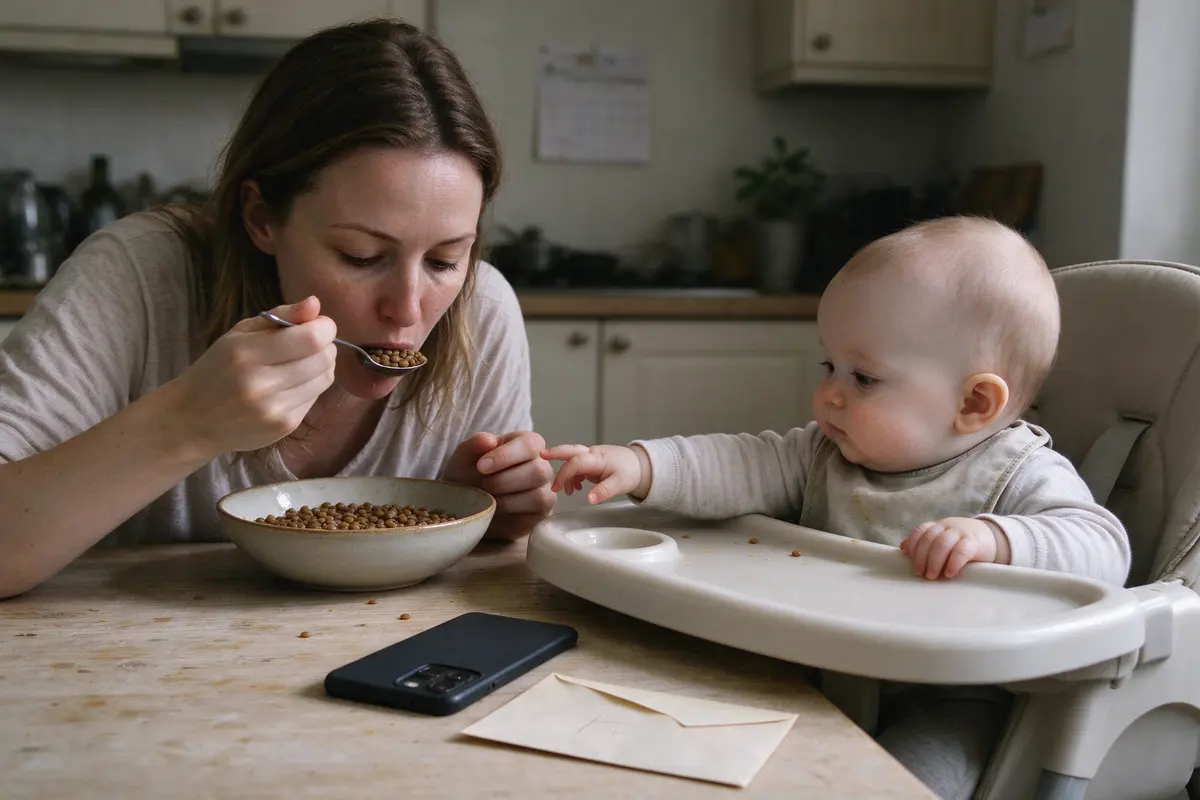
Your own iron doesn't get a checkup unless you ask for one. If you were told after the birth that you were anemic, or you left the hospital with iron tablets you stopped taking somewhere around month three, that's a question for your own provider, and the way to ask it is to say you were pregnant within the last year (CDC HEAR HER). Overwhelming tiredness is on the CDC's list of urgent maternal warning signs, and so is a fast-beating heart; neither is something to explain away with "I have a baby" (CDC HEAR HER).
If you're the partner: eat the iron plate too, and notice whether she's eating hers or just cutting it.
Sources
- American Academy of Pediatrics. "Checkup Checklist: First Birthday (12 Months Old)." HealthyChildren.org, updated 2021. https://www.healthychildren.org/English/ages-stages/Your-Childs-Checkups/Pages/Your-Checkup-Checklist-12-Months-Old.aspx
- American Academy of Pediatrics and Bright Futures. "Recommendations for Preventive Pediatric Health Care" (Periodicity Schedule). 2025. https://downloads.aap.org/AAP/PDF/periodicity_schedule.pdf
- American Academy of Pediatrics. "Iron Deficiency and Anemia in Babies, Children & Teens." HealthyChildren.org, updated 2026. https://www.healthychildren.org/English/health-issues/conditions/chronic/Pages/Anemia-and-Your-Child.aspx
- American Academy of Pediatrics. "Where We Stand: Vitamin D & Iron Supplements for Babies." HealthyChildren.org, updated 2022. https://www.healthychildren.org/English/ages-stages/baby/feeding-nutrition/Pages/vitamin-iron-supplements.aspx
- American Academy of Pediatrics. "Iron Deficiency & Iron Deficiency Anemia: AAP Updates Screening, Prevention & Treatment Guidance." HealthyChildren.org, 2026. https://www.healthychildren.org/English/news/Pages/iron-deficiency-anemia-prevention-screening-treatment-AAP-updates-guidance.aspx
- Centers for Disease Control and Prevention. "Iron." Infant and Toddler Nutrition, 2026. https://www.cdc.gov/infant-toddler-nutrition/vitamins-minerals/iron.html
- American Academy of Pediatrics. "When Can Babies Start Solid Foods? Readiness & Feeding Tips." HealthyChildren.org, updated 2026. https://www.healthychildren.org/English/ages-stages/baby/feeding-nutrition/Pages/Starting-Solid-Foods.aspx
- Daniels L, Taylor RW, Williams SM, et al. "Impact of a modified version of baby-led weaning on iron intake and status: a randomised controlled trial." BMJ Open, 2018. https://pubmed.ncbi.nlm.nih.gov/29950456/
- American Academy of Pediatrics. "Why Do Infants Need Baby Formula Instead of Cow's Milk?" HealthyChildren.org, updated 2024. https://www.healthychildren.org/English/ages-stages/baby/formula-feeding/Pages/Why-Formula-Instead-of-Cows-Milk.aspx
- Bradin S. "Choking Prevention for Babies & Children: What Every Parent Needs to Know." HealthyChildren.org, updated 2026. https://www.healthychildren.org/English/health-issues/injuries-emergencies/Pages/Choking-Prevention.aspx
- Spill MK, Johns K, Callahan EH, et al. "Repeated exposure to food and food acceptability in infants and toddlers: a systematic review." American Journal of Clinical Nutrition, 2019. https://pubmed.ncbi.nlm.nih.gov/30982874/
- American Academy of Pediatrics. "Sleeping Through the Night." HealthyChildren.org, updated 2013. https://www.healthychildren.org/English/ages-stages/baby/sleep/Pages/Sleeping-Through-the-Night.aspx
- American Academy of Pediatrics. "Fever" (symptom checker). HealthyChildren.org, accessed 2026. https://www.healthychildren.org/English/tips-tools/symptom-checker/Pages/symptomviewer.aspx?symptom=Fever
- Cox A, Pistiner M. "When to Introduce Egg, Peanut Butter & Other Common Food Allergens to a Baby." HealthyChildren.org, updated 2025. https://www.healthychildren.org/English/healthy-living/nutrition/Pages/when-to-introduce-egg-peanut-butter-and-other-common-food-allergens-to-your-baby-food-allergy-prevention-tips.aspx
- American Academy of Pediatrics. "Breathing Trouble" (symptom checker). HealthyChildren.org, accessed 2026. https://www.healthychildren.org/English/tips-tools/symptom-checker/Pages/symptomviewer.aspx?symptom=Breathing+Trouble
- Centers for Disease Control and Prevention. "Urgent Maternal Warning Signs and Symptoms." HEAR HER campaign, accessed 2026. https://www.cdc.gov/hearher/maternal-warning-signs/index.html
This guide is general education that summarizes published research and guidance from groups like the American Academy of Pediatrics, the CDC, and the WHO. It isn’t medical advice, and every child develops on their own timeline. Your pediatrician knows your child; if something feels wrong, call them. In an emergency, call 911.
Get each day’s note the morning it applies
Add your baby to a free Chorevia household with their date of birth, and every morning for 365 days the day’s note arrives in the app and by email: what’s developing, one thing to try, what to watch for, and a word for you.
Create your household