Day 346 of 365 · Week 47
Bottles, the wind-down
Last reviewed · 4 min read · 9 sources · Plain-text version
Finish between 12 and 18 months; the nap and bedtime bottles go first, a cup at meals, a story in the bottle's place, never a bottle in bed. The bedtime bottle swap, if the pediatrician agreed.

The bottle map from last month had an order to it, and the hardest line on it was the last one. Today is that line: the bedtime bottle, and what goes in its place.
Heart
The AAP suggests finishing the move from bottle to cup between 12 and 18 months; bottles that last longer are linked to filling up on milk, extra weight, and cavities (Shu, AAP). The order it gives: keep the mealtime bottles at first, drop the ones at naps and bedtime, and offer extra cuddles, songs, or a story instead (Shu, AAP). An open cup, a straw cup, or a sippy cup without a valve all work, and drinking from a cup without a lid as you hold it is a 12-month milestone (Shu, AAP; CDC).
Head
The bedtime bottle goes first for a reason that isn't about weaning. Never put your baby to bed with a bottle: sugary residue left in the mouth overnight promotes tooth decay (AAP), and milk sugars linger on teeth (AAP). The AAP's order for the evening is brush after the last drink or food of the day (AAP), which means the milk moves earlier, to dinner, and the thing that happens in the chair is a book. The guide's question is When should my baby stop using a bottle?
Body
Whether the night feed goes too is a separate question, and it's the pediatrician's. Many babies this age don't need to eat at night, but some still do; check first if your baby isn't growing and gaining weight steadily (AAP). Night waking at this age is often separation anxiety, and cuddling, feeding, or talking at every waking can prompt your baby to wake for that attention (Nemours KidsHealth). So the swap below is for the bottle at bedtime, not for whatever happens at 2 a.m., unless you've been told that can go as well.
Try today
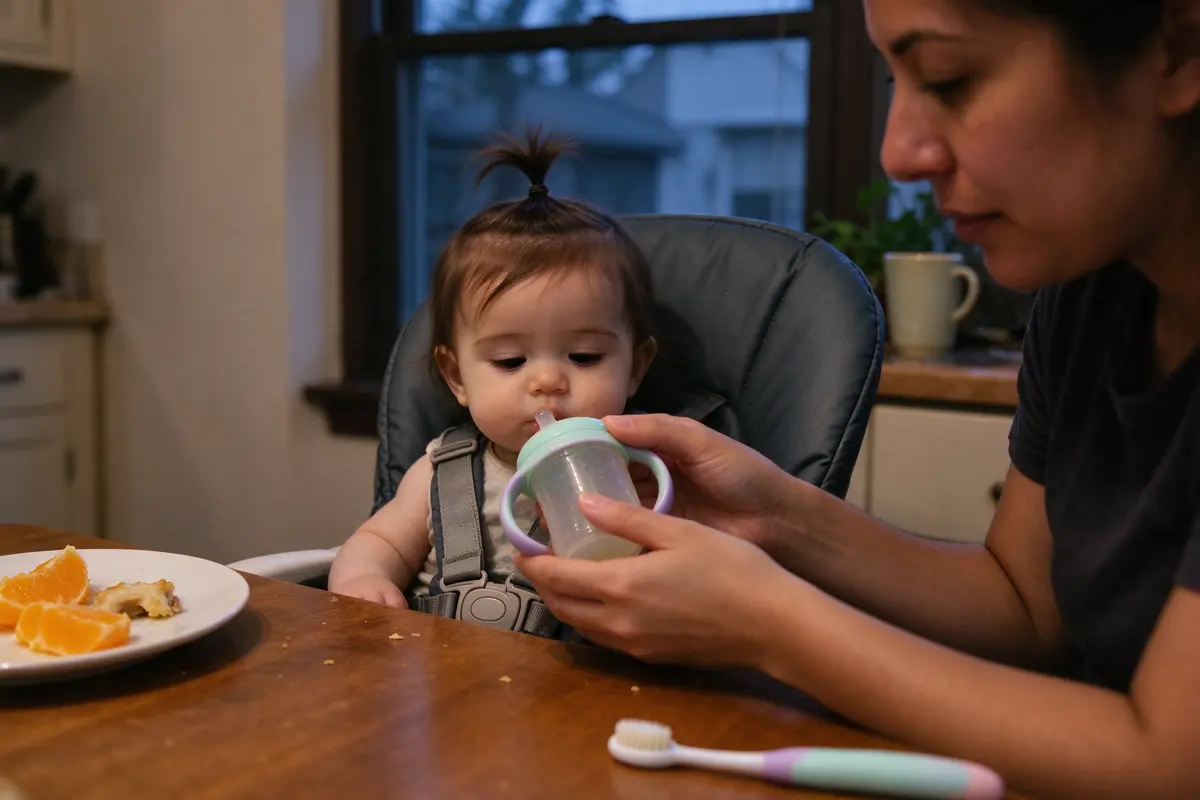
The bedtime bottle swap
Time: Tonight, if the pediatrician agreed at the 9-month visit or since; otherwise 2 minutes to write the question · From bottle to cup in the guide
The milk moves to dinner: the usual amount, in the high chair, from a cup you hold or a straw cup, while the family eats (Shu, AAP).
Sit in the chair where the bottle used to happen and read the same book you'd read anyway, then sing the same song. The cuddle is the same length as the bottle was (Shu, AAP).
Down drowsy but awake, as before (Nemours KidsHealth). If it isn't agreed yet, write "Can the bedtime bottle go now?" on the birthday-visit list and keep tonight as it is.
Make it work:Three nights before you judge it. The first is the loudest.
Watch for
Normal
a baby who drains the dinner cup and still looks for the bottle in the chair, then settles to the book by the third night.
Talk with your pediatrician
before cutting any night feed if your baby isn't growing and gaining weight steadily (AAP).
Normal
a 1 a.m. waking the same week, which is separation anxiety as often as hunger; reassure quietly, then leave (Nemours KidsHealth).
Go to the ER now
if your baby is hard to wake, isn't alert when awake, or seems confused (AAP).
Normal
a straw cup thrown and an open cup accepted, or the reverse; all three kinds work (Shu, AAP).
Call your pediatrician right away
for a fever over 104°F (40°C) (AAP).
For you

The first night is the hardest, and it's hardest on you, not the baby, who will have forgotten the bottle long before you've stopped missing the quiet it bought. The AAP's replacement is extra snuggles, songs, or a story (Shu, AAP), which is a longer evening for a week and a shorter one for years. If the week lands on top of nights that were already breaking you, say so to someone; a sadness that has lasted more than two weeks is a reason to see your own doctor, not to wait (Office on Women's Health).
If you're the partner: the first three stories are yours. The baby will protest less with the parent who never held the bottle, and she gets three evenings back.
Sources
- Shu J. "From Bottle to Cup: Helping Your Child Make a Healthy Transition." HealthyChildren.org, updated 2023. https://www.healthychildren.org/English/ages-stages/baby/feeding-nutrition/Pages/Discontinuing-the-Bottle.aspx
- Centers for Disease Control and Prevention. "Milestones by 1 Year." Learn the Signs. Act Early. program, updated 2026. https://www.cdc.gov/act-early/milestones/1-year.html
- American Academy of Pediatrics. "Sleeping Through the Night." HealthyChildren.org, updated 2013. https://www.healthychildren.org/English/ages-stages/baby/sleep/Pages/Sleeping-Through-the-Night.aspx
- American Academy of Pediatrics. "Why It's Important to Take Care of Baby Teeth." HealthyChildren.org, updated 2026. https://www.healthychildren.org/English/ages-stages/baby/teething-tooth-care/Pages/How-to-Prevent-Tooth-Decay-in-Your-Baby.aspx
- DiMaggio D, Cernigliaro J. "Baby's First Tooth: 7 Facts Parents Should Know." HealthyChildren.org, updated 2022. https://www.healthychildren.org/English/ages-stages/baby/teething-tooth-care/Pages/Babys-First-Tooth-Facts-Parents-Should-Know.aspx
- American Academy of Pediatrics. "Fluoride for Children: Parent FAQs." HealthyChildren.org, updated 2025. https://www.healthychildren.org/English/healthy-living/oral-health/Pages/FAQ-Fluoride-and-Children.aspx
- Nemours KidsHealth. "Baby Sleep: 8- to 12-Month-Olds." Reviewed 2025. https://kidshealth.org/en/parents/sleep812m.html
- American Academy of Pediatrics. "Fever" (symptom checker). HealthyChildren.org, accessed 2026. https://www.healthychildren.org/English/tips-tools/symptom-checker/Pages/symptomviewer.aspx?symptom=Fever
- Office on Women's Health. "Recovering from birth." US Department of Health and Human Services, 2021. https://womenshealth.gov/pregnancy/childbirth-and-beyond/recovering-birth
This guide is general education that summarizes published research and guidance from groups like the American Academy of Pediatrics, the CDC, and the WHO. It isn’t medical advice, and every child develops on their own timeline. Your pediatrician knows your child; if something feels wrong, call them. In an emergency, call 911.
Get each day’s note the morning it applies
Add your baby to a free Chorevia household with their date of birth, and every morning for 365 days the day’s note arrives in the app and by email: what’s developing, one thing to try, what to watch for, and a word for you.
Create your household