Day 332 of 365 · Week 45
Pat-a-cake, for real
Last reviewed · 4 min read · 10 sources · Plain-text version
Playing games with you, like pat-a-cake, is on the 1-year list. Copying is how it starts, and the games they steer are the ones that teach. Pat-a-cake, their turn.
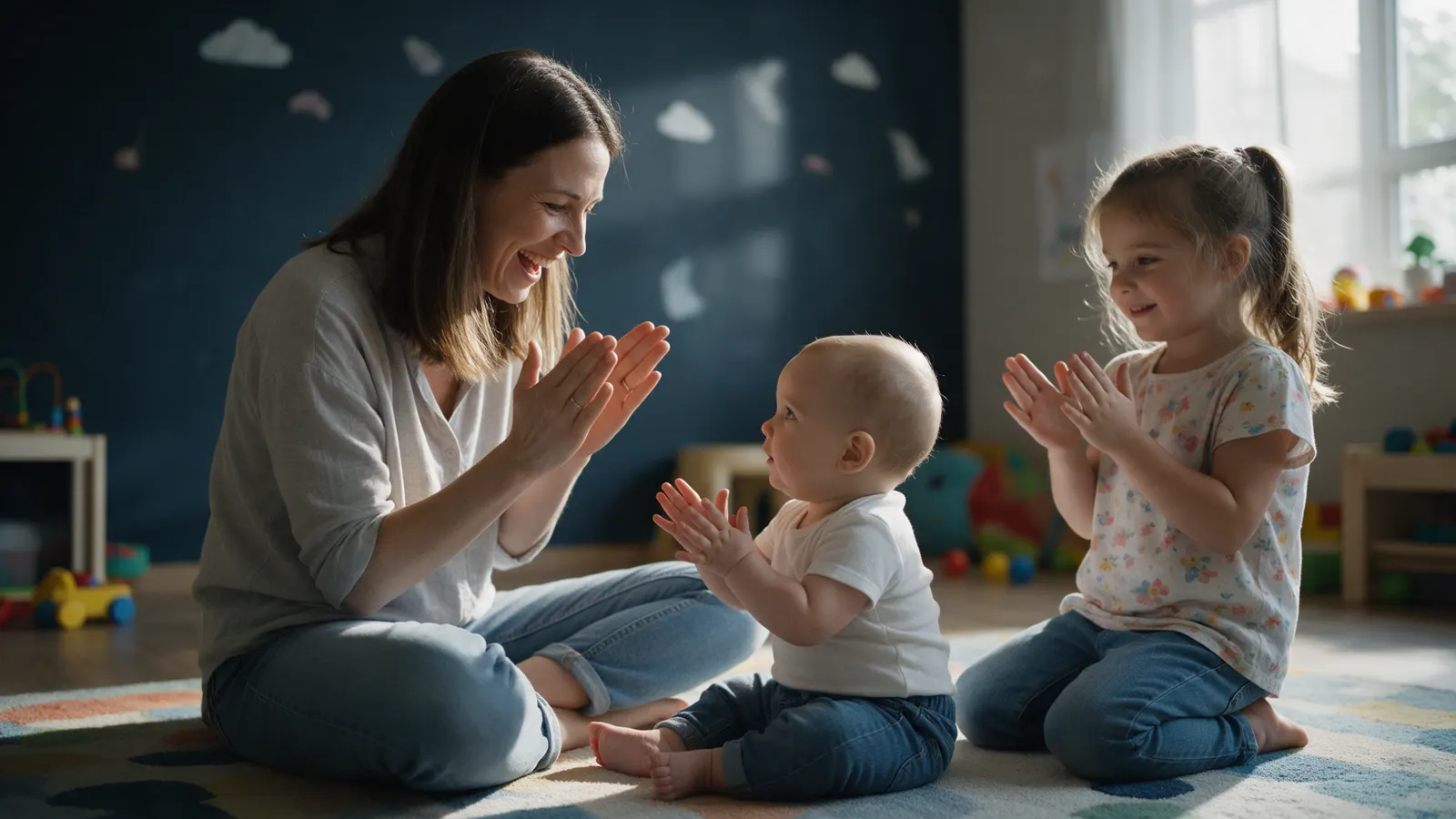
Pat-a-cake has been a thing you do at your baby for months. Sometime around now, for many, it becomes a thing you do with them: a clap that answers your clap, a hand up for "so big" before you've asked. Today is the game, played their way.
Heart
By 1 year, most babies play games with you, like pat-a-cake (CDC). It's the only social item on the 1-year list, and it stands for something bigger than a rhyme: a baby who knows the game has a shape, waits for their part, and does it. Toward the end of the first year, babies copy the gestures they see you use (AAP), and that copying is where the game comes from. The guide's version is Bye-bye and pat-a-cake: clap and sing, guiding the hands at first, then raise your arms for "So big!" and wait for the copy (CDC; CDC).
Head
What makes a game theirs is the waiting. In 24 babies followed monthly from 9 to 15 months, time spent sharing attention with their mothers, and mothers' talk about what the baby was already looking at, predicted the earliest gestures and words (Carpenter et al., 1998). That's a link, not a cause, but it points the same way as the guide's advice: follow what they're doing, then add to it. So the pat-a-cake that matters most is the one where you stop at the clap and let the next move be theirs, even if the next move is slapping your knees.
Body
Clapping asks a lot of an 11-month-old body: two hands brought to the middle at the same moment, from a sitting position that has to hold itself. Most babies get to a sitting position on their own and sit without support by 9 months (CDC), which is what frees the hands. Letting go on purpose, the skill that makes dropping and throwing favorite games, is the same control that lets two palms meet and part (AAP). A baby who claps standing at the coffee table, one hand off, is doing a balance exercise at the same time; pulling up and cruising are 12-month skills (CDC), so stay close.
Try today
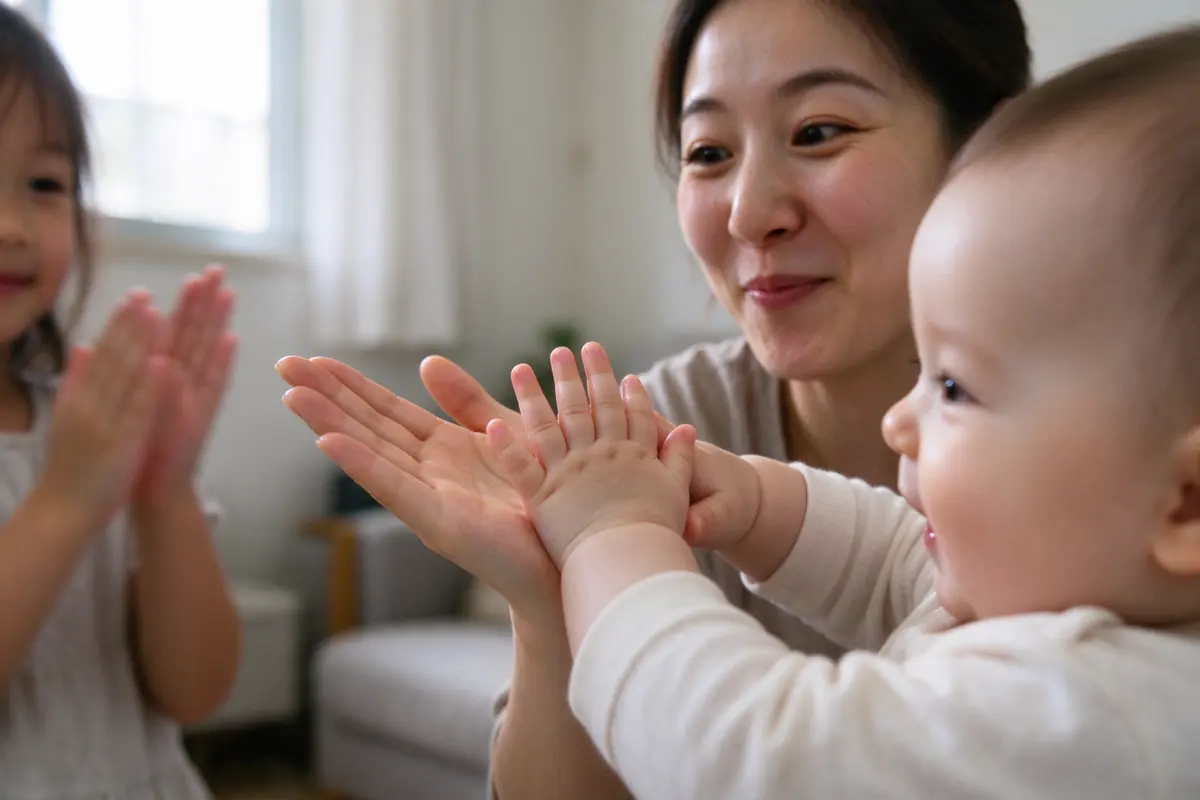
Pat-a-cake, their turn
Time: 2 minutes, a few times today · Bye-bye and pat-a-cake in the guide
Sit facing your baby on the floor and sing one round the usual way, guiding their hands if they want it (CDC).
Start the second round and stop at the first clap, hands open, mouth shut. Wait a full five seconds.
Whatever comes, a clap, a slap on your palms, a bounce, a shriek, is their turn. Copy it exactly, then finish the verse.
Stop when they look away. The game ended when they said so.
Make it work:Keep it on the floor; a baby who claps while standing at a table edge has just let go of the table.
Watch for
Normal
a clap that comes two beats late and lands on your face.
Talk with your pediatrician
if your baby seems not to see or hear well (AAP).
Normal
the game refused with a grandparent and played twice with you; wariness of strangers is often one of the first emotional milestones and isn't caused by spoiling (AAP).
Call your pediatrician right away
if your baby cries nonstop, or cries when touched or moved (AAP).
Normal
a baby who does "so big" and has never clapped; clapping when excited is a 15-month milestone (CDC).
Bring it up
if by 12 months your baby isn't playing simple games like pat-a-cake, or uses few gestures (CDC).
For you

You don't have to be the entertainment. The pause is the part that costs you something, because filling it is easier, and the whole of today's advice is to leave it empty for five seconds. The research on shared attention found that the talk that predicted first gestures and words was talk about what the baby was already doing (Carpenter et al., 1998); the same idea, applied to a rhyme, says the version of pat-a-cake with a missing clap in it is the better one. Let the clap be theirs. Let the ending be theirs too, and notice how much lighter a game is when you're not responsible for carrying it.
If you're the partner: your round tonight. The baby's clap for you may be a slap on the chest. Copy it, finish the verse, and don't correct the form.
Sources
- Centers for Disease Control and Prevention. "Milestones by 1 Year." Learn the Signs. Act Early. program, updated 2026. https://www.cdc.gov/act-early/milestones/1-year.html
- American Academy of Pediatrics. "Language Development: 8 to 12 Months." HealthyChildren.org, updated 2009. https://www.healthychildren.org/English/ages-stages/baby/Pages/Language-Development-8-to-12-Months.aspx
- Centers for Disease Control and Prevention. "Milestones by 9 Months." Learn the Signs. Act Early. program, updated 2026. https://www.cdc.gov/act-early/milestones/9-months.html
- Carpenter M, Nagell K, Tomasello M. "Social cognition, joint attention, and communicative competence from 9 to 15 months of age." Monographs of the Society for Research in Child Development, 1998. https://pubmed.ncbi.nlm.nih.gov/9835078/
- American Academy of Pediatrics. "Hand and Finger Skills." HealthyChildren.org, updated 2009. https://www.healthychildren.org/English/ages-stages/baby/Pages/Hand-and-Finger-Skills.aspx
- American Academy of Pediatrics. "Checkup Checklist: 9 Months Old." HealthyChildren.org, updated 2021. https://www.healthychildren.org/English/ages-stages/Your-Childs-Checkups/Pages/Your-Checkup-Checklist-9-Months-Old.aspx
- American Academy of Pediatrics. "Emotional and Social Development: 8 to 12 Months." HealthyChildren.org, updated 2009. https://www.healthychildren.org/English/ages-stages/baby/Pages/Emotional-and-Social-Development-8-12-Months.aspx
- American Academy of Pediatrics. "Fever" (symptom checker). HealthyChildren.org, accessed 2026. https://www.healthychildren.org/English/tips-tools/symptom-checker/Pages/symptomviewer.aspx?symptom=Fever
- Centers for Disease Control and Prevention. "Milestones by 15 Months." Learn the Signs. Act Early. program, accessed 2026. https://www.cdc.gov/act-early/milestones/15-months.html
- Centers for Disease Control and Prevention. "Signs and Symptoms of Autism Spectrum Disorder." 2024. https://www.cdc.gov/autism/signs-symptoms/index.html
This guide is general education that summarizes published research and guidance from groups like the American Academy of Pediatrics, the CDC, and the WHO. It isn’t medical advice, and every child develops on their own timeline. Your pediatrician knows your child; if something feels wrong, call them. In an emergency, call 911.
Get each day’s note the morning it applies
Add your baby to a free Chorevia household with their date of birth, and every morning for 365 days the day’s note arrives in the app and by email: what’s developing, one thing to try, what to watch for, and a word for you.
Create your household