Day 354 of 365 · Week 48
Words for feelings
Last reviewed · 4 min read · 12 sources · Plain-text version
Name what you think your baby feels, in three words, at the moment it's happening. Naming a feeling isn't giving in. Name the feeling, adapted for an 11-month-old: one feeling, one moment, today.

Eleven days to the birthday, and a word your baby won't say for a long time but can start hearing now. Today is feelings, named out loud at the moment they happen, and why that isn't the same as giving in.
Heart
The 1-year guide's first item under what to teach is words for everything, including feelings: name what you think your toddler feels (CDC), and talk about how others feel (CDC). Your baby has been showing several facial expressions, happy, sad, angry, and surprised, since the 9-month list (CDC), and the AAP's mirror games already label emotions as babies begin to recognize themselves (AAP). Naming feelings out loud is a CDC tip for this age too (CDC). The guide's activity is Name the feeling.
Head
Babies understand more than they can say (AAP), which is why the words land before the baby can use them. The AAP's script for a toddler's worst moment is three short sentences: "You're so mad. You wanted the red cup. I'm right here." Then wait (Swanson, AAP). Tantrums happen most between ages 1 and 3, and hunger and tiredness set off many of them (Swanson, AAP), so the habit you start this week is the one you'll lean on next year. Naming a feeling doesn't mean giving in: "You're mad, and it's still time to go" (Name the feeling).
Body
New fears of the dark, thunder, or the vacuum are common at this age (AAP), and they're the easiest feelings to name, because you can see what caused them. Expect your toddler, soon, to swing between fierce independence and clinging to you, especially when tired, sick, or scared; the AAP calls that normal (AAP). Rest and food head off more tantrums than words do: protect naps and carry snacks (Swanson, AAP).
Try today
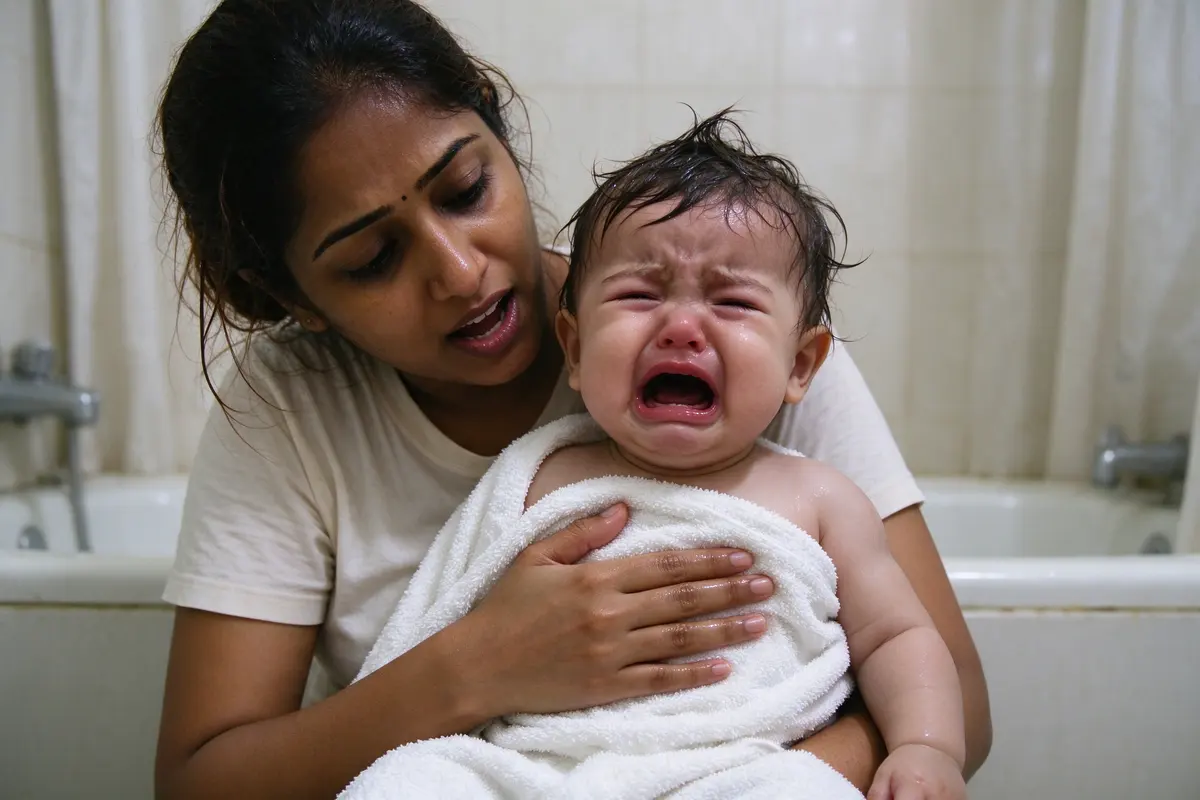
Name the feeling
Time: A moment, once today · Name the feeling in the guide
Pick the moment in advance: the end of the bath, the goodbye at the door, the block tower that falls. One moment, not all of them.
When it comes, get down to their face and name it in three words: "You're sad. The bath is done." (CDC)
Keep the rule. The bath is still done; the naming is the comfort, not a reversal.
Later, point it out in a book: "She's crying. She's sad." (CDC)
Make it work:Your own tone is the first thing they read; the advice for a meltdown is to stay calm and close (CDC).
Watch for
Normal
a wail at the end of the bath that ends in the towel, named or not.
Call your pediatrician right away
if your baby cries nonstop, or cries when touched or moved (AAP).
Normal
a baby who clings for the whole visit when a cousin arrives and then crawls off to play; some wariness is expected (AAP).
Mention it at the visit
if fear seems very intense; in 1,285 twins, fear that was high and steady from the start, or rose sharply, went with more inhibition at age 3 (Brooker et al., 2013).
Normal
a scream at the vacuum and a smile at it from your lap a week later; new fears of the dark, thunder, or the vacuum are common (AAP).
Go to the ER now
if your baby is hard to wake, isn't alert when awake, or seems confused (AAP).
For you
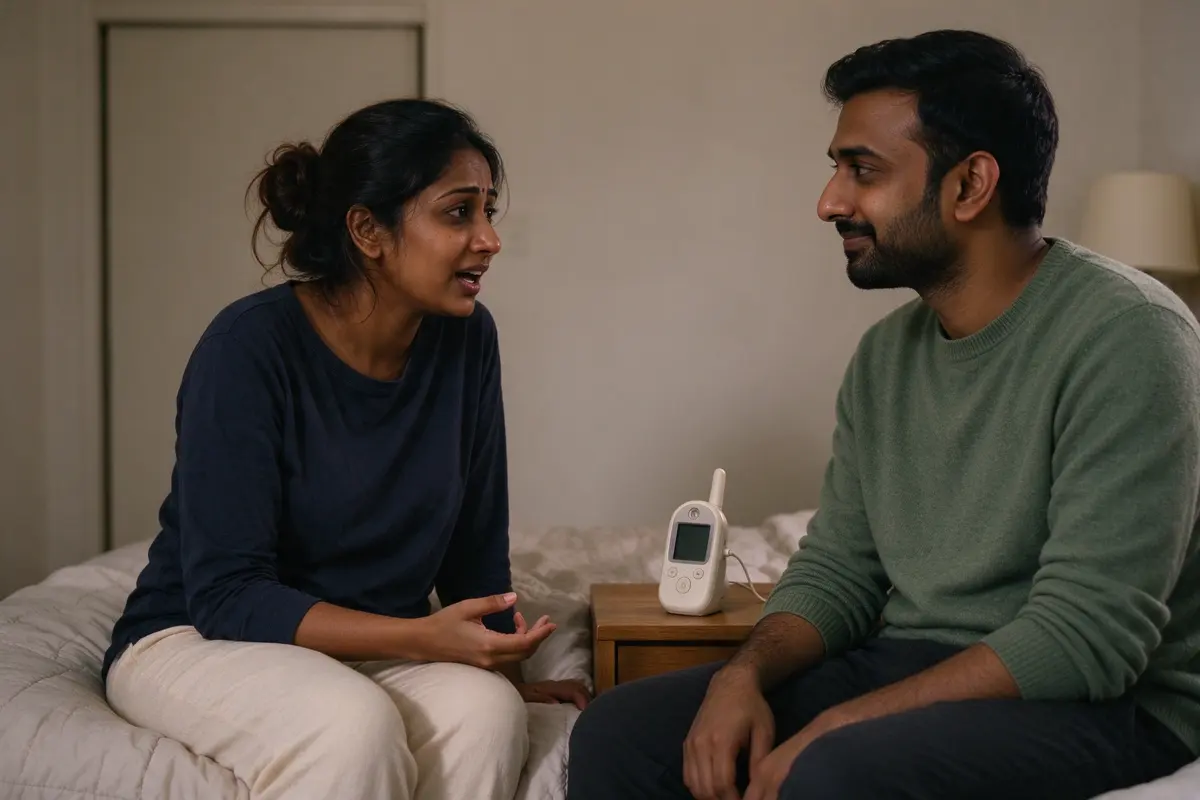
Name your own feeling once today, out loud, to an adult. Three words is enough: "I'm so tired." The CDC's urgent list for you includes thoughts about harming yourself or your baby, which need care right away (CDC HEAR HER), and the Office on Women's Health's rule is that a sadness lasting more than two weeks means going to the doctor, not waiting (Office on Women's Health). Most of what you'll name today is smaller than that. Naming it anyway is how you'll know the difference.
If you're the partner: your feeling counts, and it gets a sentence too. About 10% of fathers have depression around a birth (Paulson & Bazemore, 2010); the question "How are you, actually?" is one you can ask each other on the edge of the bed tonight.
Sources
- Centers for Disease Control and Prevention. "Milestones by 15 Months." Learn the Signs. Act Early. program, updated 2026. https://www.cdc.gov/act-early/milestones/15-months.html
- Centers for Disease Control and Prevention. "Milestones by 18 Months." Learn the Signs. Act Early. program, updated 2026. https://www.cdc.gov/act-early/milestones/18-months.html
- Centers for Disease Control and Prevention. "Milestones by 9 Months." Learn the Signs. Act Early. program, updated 2026. https://www.cdc.gov/act-early/milestones/9-months.html
- American Academy of Pediatrics. "Emotional and Social Development: 8 to 12 Months." HealthyChildren.org, updated 2009. https://www.healthychildren.org/English/ages-stages/baby/Pages/Emotional-and-Social-Development-8-12-Months.aspx
- American Academy of Pediatrics. "Language Development: 8 to 12 Months." HealthyChildren.org, updated 2009. https://www.healthychildren.org/English/ages-stages/baby/Pages/Language-Development-8-to-12-Months.aspx
- Swanson WS. "Top Tips for Surviving Tantrums." HealthyChildren.org, updated 2021. https://www.healthychildren.org/English/family-life/family-dynamics/communication-discipline/Pages/Temper-Tantrums.aspx
- American Academy of Pediatrics. "Emotional Development: 1 Year Olds." HealthyChildren.org, updated 2009. https://www.healthychildren.org/English/ages-stages/toddler/Pages/Emotional-Development-1-Year-Olds.aspx
- American Academy of Pediatrics. "Fever" (symptom checker). HealthyChildren.org, accessed 2026. https://www.healthychildren.org/English/tips-tools/symptom-checker/Pages/symptomviewer.aspx?symptom=Fever
- Brooker RJ, Buss KA, Lemery-Chalfant K, et al. "The development of stranger fear in infancy and toddlerhood: normative development, individual differences, antecedents, and outcomes." Developmental Science, 2013. https://pubmed.ncbi.nlm.nih.gov/24118713/
- Centers for Disease Control and Prevention. "Urgent Maternal Warning Signs and Symptoms." HEAR HER campaign, accessed 2026. https://www.cdc.gov/hearher/maternal-warning-signs/index.html
- Office on Women's Health. "Recovering from birth." US Department of Health and Human Services, 2021. https://womenshealth.gov/pregnancy/childbirth-and-beyond/recovering-birth
- Paulson JF, Bazemore SD. "Prenatal and postpartum depression in fathers and its association with maternal depression: a meta-analysis." JAMA, 2010. https://pubmed.ncbi.nlm.nih.gov/20483973/
This guide is general education that summarizes published research and guidance from groups like the American Academy of Pediatrics, the CDC, and the WHO. It isn’t medical advice, and every child develops on their own timeline. Your pediatrician knows your child; if something feels wrong, call them. In an emergency, call 911.
Get each day’s note the morning it applies
Add your baby to a free Chorevia household with their date of birth, and every morning for 365 days the day’s note arrives in the app and by email: what’s developing, one thing to try, what to watch for, and a word for you.
Create your household