Day 355 of 365 · Week 48
Add a word
Last reviewed · 4 min read · 13 sources · Plain-text version
Say their sound back and add one word: "ba" becomes "ball," "dog" becomes "big dog." Why the turns matter more than the word count, and why the pause after your reply is still the hard part.
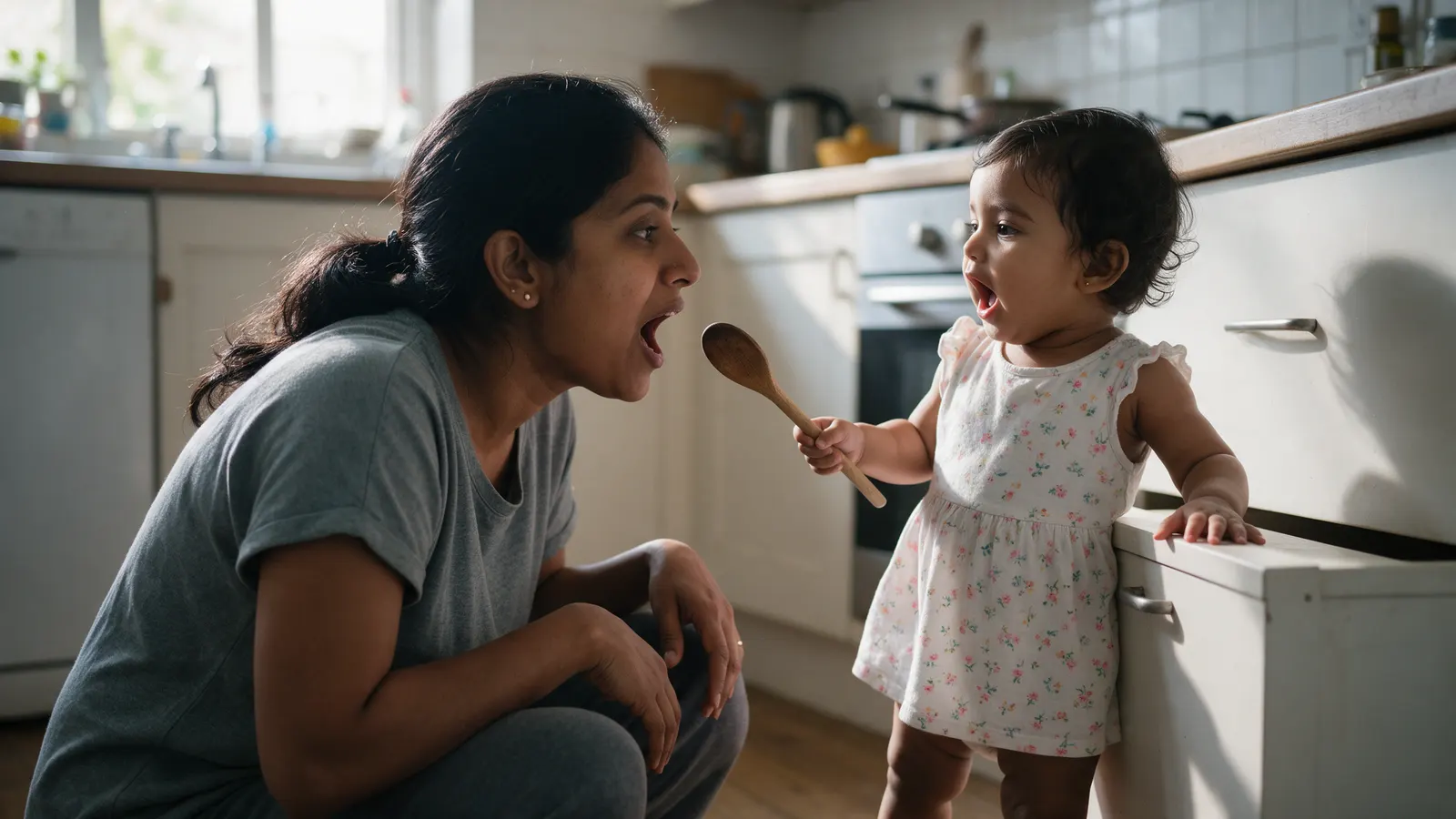
Ten days from the birthday, the sounds your baby makes have shapes, and some of them have meanings. Today is the simplest thing you can do with them: say the sound back, add one word, and wait.
Heart
The method is the guide's: repeat your baby's sounds, add simple words, and describe what they see (CDC). Keep names consistent ("cat" today, not "kitty" tomorrow), ask questions, and wait for an answer (AAP). The script for the ball: "Ba-ba? Ball! Here's your ball." The script for the dog, when they point: "Dog! A big dog. The dog says woof," then a pause for their turn (CDC). The 1-year guide's version is Add-a-word talk: "Milk" becomes "More milk" or "Cold milk" (CDC). Your baby is 11 months old, so most of what comes back will be babble, and the method is the same.
Head
Why turns, not word counts. In an observational study of 146 children, back-and-forth turns at 18 to 24 months predicted IQ and vocabulary 10 years later, even accounting for family socioeconomic status; plain word counts held up less well (Gilkerson et al., 2018). That's a correlation, not proof, and the children were older than yours. Closer to this age, 9.5-month-olds whose mothers answered their babble right away quickly reshaped it using sounds from their mothers' speech; babies answered at random times didn't (Goldstein & Schwade, 2008). Answer, then pause: these exchanges help build the brain's connections (Harvard Center on the Developing Child).
Body
What counts as a word. To a baby, a "word" is any sound used the same way each time, so "mog" for milk counts (AAP). Some babies have 2 or 3 words by their first birthday, but most 12-month speech is babble with the ups and downs of real talk (AAP). When the word is wrong, model instead of correcting: repeat it back correctly ("That's right, it's a ball!") rather than pointing out the mistake, and use real names, including for body parts: toes, not "piggies" (AAP).
Try today
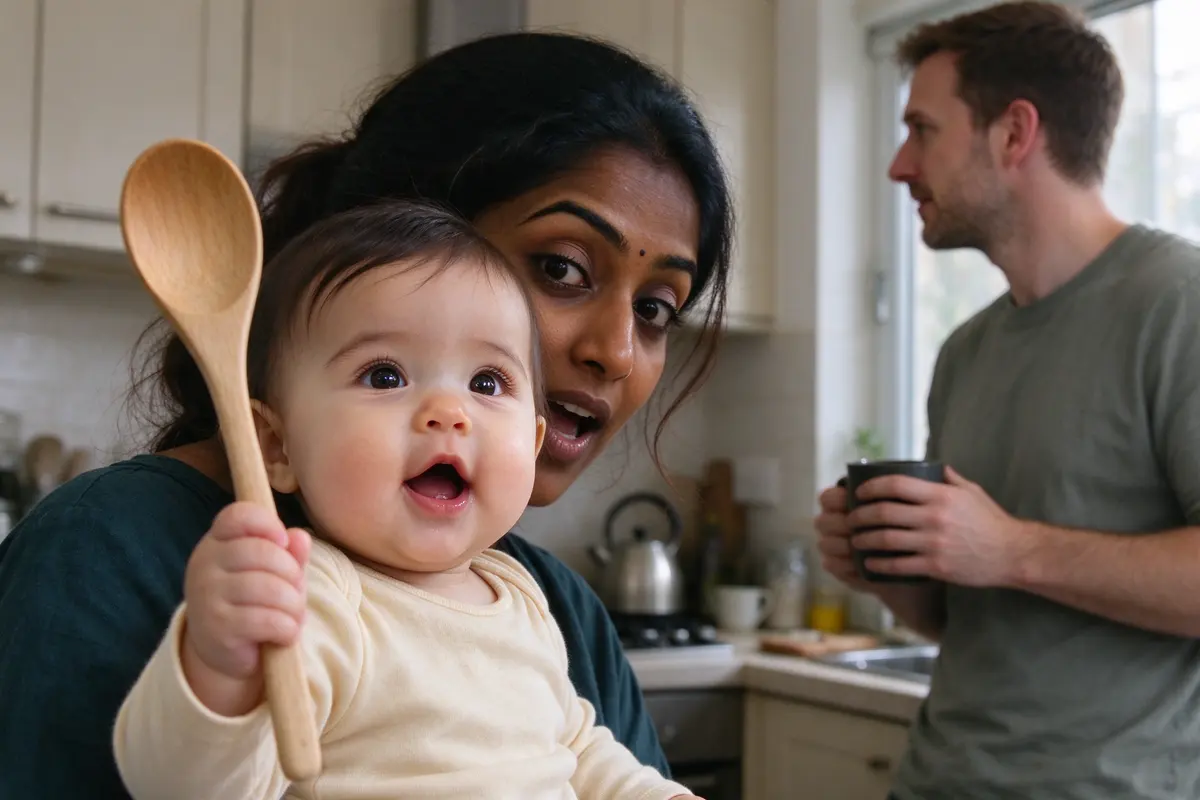
Add-a-word talk
Time: A few minutes, many times a day · Add-a-word talk in the guide
Wait for a sound aimed at something: the cup, the dog, the door. Don't start the conversation; let them.
Say the sound back as the word, plus one more: "Ba? Ball. Red ball" (CDC).
Stop talking. Count three in your head and look at them like it's their turn, because it is (Harvard Center on the Developing Child).
Whatever comes back, babble or silence or the sound again, answer it once more and add one more word. Three rounds is a conversation.
Make it work:The same name from every adult, every time (AAP). If one of you says "doggy" and one says "dog," pick one today.
Watch for
Normal
one sound that means four things, and a week where it means nothing at all; most 12-month speech is still babble (AAP).
Bring it up
if your baby doesn't look when you call their name (CDC).
Normal
a baby who talks to the dog more than to you.
Bring it up
if your baby seems not to see or hear well (AAP).
Normal
a hoarse voice after a morning of shrieking at the ceiling.
Call your pediatrician right away
for trouble breathing that isn't severe, or great trouble swallowing fluids or spit (AAP).
Normal
babble that stops while they concentrate on standing.
Don't wait
if your baby has lost skills they used to have; ask about screening, or call your state's early intervention program for a free evaluation without a referral (CDC).
For you
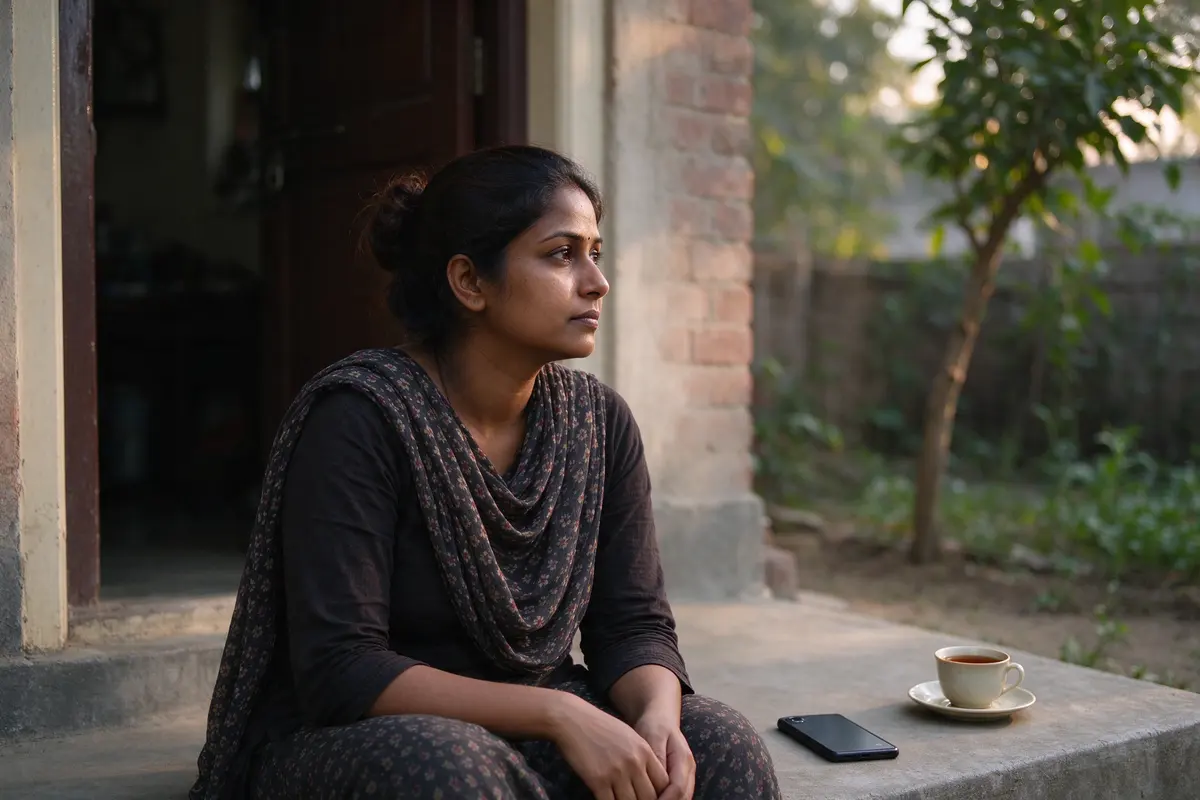
The pause is still the hard part. In home recordings of 26 babies, one-on-one parentese at 11 and 14 months was linked to more words at 24 months (Ramírez-Esparza et al., 2014); the one-on-one is the part that costs you, because it means a phone face-down and three seconds of silence while a baby decides whether to answer. Give yourself a pause too, once today, without the baby: a cup of something on the step, with nothing in your other hand. If what fills that silence is something heavy, the rule hasn't changed: if sadness has lasted more than two weeks, go to your own doctor without waiting for any visit (Office on Women's Health).
If you're the partner: you take a round tonight, three turns, the same names she uses. Then take a turn with her: ask one question and wait the same three seconds for the answer.
Sources
- Centers for Disease Control and Prevention. "Milestones by 9 Months." Learn the Signs. Act Early. program, updated 2026. https://www.cdc.gov/act-early/milestones/9-months.html
- American Academy of Pediatrics. "Language Development: 8 to 12 Months." HealthyChildren.org, updated 2009. https://www.healthychildren.org/English/ages-stages/baby/Pages/Language-Development-8-to-12-Months.aspx
- Centers for Disease Control and Prevention. "Milestones by 1 Year." Learn the Signs. Act Early. program, updated 2026. https://www.cdc.gov/act-early/milestones/1-year.html
- Centers for Disease Control and Prevention. "Milestones by 18 Months." Learn the Signs. Act Early. program, updated 2026. https://www.cdc.gov/act-early/milestones/18-months.html
- Gilkerson J, Richards JA, Warren SF, et al. "Language Experience in the Second Year of Life and Language Outcomes in Late Childhood." Pediatrics, 2018. https://pubmed.ncbi.nlm.nih.gov/30201624/
- Goldstein MH, Schwade JA. "Social feedback to infants' babbling facilitates rapid phonological learning." Psychological Science, 2008. https://pubmed.ncbi.nlm.nih.gov/18466414/
- Center on the Developing Child at Harvard University. "Serve and Return." Accessed 2026. https://developingchild.harvard.edu/key-concept/serve-and-return/
- American Academy of Pediatrics. "Language Development: 1 Year Olds." HealthyChildren.org, updated 2009. https://www.healthychildren.org/English/ages-stages/toddler/Pages/Language-Development-1-Year-Olds.aspx
- American Academy of Pediatrics. "Checkup Checklist: 9 Months Old." HealthyChildren.org, updated 2021. https://www.healthychildren.org/English/ages-stages/Your-Childs-Checkups/Pages/Your-Checkup-Checklist-9-Months-Old.aspx
- American Academy of Pediatrics. "Fever" (symptom checker). HealthyChildren.org, accessed 2026. https://www.healthychildren.org/English/tips-tools/symptom-checker/Pages/symptomviewer.aspx?symptom=Fever
- Centers for Disease Control and Prevention. "Concerned About Your Child's Development?" Updated 2026. https://www.cdc.gov/act-early/families/concerned.html
- Ramírez-Esparza N, García-Sierra A, Kuhl PK. "Look who's talking: speech style and social context in language input to infants are linked to concurrent and future speech development." Developmental Science, 2014. https://pubmed.ncbi.nlm.nih.gov/24702819/
- Office on Women's Health. "Recovering from birth." US Department of Health and Human Services, 2021. https://womenshealth.gov/pregnancy/childbirth-and-beyond/recovering-birth
This guide is general education that summarizes published research and guidance from groups like the American Academy of Pediatrics, the CDC, and the WHO. It isn’t medical advice, and every child develops on their own timeline. Your pediatrician knows your child; if something feels wrong, call them. In an emergency, call 911.
Get each day’s note the morning it applies
Add your baby to a free Chorevia household with their date of birth, and every morning for 365 days the day’s note arrives in the app and by email: what’s developing, one thing to try, what to watch for, and a word for you.
Create your household