Day 339 of 365 · Week 46
First steps, still maybe
Last reviewed · 4 min read · 10 sources · Plain-text version
A few steps alone is a 15-month milestone, and many babies aren't walking alone at 12 months. The honest range, the question worth asking, and three steps with one hand held. The one-hand walk.

If the first steps come this month, they'll come the way they come: a lurch between two adults, a surprised face, a sit-down. If they don't, they're on the list for the next age, not this one. Today is the honest range, the question worth asking if the range runs out, and a game with one hand.
Heart
Taking a few steps alone is a 15-month milestone (CDC). Many babies aren't walking alone at 12 months; by 12 months, most pull up to stand and walk while holding on to furniture (CDC). Healthy children in the WHO's study started walking alone anywhere from 8.2 to 17.6 months (WHO Multicentre Growth Reference Study Group, 2006). The 1-year guide takes it from there: most toddlers take a few steps on their own by 15 months and walk without holding on by 18 months, and not walking by 18 months is a reason to call, not to wait (CDC; CDC). That line is seven months past the birthday.
Head
The question worth asking, if it comes to it, is about pulling up, not walking: if your baby isn't pulling to stand by 12 months or has lost skills, ask about a developmental screening (CDC). Talk with your pediatrician if your baby favors one side or doesn't seem to be moving normally (AAP). Those are the lines with a job. "Not walking at the birthday" isn't one of them. The guide's question is Is it normal if my baby isn't walking by their first birthday?
Body
Walking, once it starts, is learned by volume. Filmed during free play, 12- to 19-month-olds averaged 2,368 steps and 17 falls per hour, and new walkers improved fast, taking more steps and falling less (Adolph et al., 2012). What they walk on matters: safe floor space beats any gadget, and baby walkers don't help and send thousands of children to hospitals each year, mostly from falls down stairs (AAP). A hand held by an adult is the opposite of a walker: the baby does the balancing, and lets go when they're done.
Try today

The one-hand walk
Time: 2 minutes, once or twice today · Crawling, cruising, and first steps in the guide
Stand your baby at the sofa, or on the grass, with the other adult a few feet away.
Offer one hand, at their shoulder height, and let them take it. One hand, not two: the free arm is their balance, and the balancing is the practice (Adolph et al., 2012).
Walk three steps toward the other adult, then stop and let them sit. That's the whole round.
If they drop to crawl, that's their answer; crawling is faster and they know it. A few steps alone has until 15 months (CDC).
Make it work:On a cleared rug or grass, away from table corners. Bare feet indoors; shoes are for walking outside (AAP).
Watch for
Normal
knees that buckle the moment the finger is taken, and a baby who'd rather cruise; walking alone starts anywhere from 8.2 to 17.6 months (WHO Multicentre Growth Reference Study Group, 2006).
Talk with your pediatrician
if your baby uses one arm or leg much more than the other (AAP).
Normal
two steps between you on Tuesday and none for the rest of the week.
Call your pediatrician now
for any head injury in a baby under 1 year, even if your baby seems fine (AAP).
Normal
a hot, cross evening with no interest in standing at all.
Call your pediatrician right away
if your baby won't move an arm or leg normally, or cries when touched or moved (AAP).
For you
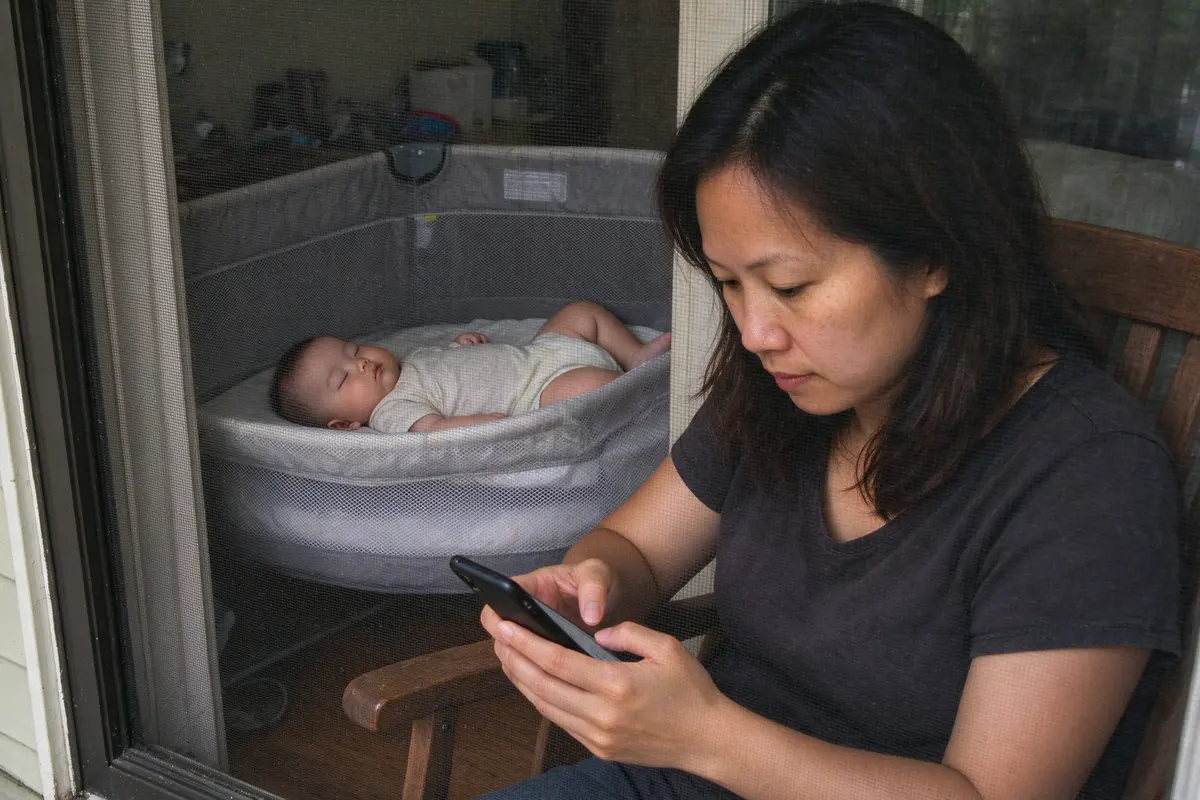
Not walking at the birthday is normal, and you'll be asked. Here's the sentence, so you don't have to build it on the spot: "A few steps alone is a 15-month milestone, and the normal range for walking runs past 17 months; we're in it" (CDC; WHO Multicentre Growth Reference Study Group, 2006). Say it once, kindly, and change the subject to the cake. The relatives mean well; they're working from a story about their own children, and those children's dates were inside the same window. If the birthday passes and the question that has a job, pulling to stand, is still open, that goes to the 12-month visit, and the free evaluation needs no referral (CDC).
If you're the partner: be the other adult today, the one with the open arms. And when the sentence is needed at the party, say it before she has to.
Sources
- Centers for Disease Control and Prevention. "Milestones by 15 Months." Learn the Signs. Act Early. program, accessed 2026. https://www.cdc.gov/act-early/milestones/15-months.html
- Centers for Disease Control and Prevention. "Milestones by 1 Year." Learn the Signs. Act Early. program, updated 2026. https://www.cdc.gov/act-early/milestones/1-year.html
- WHO Multicentre Growth Reference Study Group. "WHO Motor Development Study: windows of achievement for six gross motor development milestones." Acta Paediatrica Supplement, 2006. https://pubmed.ncbi.nlm.nih.gov/16817682/
- Centers for Disease Control and Prevention. "Milestones by 18 Months." Learn the Signs. Act Early. program, updated 2026. https://www.cdc.gov/act-early/milestones/18-months.html
- American Academy of Pediatrics. "Movement Milestones in Babies 8 to 12 Months Old." HealthyChildren.org, updated 2021. https://www.healthychildren.org/English/ages-stages/baby/Pages/Movement-8-to-12-Months.aspx
- Adolph KE, Cole WG, Komati M, et al. "How do you learn to walk? Thousands of steps and dozens of falls per day." Psychological Science, 2012. https://pubmed.ncbi.nlm.nih.gov/23085640/
- American Academy of Pediatrics. "Baby Walkers: A Dangerous Choice." HealthyChildren.org, updated 2022. https://www.healthychildren.org/English/safety-prevention/at-home/Pages/Baby-Walkers-A-Dangerous-Choice.aspx
- American Academy of Pediatrics. "Head Injury" (symptom checker). HealthyChildren.org, accessed 2026. https://www.healthychildren.org/English/tips-tools/symptom-checker/Pages/symptomviewer.aspx?symptom=Head+Injury
- American Academy of Pediatrics. "Fever" (symptom checker). HealthyChildren.org, accessed 2026. https://www.healthychildren.org/English/tips-tools/symptom-checker/Pages/symptomviewer.aspx?symptom=Fever
- Centers for Disease Control and Prevention. "Concerned About Your Child's Development?" Updated 2026. https://www.cdc.gov/act-early/families/concerned.html
This guide is general education that summarizes published research and guidance from groups like the American Academy of Pediatrics, the CDC, and the WHO. It isn’t medical advice, and every child develops on their own timeline. Your pediatrician knows your child; if something feels wrong, call them. In an emergency, call 911.
Get each day’s note the morning it applies
Add your baby to a free Chorevia household with their date of birth, and every morning for 365 days the day’s note arrives in the app and by email: what’s developing, one thing to try, what to watch for, and a word for you.
Create your household