Day 343 of 365 · Week 46
Family food, month twelve
Last reviewed · 4 min read · 16 sources · Plain-text version
Finely chopped, from the family's own dinner, on one plate; three meals and snacks; the refused food back again tomorrow. The same-plate dinner, with the birthday three weeks away.
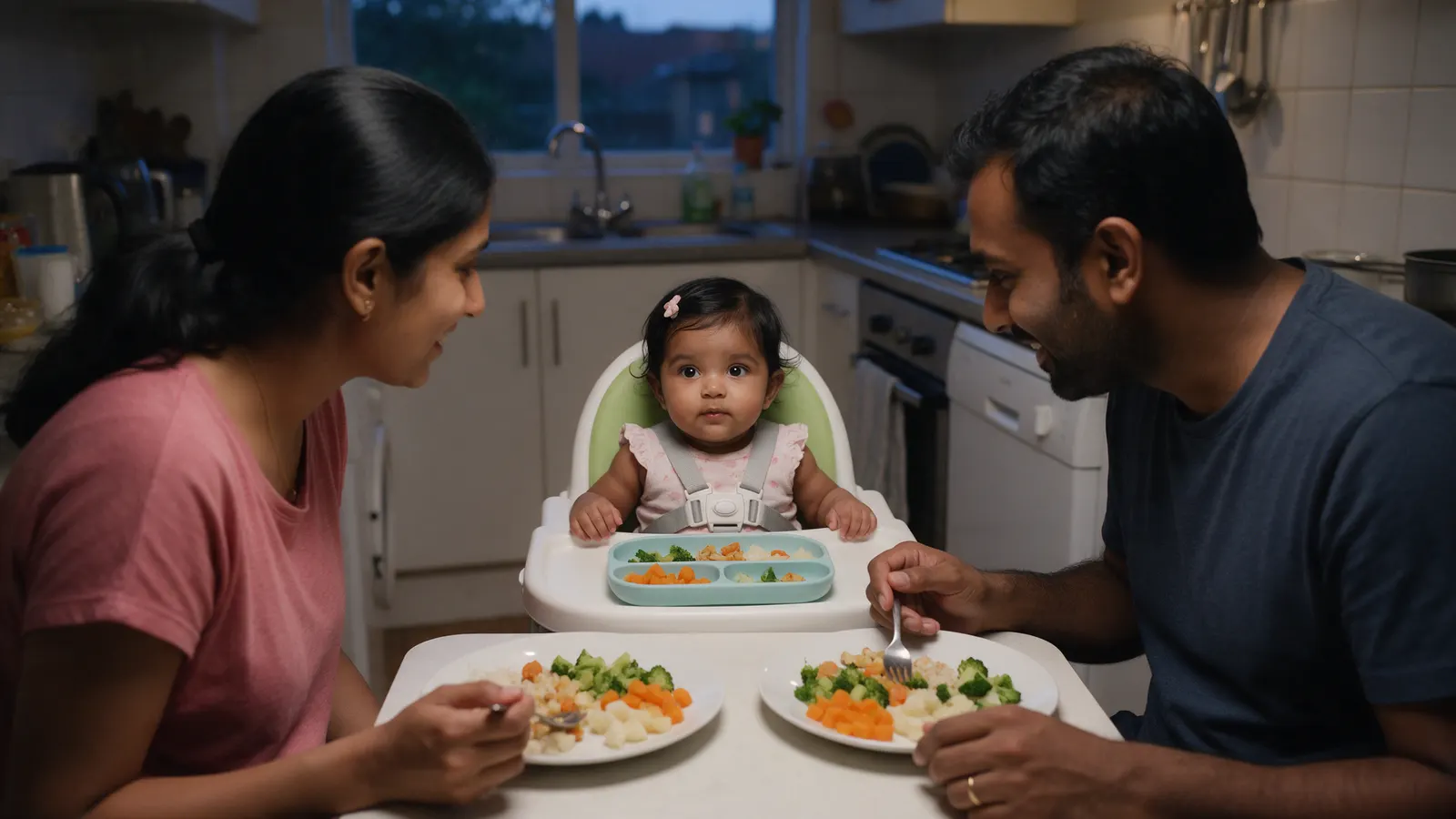
Three weeks before the birthday, the menu has mostly caught up with the family. Today is the last big feeding idea of the first year: one dinner, cut small, eaten together, with the baby deciding how much.
Heart
The AAP encourages family meals from the first feeding, and says to let your baby's fullness cues, not the plate, decide when the meal is over (AAP). Fullness looks like pushing food away, closing the mouth, or turning the head; your baby decides how much, and food is never a reward or a punishment (CDC). Near 12 months, growth slows and appetite often levels off (AAP), so a baby who eats less this month than last is usually a baby doing the math right.
Head
Textures have been thickening since summer, from smooth to mashed and lumpy to finely chopped (CDC), which is what makes the family's dinner possible. The refused foods go back on the plate: CDC says to keep offering foods your baby refused before (CDC), and a systematic review of 21 studies, mostly controlled trials, found moderate evidence that tasting a vegetable or fruit daily for 8 to 10 or more days makes babies and toddlers more willing to eat it (Spill et al., 2019). The AAP's checkup page puts it at 10 to 15 tries before a baby accepts a new food (AAP). The guide's section is From purees to family food.
Body
The shape of the day is the one the AAP suggested at 9 months: 3 meals and 2 to 3 snacks (AAP), with breast milk or formula still the main drink and 4 to 8 ounces of water a day (Muth, AAP). Cow's milk as a drink waits for the birthday (AAP). Pieces stay no larger than half an inch, and you stay at the table while your baby eats (AAP).
Try today

The same-plate dinner
Time: Tonight's dinner, no extra cooking · Baby at the family table in the guide
Cook what the family is eating. Before the salt goes in, set aside your baby's portion (AAP).
Cut it to half an inch or smaller, skipping anything on the not-before-1 list (AAP). One plate, three or four things on it, including one they pushed away last week.
High chair pulled up to the table, harness buckled, a cup with a little water, and the same food on your own plate (AAP).
Eat. Talk about the food, not the amount. When the head turns away or the mouth closes, the meal is over (CDC).
Make it work:The refused thing goes back on the plate tomorrow, without comment; the review's number was 8 to 10 or more days (Spill et al., 2019).
Watch for
Normal
three bites of rice, the chicken examined and dropped, the whole meal over in ten minutes; appetite levels off near 12 months (AAP).
Talk with your pediatrician
if your baby isn't growing and gaining weight steadily (AAP).
Normal
a gag on a bigger lump, loud and red-faced and over in seconds; give them a moment and don't sweep with a finger (Children's Wisconsin).
Call 911
if your baby is choking and can't breathe, cry, or make noise, turns bluish, or goes limp (AAP).
Normal
a dinner eaten entirely with the pincer, pea by pea; picking up small bits of food between thumb and pointer finger is a 12-month milestone (CDC).
Call your pediatrician right away
for signs of dehydration: no urine in more than 8 hours, dark urine, a very dry mouth, and no tears (AAP).
For you
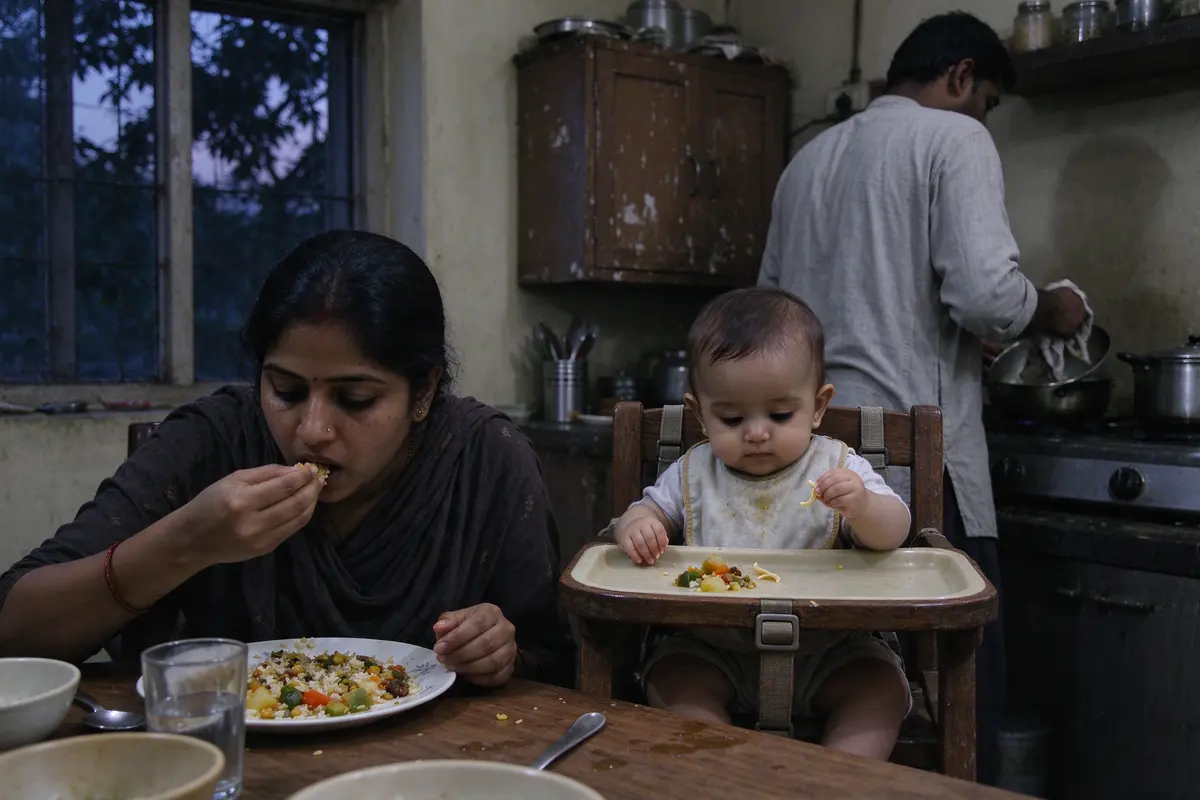
One dinner. Not a baby meal at five and yours at eight, cold. The AAP's advice is to eat the same foods yourself and let your baby decide how much (AAP), which means the meal you cook for them is the meal you get to sit down to. For your own body, the Office on Women's Health's recovery advice was plain: plenty of water and fresh fruits and vegetables (Office on Women's Health). A plate of what the baby is eating covers most of it.
If you're the partner: you cut. The half-inch rule is a job for whoever isn't holding the baby, and it's the same job every night for a long time (AAP).
Sources
- American Academy of Pediatrics. "When Can Babies Start Solid Foods? Readiness & Feeding Tips." HealthyChildren.org, updated 2026. https://www.healthychildren.org/English/ages-stages/baby/feeding-nutrition/Pages/Starting-Solid-Foods.aspx
- Centers for Disease Control and Prevention. "Signs Your Child Is Hungry or Full." 2026. https://www.cdc.gov/infant-toddler-nutrition/mealtime/signs-your-child-is-hungry-or-full.html
- American Academy of Pediatrics. "Checkup Checklist: First Birthday (12 Months Old)." HealthyChildren.org, updated 2021. https://www.healthychildren.org/English/ages-stages/Your-Childs-Checkups/Pages/Your-Checkup-Checklist-12-Months-Old.aspx
- Centers for Disease Control and Prevention. "Tastes and Textures." 2026. https://www.cdc.gov/infant-toddler-nutrition/foods-and-drinks/tastes-and-textures.html
- Centers for Disease Control and Prevention. "Milestones by 9 Months." Learn the Signs. Act Early. program, updated 2026. https://www.cdc.gov/act-early/milestones/9-months.html
- Spill MK, Johns K, Callahan EH, et al. "Repeated exposure to food and food acceptability in infants and toddlers: a systematic review." American Journal of Clinical Nutrition, 2019. https://pubmed.ncbi.nlm.nih.gov/30982874/
- American Academy of Pediatrics. "Checkup Checklist: 6 Months Old." HealthyChildren.org, updated 2023. https://www.healthychildren.org/English/ages-stages/Your-Childs-Checkups/Pages/Your-Checkup-Checklist-6-Months-Old.aspx
- American Academy of Pediatrics. "Checkup Checklist: 9 Months Old." HealthyChildren.org, updated 2021. https://www.healthychildren.org/English/ages-stages/Your-Childs-Checkups/Pages/Your-Checkup-Checklist-9-Months-Old.aspx
- Muth ND. "Recommended Drinks for Children Age 5 & Younger." HealthyChildren.org, updated 2023. https://www.healthychildren.org/English/healthy-living/nutrition/Pages/Recommended-Drinks-for-Young-Children-Ages-0-5.aspx
- American Academy of Pediatrics. "Why Do Infants Need Baby Formula Instead of Cow's Milk?" HealthyChildren.org, updated 2024. https://www.healthychildren.org/English/ages-stages/baby/formula-feeding/Pages/Why-Formula-Instead-of-Cows-Milk.aspx
- Bradin S. "Choking Prevention for Babies & Children: What Every Parent Needs to Know." HealthyChildren.org, updated 2026. https://www.healthychildren.org/English/health-issues/injuries-emergencies/Pages/Choking-Prevention.aspx
- American Academy of Pediatrics. "Sleeping Through the Night." HealthyChildren.org, updated 2013. https://www.healthychildren.org/English/ages-stages/baby/sleep/Pages/Sleeping-Through-the-Night.aspx
- Lehman P. "Choking vs. gagging: What parents need to know when introducing solid foods to children." Children's Wisconsin, 2024. https://childrenswi.org/at-every-turn/stories/2024/03/choking-vs-gagging-what-parents-need-to-know-when-introducing-solid-foods-to-children
- Centers for Disease Control and Prevention. "Milestones by 1 Year." Learn the Signs. Act Early. program, updated 2026. https://www.cdc.gov/act-early/milestones/1-year.html
- American Academy of Pediatrics. "Fever" (symptom checker). HealthyChildren.org, accessed 2026. https://www.healthychildren.org/English/tips-tools/symptom-checker/Pages/symptomviewer.aspx?symptom=Fever
- Office on Women's Health. "Recovering from birth." US Department of Health and Human Services, 2021. https://womenshealth.gov/pregnancy/childbirth-and-beyond/recovering-birth
This guide is general education that summarizes published research and guidance from groups like the American Academy of Pediatrics, the CDC, and the WHO. It isn’t medical advice, and every child develops on their own timeline. Your pediatrician knows your child; if something feels wrong, call them. In an emergency, call 911.
Get each day’s note the morning it applies
Add your baby to a free Chorevia household with their date of birth, and every morning for 365 days the day’s note arrives in the app and by email: what’s developing, one thing to try, what to watch for, and a word for you.
Create your household