Day 350 of 365 · Week 47
Separation, near the peak
Last reviewed · 4 min read · 9 sources · Plain-text version
Separation anxiety peaks between 10 and 18 months. The same goodbye every time, back when you said, a new sitter who arrives early. The sitter's card: the ritual and the routine on one page.

The goodbyes have been hard for weeks, and the research says they may stay hard past the birthday. Today is the ritual once more, what to tell a sitter, and the evening out that the card makes possible.
Heart
Separation anxiety usually gets stronger around 9 months (Swanson, AAP) and peaks between 10 and 18 months; the AAP calls it a sign of attachment, not of spoiling (AAP). Separations are harder when babies are tired, hungry, or sick, and the tears usually stop within minutes of your leaving (AAP). Many toddlers who breezed through goodbyes as babies start protesting at 15 or 18 months (AAP), so a baby who has already started is simply early to a normal thing.
Head
The ritual hasn't changed since you first practiced it: never sneak away; say a quick, cheerful goodbye even if your baby cries (CDC); use the same short ritual every time, and come back when you said you would (Swanson, AAP). The AAP's version for the year ahead adds two things: give your full attention, then leave, even through tears, and describe your return in toddler terms, "after nap, before snack" (Swanson, AAP). Toddlers who never know when you'll vanish may cling more (AAP). The guide's section is Ease goodbyes and new faces.
Body
The person you leave the baby with matters as much as the words. A familiar sitter helps, and a new one should arrive early enough to get acquainted; then offer a distraction, say goodbye, and go (AAP). If child care is starting, the AAP's advice is to avoid starting during this stage if you can, or ease in slowly, and take a little extra time at drop-off (AAP). The sitter also gets the night-waking rule: reassure quietly, then leave (Nemours KidsHealth).
Try today
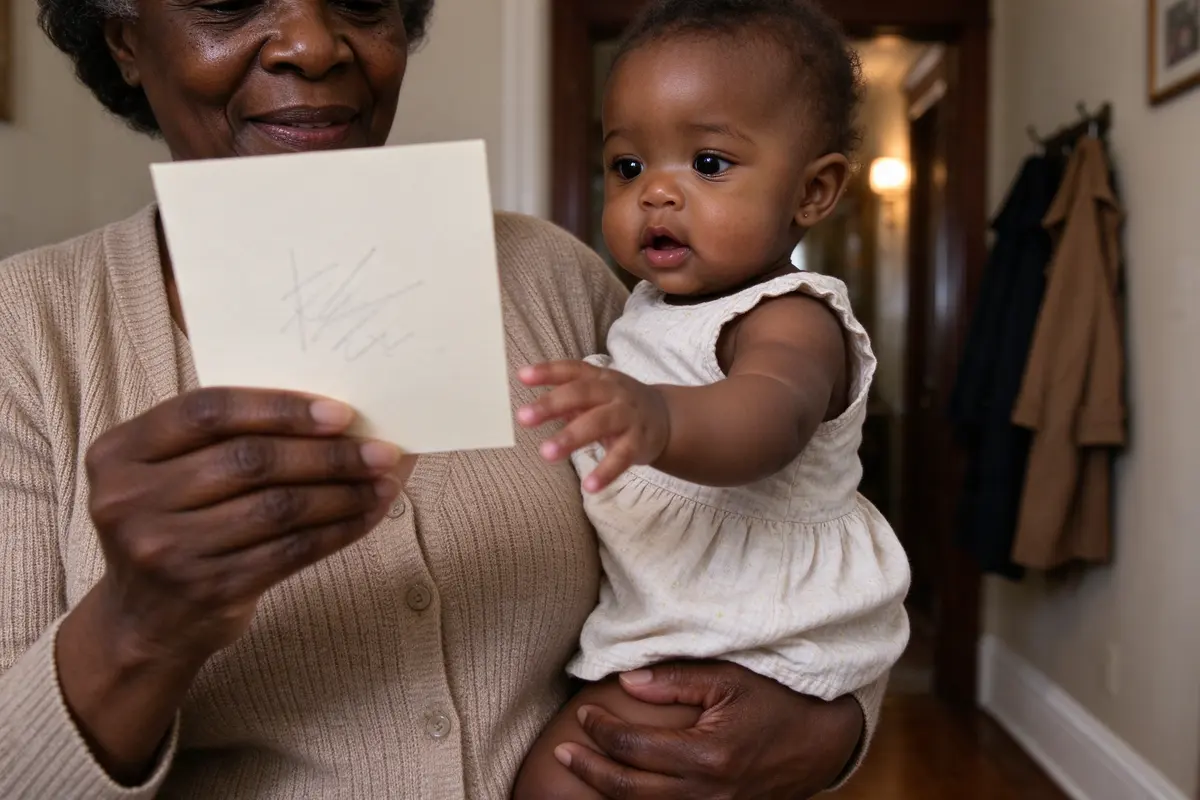
The sitter's card
Time: 10 minutes, the second side of yesterday's card · Practice goodbyes in the guide
Side two, line one: the goodbye ritual, word for word, so the sitter hears the same thing you'll say at the door (Swanson, AAP).
Line two: what calms this baby in the first five minutes after you've gone, the toy, the window, the song. Distraction, goodbye, go (AAP).
Line three: when you'll be back, in baby terms and in clock time, and a promise to keep it (Swanson, AAP).
Ask the sitter to arrive 20 minutes early and hand them the card while the baby watches from your arms (AAP). Then do the ritual, and leave.
Make it work:Tears at the door are the sign the ritual is needed, not the sign it failed; they usually stop within minutes (AAP).
Watch for
Normal
a wail at the door and, per the sitter's text, a baby waving at the window six minutes later (AAP).
Go to the ER now
if your baby had a seizure with a fever, has a stiff neck, or has a bulging soft spot (AAP).
Normal
a baby who clings to you with a favorite aunt in the room and goes to her ten minutes later; even favorite relatives can make a baby cry if they swoop in fast (AAP).
Mention it at the visit
if fear of new people is very intense; in 1,285 twins, fear that was high and steady from the start, or rose sharply, went with more inhibition at age 3 (Brooker et al., 2013).
Normal
a night waking on the evening you went out, settled by the sitter with one quiet sentence (Nemours KidsHealth).
Call your pediatrician right away
for a fever over 104°F (40°C), or if your baby looks or acts very sick (AAP).
For you

An evening out is allowed. The AAP's whole method for separation is a ritual and a kept promise (Swanson, AAP), and a promise can only be kept by someone who leaves. The tears stop faster than your guilt will; the AAP's number is minutes (AAP). Pick a night before the birthday and go somewhere with a chair that nobody climbs out of.
If you're the partner: the one who stays says the same words as the one who goes, and the one who goes doesn't come back early. Book the sitter; she's spent a year being the one who's hardest to leave.
Sources
- Swanson WS. "How to Ease Your Child's Separation Anxiety." HealthyChildren.org, updated 2026. https://www.healthychildren.org/English/ages-stages/toddler/Pages/Soothing-Your-Childs-Separation-Anxiety.aspx
- American Academy of Pediatrics. "Emotional and Social Development: 8 to 12 Months." HealthyChildren.org, updated 2009. https://www.healthychildren.org/English/ages-stages/baby/Pages/Emotional-and-Social-Development-8-12-Months.aspx
- Centers for Disease Control and Prevention. "Milestones by 9 Months." Learn the Signs. Act Early. program, updated 2026. https://www.cdc.gov/act-early/milestones/9-months.html
- American Academy of Pediatrics. "Emotional Development: 1 Year Olds." HealthyChildren.org, updated 2009. https://www.healthychildren.org/English/ages-stages/toddler/Pages/Emotional-Development-1-Year-Olds.aspx
- American Academy of Pediatrics. "Separation Anxiety & Sleeping Trouble in Young Children." HealthyChildren.org, updated 2022. https://www.healthychildren.org/English/healthy-living/sleep/Pages/separation-anxiety-and-sleeping.aspx
- American Academy of Pediatrics. "Making Baby Drop Off at Child Care Easier." HealthyChildren.org, updated 2022. https://www.healthychildren.org/English/family-life/work-and-child-care/Pages/making-baby-drop-off-at-child-care-easier.aspx
- Nemours KidsHealth. "Baby Sleep: 8- to 12-Month-Olds." Reviewed 2025. https://kidshealth.org/en/parents/sleep812m.html
- American Academy of Pediatrics. "Fever" (symptom checker). HealthyChildren.org, accessed 2026. https://www.healthychildren.org/English/tips-tools/symptom-checker/Pages/symptomviewer.aspx?symptom=Fever
- Brooker RJ, Buss KA, Lemery-Chalfant K, et al. "The development of stranger fear in infancy and toddlerhood: normative development, individual differences, antecedents, and outcomes." Developmental Science, 2013. https://pubmed.ncbi.nlm.nih.gov/24118713/
This guide is general education that summarizes published research and guidance from groups like the American Academy of Pediatrics, the CDC, and the WHO. It isn’t medical advice, and every child develops on their own timeline. Your pediatrician knows your child; if something feels wrong, call them. In an emergency, call 911.
Get each day’s note the morning it applies
Add your baby to a free Chorevia household with their date of birth, and every morning for 365 days the day’s note arrives in the app and by email: what’s developing, one thing to try, what to watch for, and a word for you.
Create your household