Day 364 of 365 · One year
The day before
Last reviewed · 4 min read · 12 sources · Plain-text version
The birthday plan, kept small: the nap protected, the cake out of reach with no honey or whole nuts in it, no balloons at floor level, the candle held by an adult. And the same-blanket photo.
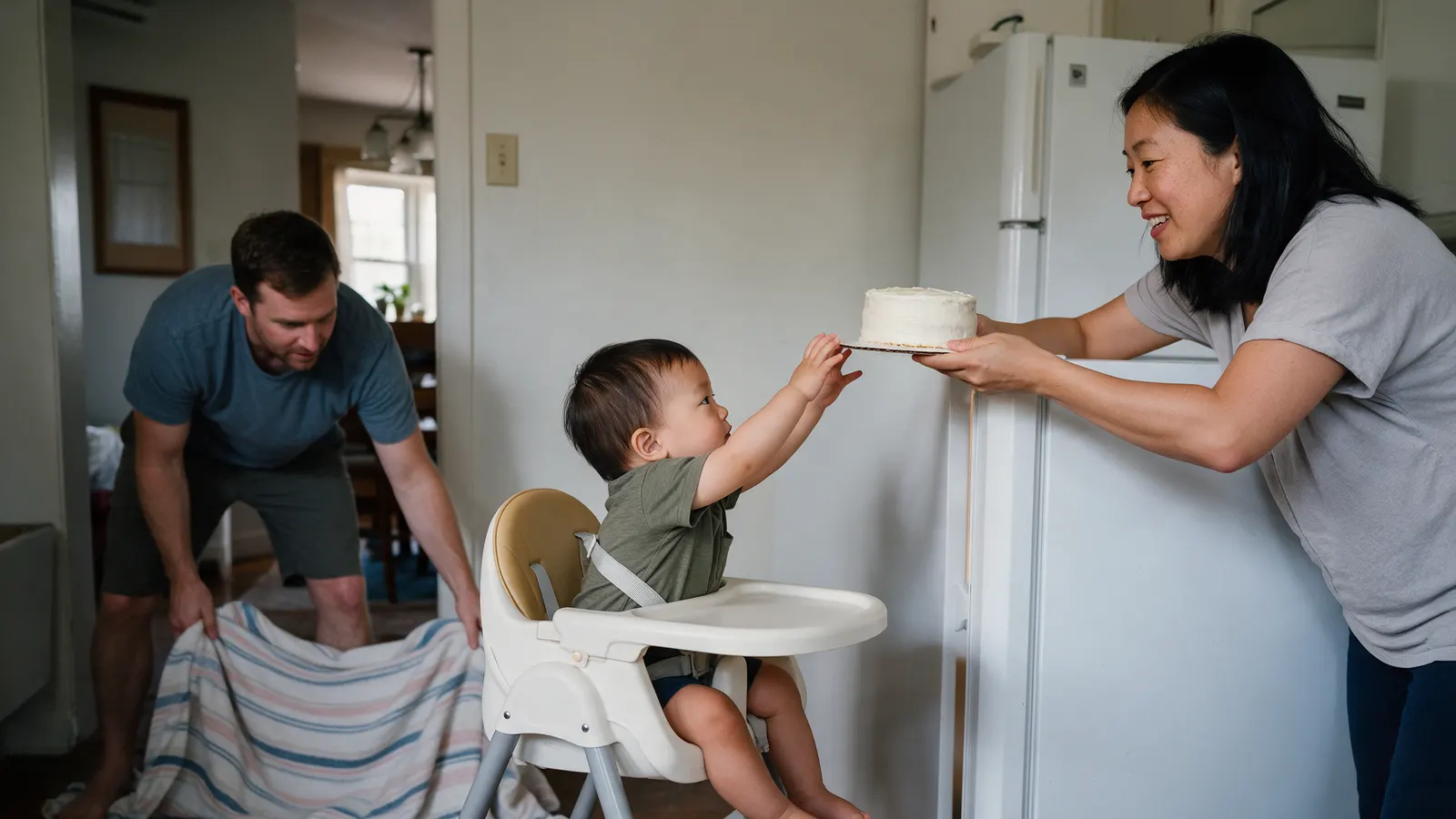
Tomorrow is one year. Today is the plan for it, which is mostly a list of things to keep small and out of reach, and a photo on the blanket where the first one was taken.
Heart
Keep it small, and keep the nap. Hunger and tiredness set off many tantrums, so protect naps and carry snacks (Swanson, AAP), and separations and new faces are harder when babies are tired, hungry, or sick (AAP). A party is a room full of relatives, and even favorite ones can make a baby cry if they swoop in fast; ask visitors to go slowly and let your baby watch from your arms first (AAP). The birthday that works has a nap in the middle and guests who sit on the floor.
Head
The cake, made today, waits on top of the fridge. No honey in it: the CDC's rule is none before 12 months, not even on a pacifier, because it can cause botulism (CDC). No whole nuts on it or in it: the AAP says hold off on nuts, popcorn, and hard or sticky candy until age 4 or later (AAP). Keep it a small one: the new US Dietary Guidelines say to avoid added sugars in early childhood (USDA & HHS, 2026). The candle is lit, held, and blown out by an adult, well away from a baby's hands; for any burn, put cold water on it for a few minutes, cover it loosely, and call your pediatrician (AAP).
Body
The rest of the room. Balloons, balls, marbles, toy parts, and coins are common choking hazards, and balloons stay a hazard until age 8 (AAP), so a party without balloons at floor level is a safer party. Juice stays off the menu today, no juice before 12 months (AAP), and after the birthday there's no need to start; if you serve it, 4 ounces or less of 100% juice a day (CDC). Gifts: a baby walker is the one to say no to kindly, since walkers don't help children learn to walk and send thousands to hospitals each year (AAP). A sturdy push toy or a laundry basket is the 1-year guide's suggestion instead (Push-and-carry walks).
Try today
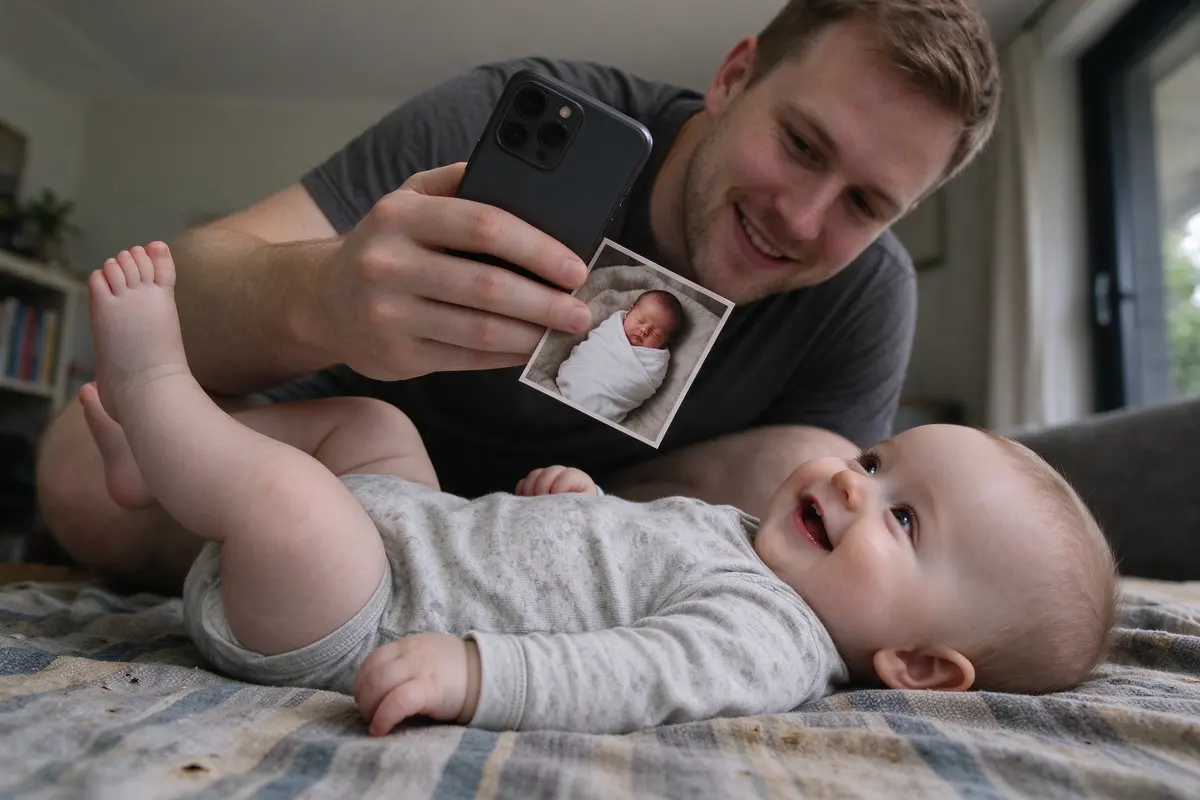
The same-blanket photo
Time: 15 minutes, before the nap
Find the day-one blanket, or the closest thing to it, and spread it in the same spot, in the same light if you can.
Lay your baby on it the way they were laid on day one, on their back, and take the photo from the same height. Then let them do what they do now: roll, sit, crawl off, pull up on the sofa. Take that one too.
Hold the first-day photo beside the phone and line up the frame; the blanket is the ruler, the baby is the measurement.
Print both and put them with the year letter. Tomorrow's photo, with the cake out of reach, goes beside them.
Make it work:Nothing small on the blanket, and the cake stays on the fridge until there's an adult holding the baby and another holding the plate (AAP).
Watch for
Normal
a baby overwhelmed by a doorbell and three new voices, who hides in your neck for the first ten minutes; wariness of strangers is expected, and some babies have more of it than others (Brooker et al., 2013).
Mention it
at the checkup if the fear seems very intense (Brooker et al., 2013).
Normal
a fistful of wrapping paper headed for the mouth.
Call 911
if your baby is choking and can't breathe, cry, or make noise, turns bluish, or goes limp, and start back blows and chest thrusts while someone calls (AAP).
Normal
a skipped nap and a meltdown at four o'clock that ends in your lap.
Call your pediatrician right away
for a fever over 104°F (40°C), or if your baby looks or acts very sick (AAP).
For you
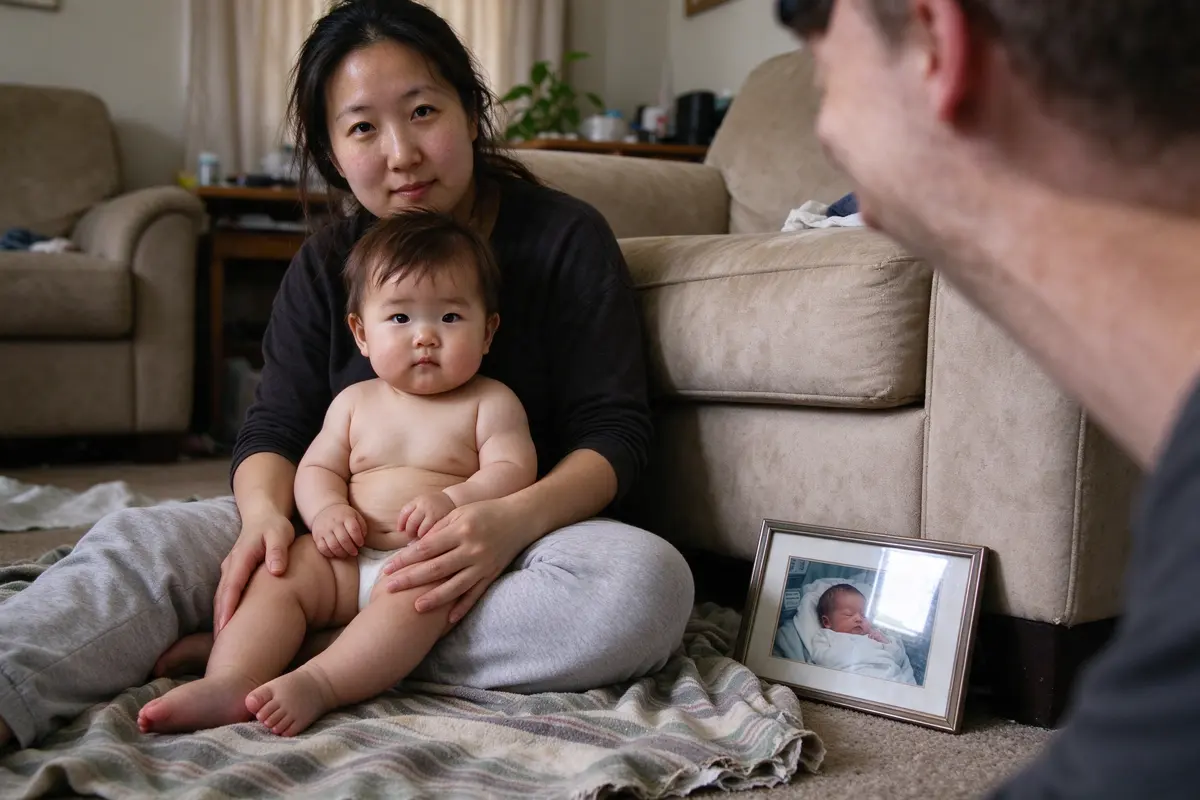
The photo of you, one year on. On the same blanket, with the baby in your lap, before you've done anything to your hair, held up against the one from the hospital bed. The person in the first photo had just done the hardest physical thing of her life; the one on the blanket has done the longest. Look at her kindly. The Office on Women's Health's postpartum visit was about six weeks after birth (Office on Women's Health); if there's a question about your body that's been waiting since then, the birthday is a fine deadline to book it by.
If you're the partner: take hers, then hand over the phone and lie down on the blanket yourself, baby on your chest, the way the first-week photos went. Then go check the cake is still on the fridge.
Sources
- Swanson WS. "Top Tips for Surviving Tantrums." HealthyChildren.org, updated 2021. https://www.healthychildren.org/English/family-life/family-dynamics/communication-discipline/Pages/Temper-Tantrums.aspx
- American Academy of Pediatrics. "Emotional and Social Development: 8 to 12 Months." HealthyChildren.org, updated 2009. https://www.healthychildren.org/English/ages-stages/baby/Pages/Emotional-and-Social-Development-8-12-Months.aspx
- Centers for Disease Control and Prevention. "Foods and Drinks to Avoid or Limit." 2026. https://www.cdc.gov/infant-toddler-nutrition/foods-and-drinks/foods-and-drinks-to-avoid-or-limit.html
- Bradin S. "Choking Prevention for Babies & Children: What Every Parent Needs to Know." HealthyChildren.org, updated 2026. https://www.healthychildren.org/English/health-issues/injuries-emergencies/Pages/Choking-Prevention.aspx
- US Department of Agriculture and US Department of Health and Human Services. "Dietary Guidelines for Americans, 2025–2030." 2026. https://cdn.realfood.gov/DGA.pdf
- American Academy of Pediatrics. "Safety for Your Child: 1 to 2 Years." HealthyChildren.org, updated 2022. https://www.healthychildren.org/English/ages-stages/toddler/Pages/safety-for-your-child-1-to-2-years.aspx
- American Academy of Pediatrics. "When Can Babies Start Solid Foods? Readiness & Feeding Tips." HealthyChildren.org, updated 2026. https://www.healthychildren.org/English/ages-stages/baby/feeding-nutrition/Pages/Starting-Solid-Foods.aspx
- Centers for Disease Control and Prevention. "Milestones by 15 Months." Learn the Signs. Act Early. program, updated 2026. https://www.cdc.gov/act-early/milestones/15-months.html
- American Academy of Pediatrics. "Baby Walkers: A Dangerous Choice." HealthyChildren.org, updated 2022. https://www.healthychildren.org/English/safety-prevention/at-home/Pages/Baby-Walkers-A-Dangerous-Choice.aspx
- Brooker RJ, Buss KA, Lemery-Chalfant K, et al. "The development of stranger fear in infancy and toddlerhood: normative development, individual differences, antecedents, and outcomes." Developmental Science, 2013. https://pubmed.ncbi.nlm.nih.gov/24118713/
- American Academy of Pediatrics. "Fever" (symptom checker). HealthyChildren.org, accessed 2026. https://www.healthychildren.org/English/tips-tools/symptom-checker/Pages/symptomviewer.aspx?symptom=Fever
- Office on Women's Health. "Recovering from birth." US Department of Health and Human Services, 2021. https://womenshealth.gov/pregnancy/childbirth-and-beyond/recovering-birth
This guide is general education that summarizes published research and guidance from groups like the American Academy of Pediatrics, the CDC, and the WHO. It isn’t medical advice, and every child develops on their own timeline. Your pediatrician knows your child; if something feels wrong, call them. In an emergency, call 911.
Get each day’s note the morning it applies
Add your baby to a free Chorevia household with their date of birth, and every morning for 365 days the day’s note arrives in the app and by email: what’s developing, one thing to try, what to watch for, and a word for you.
Create your household