Day 336 of 365 · Week 45
In the cup
Last reviewed · 4 min read · 8 sources · Plain-text version
Putting something in a container, like a block in a cup, is on the 1-year list. In and out, the low cabinet, and why the dumping out matters too. The block and the cup, timed.

In goes the block. Out comes the block. In goes the block again. This is a milestone, a physics lesson, and an hour of your afternoon, and today is all three.
Heart
By 1 year, most babies put something in a container, like a block in a cup (CDC). The CDC's suggested practice is dumping and refilling blocks (CDC; CDC), which is the guide's In and out: a bowl or bucket and a few blocks or large plastic lids, dumped out together, dropped back in one at a time, "in!" and "out!" each time. The hand skill underneath is letting go on purpose, the one that makes dropping and throwing favorite games (AAP). A block that lands in the cup is a block released at the right moment over the right spot, which is harder than it looks.
Head
The AAP's view of this age is that dropping and banging are experiments in how things work, and that ordinary household objects are the most fascinating toys: a low cabinet stocked with wooden spoons, pots, and plastic containers (AAP). The cup game is the first version of a year of filling and dumping, and the same game with a laundry basket and a sock is where the 1-year guide's family jobs for helpers in diapers begin. A baby who puts a block in a cup is weeks away from putting a toy in a bin, and the thank-you is the only difference.
Body
Everything still goes in the mouth, so check the floor often (AAP). The blocks for today are the ones too big to fit entirely in the mouth (AAP); the small things between the cushions are the ones to find first (AAP). The cup is plastic, not glass. And the game happens on the floor, not the high-chair tray, because a block dropped from a tray is a different, louder game.
Try today
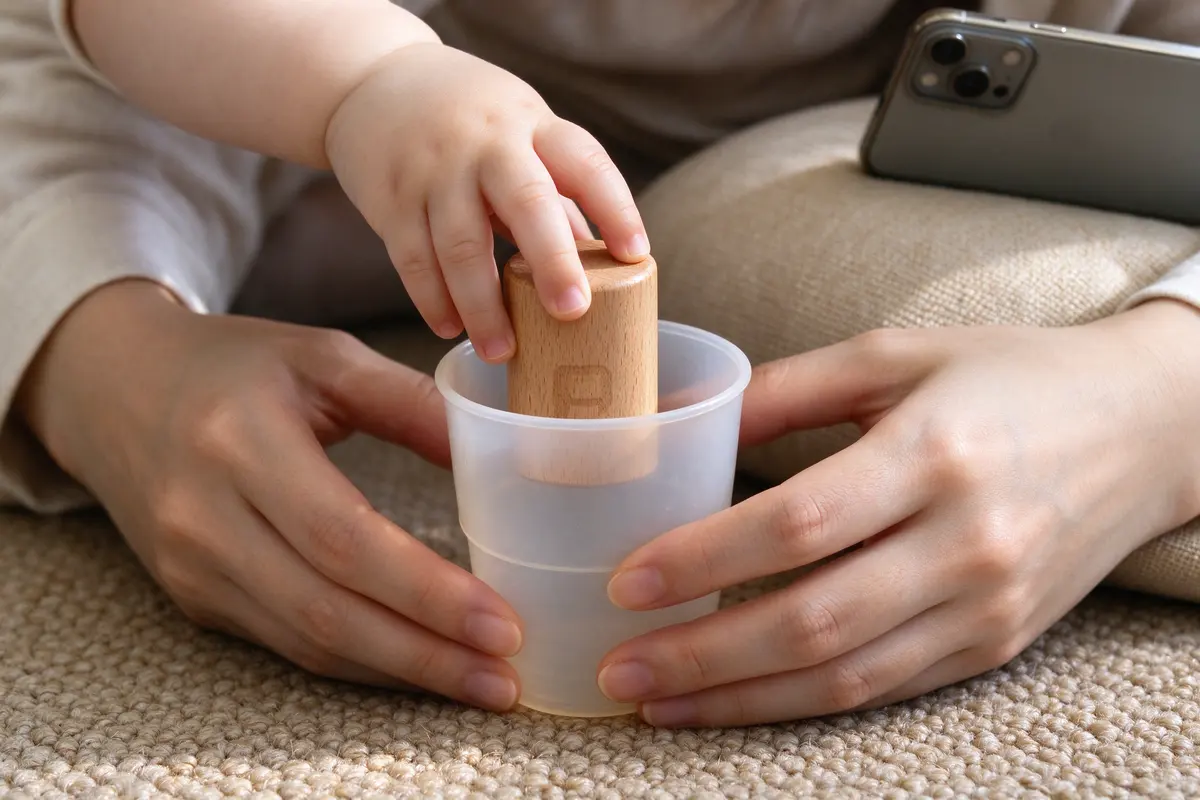
The block and the cup, timed
Time: 1 minute, three rounds · In and out in the guide
Six blocks on the rug, one wide plastic cup, your baby sitting. Start a one-minute timer on your phone, for fun.
Hand over one block at a time and hold the cup steady. Count each one that goes in, out loud: "One! In!" (CDC)
When the minute's up, tip the cup out together with a cheer. That's the dump, and it's half the lesson (AAP).
Two more rounds if they want them, with the cup unheld on the last one. Nobody keeps score.
Make it work:Blocks too big to fit entirely in the mouth, and a cup too light to hurt when thrown (AAP).
Watch for
Normal
six blocks thrown at the cup and none in it; letting go over a target is new (AAP).
Call 911
if your baby is choking and can't breathe, cry, or make noise, turns bluish, or goes limp, and start back blows and chest thrusts while someone calls (AAP).
Normal
the cup carried to the low cabinet and the pots dumped out instead (AAP).
Call Poison Help, 1-800-222-1222,
if you think your baby swallowed anything poisonous, and call 911 if they collapse, have a seizure, have trouble breathing, or can't be woken (Poison Control).
Normal
a block in the mouth before it's in the cup; everything still goes there (AAP).
Bring it up
if by 12 months your baby doesn't pull up to stand, wave bye-bye, or look for a toy they saw you hide (CDC).
For you
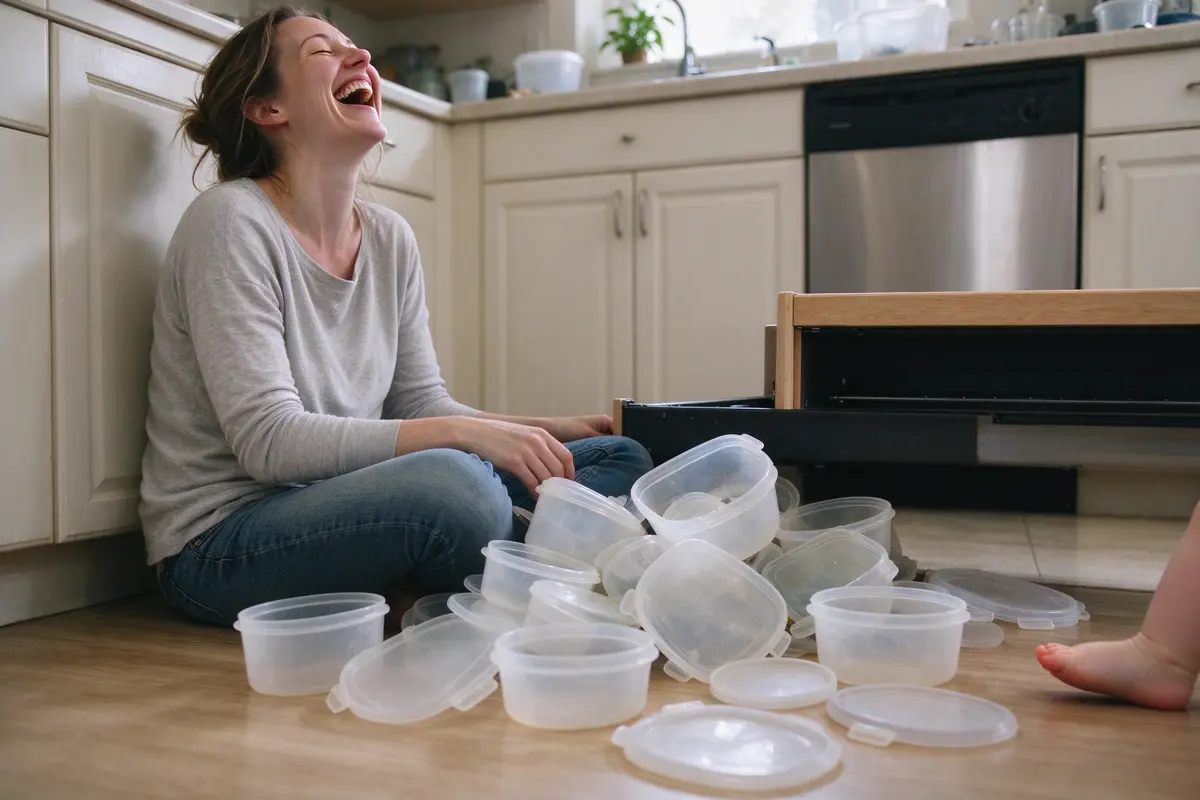
The dumping out is the other half of the lesson. It's the loud half, and it undoes the quiet half, and it is still, by the AAP's account, an experiment in how things work (AAP). The urge to stop the dump and keep the blocks in the cup is strongest at 5 p.m., so here's the deal for today: the cup gets dumped, and the drawer of lids across the kitchen floor is the yes space doing its job. You'll put it back once. Tomorrow it'll be out again. That's the game, and it changes on its own around the time they can stack two small objects, which is a 15-month skill (CDC).
If you're the partner: the drawer of lids is yours to put back tonight, once, without the sigh. The sigh is also copied.
Sources
- Centers for Disease Control and Prevention. "Milestones by 1 Year." Learn the Signs. Act Early. program, updated 2026. https://www.cdc.gov/act-early/milestones/1-year.html
- Centers for Disease Control and Prevention. "Milestones by 9 Months." Learn the Signs. Act Early. program, updated 2026. https://www.cdc.gov/act-early/milestones/9-months.html
- American Academy of Pediatrics. "Hand and Finger Skills." HealthyChildren.org, updated 2009. https://www.healthychildren.org/English/ages-stages/baby/Pages/Hand-and-Finger-Skills.aspx
- American Academy of Pediatrics. "Cognitive Development in Infants: 8 to 12 Months." HealthyChildren.org, updated 2023. https://www.healthychildren.org/English/ages-stages/baby/Pages/Cognitive-Development-8-to-12-Months.aspx
- Bradin S. "Choking Prevention for Babies & Children: What Every Parent Needs to Know." HealthyChildren.org, updated 2026. https://www.healthychildren.org/English/health-issues/injuries-emergencies/Pages/Choking-Prevention.aspx
- American Academy of Pediatrics. "Home Safety: Tips for Families With Young Children." HealthyChildren.org, updated 2022. https://www.healthychildren.org/English/safety-prevention/at-home/Pages/Home-Safety-Heres-How.aspx
- National Capital Poison Center. "Poison Control." Accessed 2026. https://www.poison.org/
- Centers for Disease Control and Prevention. "Milestones by 15 Months." Learn the Signs. Act Early. program, accessed 2026. https://www.cdc.gov/act-early/milestones/15-months.html
This guide is general education that summarizes published research and guidance from groups like the American Academy of Pediatrics, the CDC, and the WHO. It isn’t medical advice, and every child develops on their own timeline. Your pediatrician knows your child; if something feels wrong, call them. In an emergency, call 911.
Get each day’s note the morning it applies
Add your baby to a free Chorevia household with their date of birth, and every morning for 365 days the day’s note arrives in the app and by email: what’s developing, one thing to try, what to watch for, and a word for you.
Create your household