Day 358 of 365 · Week 48
Outside, every day
Last reviewed · 4 min read · 16 sources · Plain-text version
Twenty minutes or more outdoors, every day you can: the stroller as the base, grass and a bench as the gym, and whatever they point at as the lesson. The week-48 habit that outlasts the series.
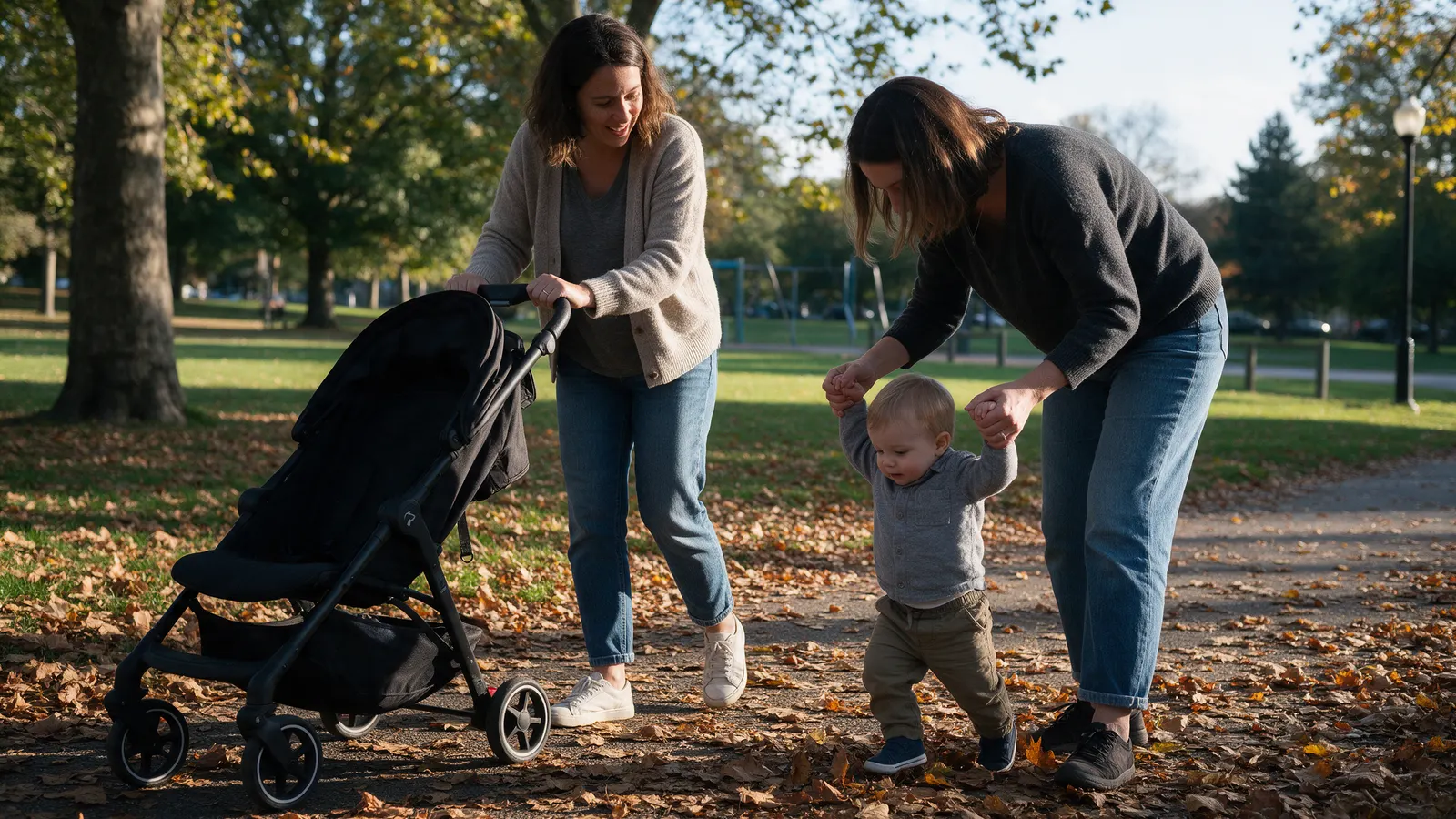
Week forty-eight ends outdoors. Every guide from here on asks for it daily, so today is the case for a short walk that happens whether or not the weather is nice, and the version of it that fits a baby who cruises but doesn't walk.
Heart
The 1-year guide's Outdoor explore walk asks for 20 minutes or more, every day if you can: let your toddler walk part of the way instead of riding, stop for whatever they point at and name it, and bring a leaf or a stone home to talk about. The WHO recommends at least 180 minutes of active play a day for 1- and 2-year-olds and says not to keep them strapped in for more than an hour at a time (WHO), and CDC suggests outdoor play and walks (CDC). At 11 months the "walk part of the way" is a crawl across grass or a cruise along a bench, with the stroller as the base you come back to.
Head
Why the outside walk is a vocabulary lesson. When your baby points or stares at something, look where they're looking and name it (CDC). In 24 babies followed from 9 to 15 months, mothers' talk about what the baby was already looking at predicted the earliest gestures and words (Carpenter et al., 1998), and in 10 toddlers, many things children first pointed at later became words (Iverson & Goldin-Meadow, 2005). The living room has the same forty things in it every day. The path has a dog, a bus, a leaf, a puddle, and a bird that wasn't there yesterday.
Body
The rules that come along. Sunscreen is fine on uncovered skin from 6 months, broad-spectrum SPF 15 or higher, reapplied every 90 minutes to 2 hours, with shade first (AAP). Bare feet or socks are fine on grass; shoes are for walking outside, and your baby isn't yet (AAP). Near a pond, a fountain, or a paddling pool, stay within arm's reach: more children ages 1 to 4 die from drowning than from any other cause (CDC), and in one analysis 69% of drownings in children 4 and under happened when they weren't expected to be in the water (AAP). Hold hands near streets and driveways (AAP).
Try today
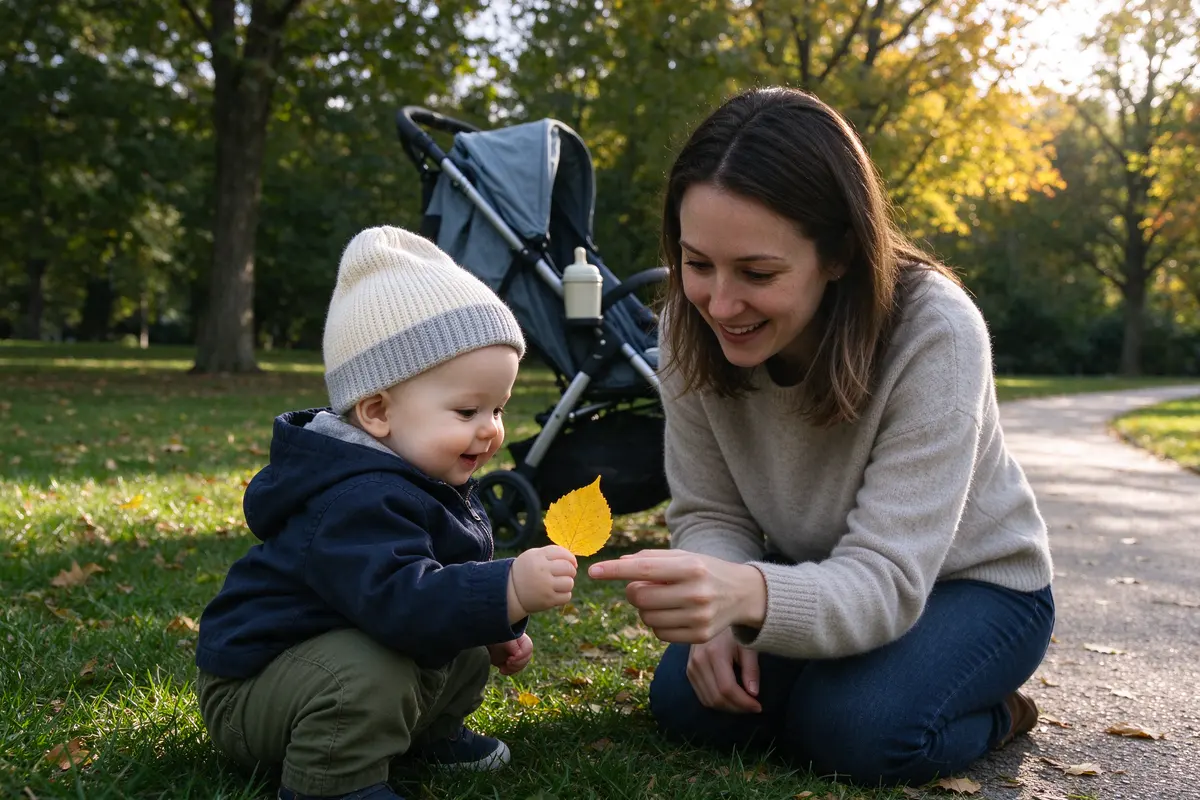
Outdoor explore walk
Time: 20 minutes or more, today and tomorrow and the day after · Outdoor explore walk in the guide
Stroller to somewhere with grass or a bench, not for the whole walk; a strapped-in stroller ride is still strapped in (WHO).
Out onto the grass for the first stretch: crawl, sit, cruise the bench with your hands near their ribs. Let them go the direction they choose.
Stop for whatever they point at or stare at, name it, add a little more, and pause for their turn (CDC).
Pick one thing, a leaf or a smooth stone, to carry home and name again at dinner.
Tomorrow, the same walk. The habit is the point, not the route.
Make it work:Check the ground before they do: a bottle cap or an acorn is a choking hazard outside too (AAP).
Watch for
Normal
a walk that ends with grass stains on both knees and a long nap.
Call your pediatrician right away
for signs of dehydration: no urine in more than 8 hours, dark urine, a very dry mouth, and no tears (AAP).
Normal
a tumble off a low bench onto grass and a baby who gets straight back up.
Call your pediatrician now
for any head injury in a baby under 1, even on soft ground, even if they seem fine (AAP).
Normal
a handful of leaves heading for the mouth, caught halfway; everything still goes in the mouth (AAP).
For you

Every day means every day for you too, and the walk is the cheapest check-in you have with yourself: twenty minutes in which nothing is being asked of you but to push. Notice what you think about on it. If what comes up is heavy more days than not, the Office on Women's Health's line holds all year: if sadness lasts more than two weeks, go to the doctor; don't wait (Office on Women's Health). If what comes up is the grocery list, that's a good day, and the walk still counts.
If you're the partner: the weekend walks are yours, both of them, and on weekdays you take the first ten minutes of the walk alone while she stays in with the baby, so the quiet gets shared.
Sources
- World Health Organization. "To grow up healthy, children need to sit less and play more." 2019. https://www.who.int/news/item/24-04-2019-to-grow-up-healthy-children-need-to-sit-less-and-play-more
- Centers for Disease Control and Prevention. "Milestones by 2 Years." Learn the Signs. Act Early. program, updated 2026. https://www.cdc.gov/act-early/milestones/2-years.html
- Centers for Disease Control and Prevention. "Milestones by 1 Year." Learn the Signs. Act Early. program, updated 2026. https://www.cdc.gov/act-early/milestones/1-year.html
- Carpenter M, Nagell K, Tomasello M. "Social cognition, joint attention, and communicative competence from 9 to 15 months of age." Monographs of the Society for Research in Child Development, 1998. https://pubmed.ncbi.nlm.nih.gov/9835078/
- Iverson JM, Goldin-Meadow S. "Gesture paves the way for language development." Psychological Science, 2005. https://pubmed.ncbi.nlm.nih.gov/15869695/
- American Academy of Pediatrics. "Baby Sunburn Prevention Tips." HealthyChildren.org, updated 2026. https://www.healthychildren.org/English/ages-stages/baby/bathing-skin-care/Pages/Baby-Sunburn-Prevention.aspx
- American Academy of Pediatrics. "Movement Milestones in Babies 8 to 12 Months Old." HealthyChildren.org, updated 2021. https://www.healthychildren.org/English/ages-stages/baby/Pages/Movement-8-to-12-Months.aspx
- Centers for Disease Control and Prevention. "Drowning Facts." 2026. https://www.cdc.gov/drowning/data-research/facts/index.html
- American Academy of Pediatrics. "Drowning Prevention for Curious Toddlers: What Parents Need to Know." HealthyChildren.org, updated 2026. https://www.healthychildren.org/English/safety-prevention/at-play/Pages/Water-Safety-And-Young-Children.aspx
- Bradin S. "Choking Prevention for Babies & Children: What Every Parent Needs to Know." HealthyChildren.org, updated 2026. https://www.healthychildren.org/English/health-issues/injuries-emergencies/Pages/Choking-Prevention.aspx
- American Academy of Pediatrics. "Fever" (symptom checker). HealthyChildren.org, accessed 2026. https://www.healthychildren.org/English/tips-tools/symptom-checker/Pages/symptomviewer.aspx?symptom=Fever
- American Academy of Pediatrics. "Head Injury" (symptom checker). HealthyChildren.org, accessed 2026. https://www.healthychildren.org/English/tips-tools/symptom-checker/Pages/symptomviewer.aspx?symptom=Head+Injury
- American Academy of Pediatrics. "Cognitive Development in Infants: 8 to 12 Months." HealthyChildren.org, updated 2023. https://www.healthychildren.org/English/ages-stages/baby/Pages/Cognitive-Development-8-to-12-Months.aspx
- US Consumer Product Safety Commission. "Making Families Safer from Button Cell or Coin Battery Dangers; Reese's Law Leads to New Federal Mandatory Safety Standard." 2023. https://www.cpsc.gov/Newsroom/News-Releases/2023/Making-Families-Safer-from-Button-Cell-or-Coin-Battery-Dangers-Reeses-Law-Leads-to-New-Federal-Mandatory-Safety-Standard
- US Consumer Product Safety Commission. "Magnets" (Safety Education Center). Accessed 2026. https://www.cpsc.gov/Safety-Education/Safety-Education-Centers/Magnets
- Office on Women's Health. "Recovering from birth." US Department of Health and Human Services, 2021. https://womenshealth.gov/pregnancy/childbirth-and-beyond/recovering-birth
This guide is general education that summarizes published research and guidance from groups like the American Academy of Pediatrics, the CDC, and the WHO. It isn’t medical advice, and every child develops on their own timeline. Your pediatrician knows your child; if something feels wrong, call them. In an emergency, call 911.
Get each day’s note the morning it applies
Add your baby to a free Chorevia household with their date of birth, and every morning for 365 days the day’s note arrives in the app and by email: what’s developing, one thing to try, what to watch for, and a word for you.
Create your household